John Gast, American Progress (and other titles), 1872, most frequently seen in chromolithograph form inside cigar boxes.
Walter Russell Mead starts a new insightful essay which argues that the Progressive, Blue State-politics ideas revolving around suburbia, a manufacturing economy, a constantly-expanding regulatory regime and welfare state pertain to rapidly vanishing world, destined to follow the Indians and the buffalo, and the family farm and homestead into America’s past.
The frustration and bitterness that fills American politics these days reflects the failure of our current social, political and economic institutions and practices to deliver the results that Americans want and expect. It’s comparable to the frustration and fear that swept through the country in the late 19th and early 20th century as the first American dream – that every family could prosper on its own farm – gradually died….
Our political battles today reflect the same kinds of frustrations we saw in the old populist era. Many cannot fathom another and “higher†form of the American Dream beyond the old crabgrass utopia. They want to turn back the clock and restore the old system because they don’t know of anything else that will work. …
It is, of course, a very similar situation today. The forces ripping up our old social model are too powerful to beat. That is not because the rich bankers or global multinationals are engaged in a conscious conspiracy of rip-offs and oppression (though, frankly speaking, big business does sometimes engage in exactly that). It is because the forces ripping up the social model are deeply implanted in the nature of the economic system — and that system is a reflection of the propensities in human nature which we cannot and perhaps should not overcome.
There is another important similarity, one often overlooked in the pessimism, anger and anxiety provoked by the inexorable decline of the “blue social model†that shaped America in the 20th century — just as it was overlooked 100 years ago.
The Battle of Gettysburg, generally looked upon as the turning point of the Civil War, occurred over three days, July 1 – July 3, 1863.
The first day of Gettysburg consisted of a meeting engagement, in which fate favored the Union. Elements of A.P. Hill’s Corps ran into veteran Union cavalry armed with repeating carbines occupying a good defensible position on a ridge. Reinforcements arrived for both sides, but the Union forces which arrived first consisted of the best troops in the Union Army, Reynolds‘ First Corps, including the renowned Iron Brigade. Nonetheless, the Confederate infantry eventually drove the Union forces back, compelling them to retreat to the next ridge line east of the town. The first day of the Battle of Gettysburg ended with a significant Confederate victory.
On the second day, Confederate forces attacked both the left and right ends of the Union line, attempting to turn the Army of the Potomac’s flank. But the Union positions on high ground were strong, the Confederate attacks were delayed and not ideally coordinated, and the Union defense held. The second day’s fighting of the Battle of Gettysburg ended in an indecisive stalemate.
On the third day, Robert E. Lee choose to emulate the offensive strategy adopted by Napoleon successfully at both Wagram and Borodino, a full-scale frontal attack on the enemy center intended to break his line decisively and to drive him from the field in full retreat. Lee sent Pickett’s Division and six brigades from A.P. Hill’s Corps, nearly 13,000 men, to advance and break the Union center. Pickett’s Charge failed, and the third day of Gettysburg resulted in a decisive Confederate defeat.
Robert E. Lee’s decision to order a frontal attack has provoked endless re-examination and criticism.
In the latest issue of The Gettysburg Magazine, Dr. Carl Coppolino proposes a medical explanation for General Lee’s misjudgment.
I don’t put any stock in these kinds of explanations myself, but there may be something valid in the mention of Lee’s heart trouble. The possibility that Lee’s cardiac illness played a role at Gettysburg has been offered before. Mainwaring, Tribble 1992.
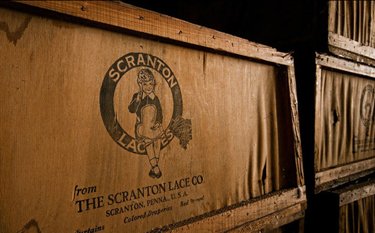
These photographs by Walter Arnold of the derelict Scranton Lace Company were recently linked on a North East Pennsylvania Genealogy list.
Incorporated in 1897, the Scranton Lace Company in its heyday employed 1400 people, and was the world’s largest producer of Nottingham lace. It possessed the largest looms ever built, each of which stood nearly three stories tall, was 50 feet long, and weighed over 20 tons. During World War II, the company expanded its production line to include mosquito and camouflage netting, bomb parachutes, and tarpaulins. After the war, the company returned to producing cotton yarn, vinyl shower curtains, and textile laminates for umbrellas, patio furniture, and pool liners.
Its factory complex boasted “bowling alleys in the basement, a fully staffed infirmary, a staff barber and a gymnasium, and owned its own cotton field and coal mine. Its clock tower was a city landmark. U.S. Sen. Hillary Rodham Clinton’s father and grandfather worked there.”
The Scranton Lace Company closed abruptly in 2002 with an announcement from the company’s vice president, in the middle of the daily work shift, that the company was closing “effective immediately.”
The photo essay is a moving testament to the scale of everything that has been lost as the American economy changed in recent decades to a postindustrial era and manufacturing in most cases moved overseas.
Born: Richard II, King of England, 1366; Joan d’Arc, 1402; Peter Metastasio, poet, 1698; Benjamin Franklin, philosopher, Boston, U.S., 1706; David Dale, philanthropist, 1739; George Thomas Doo, engraver, 1800.
Feast Day: St. Melanius, bishop, 490. St. Nilammon, Hermit. St. Peter, abbot of St. Austin’s, Canterbury, 608.
TWELFTH-DAY
This day, called Twelfth-Day, as being in that number after Christmas, and Epiphany from the Greek ‘‘ΕπιΦáνєια”, signifying appearance, is a festival of the Church, in commemoration of the Manifestation of Christ to the Gentiles; more expressly to the three Magi, or Wise Men of the East, who came, led by a star, to worship him immediately after his birth. (Matt. ii. 1-12.) The Epiphany appears to have been first observed as a separate feast in the year 813. Pope Julius I is, however, reputed to have taught the Church to distinguish the Feasts of the Nativity and Epiphany, so early as about the middle of the fourth century.
The primitive Christians celebrated the Feast of the Nativity for twelve days, observing the first and last with great solemnity; and both of these days were denominated Epiphany, the first the greater Epiphany, from our Lord having on that day become Incarnate, or made his appearance in “the flesh;” the latter, the lesser Epiphany, from the three-fold manifestation of His Godhead—the first, by the appearance of the blazing star which conducted Melchior, Jasper, and Balthuzar, the three Magi, or wise men, commonly styled the three Kings of Cologne, out of the East, to worship the Messiah, and to offer him presents of “Gold, Frankincense, and Myrrh”—Melchior the Gold, in testimony of his royalty as the promised King of the Jews; Jasper the Frankincense, in token of his Divinity; and Balthuzar the Myrrh, in allusion to the sorrows which, in the humiliating condition of a man, our Redeemer vouchsafed to take upon him: the second, of the descent of the Holy Ghost in the form of a Dove, at the Baptism: and the third, of the first miracle of our Lord turning water into wine at the marriage in Cana. All of which three manifestations of the Divine nature happened on the same day, though not in the same year.
‘To render due honour to the memory of the ancient Magi, who are supposed to have been kings, the monarch of this country himself, either personally or through his chamberlain, offers annually at the altar on this day, Gold, Frank-incense, and Myrrh; and the kings of Spain, where the Feast of Epiphany is likewise called the “Feast of the Kings,” were accustomed to make the like offerings. — Brady.
In the middle ages, the worship by the Magi was celebrated by a little drama, called the Feast of the Star:
‘Three priests, clothed as kings, with their servants carrying offerings, met from different directions before the altar. The middle one, who came from the east, pointed with his staff to a star. A dialogue then ensued; and, after kissing each other, they began to sing, “Let us go and inquire;” after which the precentor began a responsory, “Let the Magi come.” A procession then commenced; and as soon as it began to enter the nave, a crown, with a star resembling a cross, was lighted up, and pointed out to the Magi, with, “Behold the Star in the East.” This being concluded, two priests standing at each side of the altar, answered meekly, “We are those whom you seek;” and, drawing a curtain, shewed them a child, whom, falling down, they worshipped. Then the servants made the offerings of gold, frankincense, and myrrh, which were divided among the priests. The Magi, meanwhile, continued praying till they dropped asleep; when a boy, clothed in an alb, like an angel, addressed them with, “All things which the prophets said are fulfilled.” The festival concluded with chanting services, &c. At Soissons, a rope was let down from the roof of the church, to which was annexed an iron circle having seven tapers, intended to represent Lucifer, or the morning star; but this was not confined to the Feast of the Star.’ — Fosbroke’s Antiquities, ii. 700.
At Milan, in 1336, the Festival of the Three Kings was celebrated in a manner that brings forcibly before us the tendency of the middle ages to fix attention on the historical externals of Christianity. The affair was got up by the Preaching Friars. The three kings appeared, crowned, on three great horses richly habited, surrounded by pages, body guards, and an innumerable retinue. A golden star was exhibited in the sky, going before them. They proceeded to the pillars of St. Lawrence, where King Herod was represented with his scribes and wise men. The three kings ask Herod where Christ should be born, and his wise men, having consulted their books, answer, at Bethlehem. On which the three kings, with their golden crowns, having in their hands golden cups filled with frankincense, myrrh, and gold, the star going before, marched to the church of St. Eustorgius, with all their attendants, preceded by trumpets, horns, asses, baboons, and a great variety of animals. In the church, on one side of the high altar, there was a manger with an ox and ass, and in it the infant Christ in the arms of his mother. Here the three kings offer Him gifts. The concourse of the people, of knights, ladies, and ecclesiastics, was such as was never before beheld.
In its character as a popular festival, Twelfth-Day stands only inferior to Christmas. The leading object held in view is to do honour to the three wise men, or, as they are more generally denominated, the three kings. It is a Christian custom, ancient past memory, and probably suggested by a pagan custom, to indulge in a pleasantry called the Election of Kings by Beans. In England, in later times, a large cake was formed, with a bean inserted, and this was called Twelfth-Cake. The family and friends being assembled, the cake was divided by lot, and who-ever got the piece containing the bean was accepted as king for the day, and called King of the Bean.
In England, it appears there was always a queen as well as a king on Twelfth-Night. A writer, speaking of the celebration in the south of England in 1774, says:
‘After tea, a cake is produced, with two bowls containing the fortunate chances for the different sexes. The host fills up the tickets, and the whole company, except the king and queen, are to be ministers of state, maids of honour, or ladies of the bed-chamber. Often the host and hostess, more by design, than accident, become king and queen. According to Twelfth-Day law, each party is to support his character till midnight.’
In the sixteenth century, it would appear that some peculiar ceremonies followed the election of the king and queen. Barnaby Goodge, in his paraphrase of the curious poem of Nagcorgus, The Popish Kingdom, 1570, states that the king, on being elected, was raised up with great cries to the ceiling, where, with chalk, he inscribed crosses on the rafters to protect the house against evil spirits.
A Twelfth-Day custom, connected with Paget’s Bromley in Staffordshire, went out in the seventeenth century. A man came along the village with a mock horse fastened to him, with which he danced, at the same making a snapping noise with a bow and arrow. He was attended by half-a-dozen fellow-villagers, wearing mock deers’ heads, and displaying the arms of the several chief landlords of the town. This party danced the Hays, and other country dances, to music, amidst the sympathy and applause of the multitude. There was also a huge pot of ale with cakes by general contribution of the village, out of the very surplus of which ‘they not only repaired their church, but kept their poor too; which charges are not now, perhaps, so cheerfully borne.’
On Twelfth-Night, 1606, Ben Jonson’s masque of Hymen was preformed before the Court; and in 1613, the gentleman of Gray’s Inn were permitted by Lord Bacon to perform a Twelfth-Day masque at Whitehall. In the masque the character of Baby cake is attended by ‘an usher bearing a great cake with a bean and all with good will have spared unto your lordship, please.’
On Twelfth-Day, 1563, Mary Queen of Scots celebrated the French pastime of the King of the Bean at Holyrood, but with a queen instead of a king, as more appropriate, in consideration of herself being a female sovereign. The lot fell to the real queen’s attendant, Mary Fleming, and the mistress good-naturedly arrayed the servant in her own robes and jewels, that she might duly sustain the mimic dignity in the festivities of the night. The English resident, Randolph, who was in love with Mary Beton, another of the queen’s maids of honour, wrote in excited terms about this festival to the Earl of Leicester.
‘Happy was it,’ says he, ‘unto this realm, that her reign endured no longer. Two such sights, in one state, in so good accord, I believe was never seen, as to behold two worthy queens possess, without envy, one kingdom, both upon a day. I leave the rest to your lordship to be judged of. My pen staggereth, my hand faileth, further to write.’
The queen of the bean was that day in a gown of cloth of silver; her head, her neck, her shoulders, the rest of her whole body, so beset with stones, that more in our whole jewel-house were not to be found. . . The cheer was great. I never found myself so happy, nor so well treated, until that it came to the point that the old queen [Mary] herself, to show her mighty power, contrary unto the assurance granted me by the younger queen [Mary Fleming], drew me into the dance, which part of the play I could with good will have spared unto your lordship, as much fitter for the purpose.”
Charles I had his masque on Twelfth-Day, and the Queen hers on the Shrovetide following, the expenses exceeding £2000; and on Twelfth-Night, 1633, the Queen feasted the King at Somerset House, and presented a pastoral, in which she took part.
Down to the time of the Civil Wars, the feast was observed with great splendour, not only at Court, but at the Inns of Court, and the Universities (where it was an old custom to choose the king by the bean in a cake), as well as in private mansions and smaller households.
Then, too, we read of the English nobility keeping Twelfth-Night otherwise than with cake and characters, by the diversion of blowing up pasteboard castles; letting claret flow like blood, out of a stag made of paste; the castle bombarded from a pasteboard ship, with cannon, in the midst of which the company pelted each other with egg-shells filled with rose-water; and large pies were made, filled with live frogs, which hopped and flew out, upon some curious person lifting up the lid.
Twelfth-Night grew to be a Court festival, in which gaming was a costly feature. Evelyn tells us that on Twelfth-Night, 1662, according to custom, his Majesty [Charles II] opened the revels of that night by throwing the dice himself in the Privy Chamber, where was a table set on purpose, and lost his £100. [The year before he won £1500.] The ladies also played very deep. Evelyn came away when the Duke of Ormond had won about £1000, and left them still at passage, cards, &c., at other tables.
The Rev. Henry Teonge, chaplain of one of Charles’s ships-of-war, describes Twelfth-Night on board:
‘Wee had a great kake made, in which was put a beane for the king, a pease for the queen, a cloave for the knave, &c. The kake was cut into several pieces in the great cabin, and all put into a napkin, out of which every one took his piece as out of a lottery; then each piece is broaken to see what was in it, which caused much laughter, and more to see us tumble one over the other in the cabin, by reason of the ruff weather.’
The celebrated Lord Peterborough, then a youth, was one of the party on board this ship, as Lord Mordaunt.
The Lord Mayor and Aldermen and the guilds of London used to go to St. Paul’s on Twelfth-Day, to hear a sermon, which is mentioned as an old custom in the early part of Elizabeth’s reign.
A century ago, the king, preceded by heralds, pursuivants, and the Knights of the Garter, Thistle, and Bath, in the collars of their respective orders, went to the Royal Chapel at St. James’s, and offered gold, myrrh, and frankincense, in imitation of the Eastern Magi offering to our Saviour. Since the illness of George III, the procession, and even the personal appearance of the monarch, have been discontinued. Two gentlemen from the Lord Chamberlain’s office now appear instead, attended by a box ornamented at top with a spangled star, from which they take the gold, frankincense, and myrrh, and place them on an alms-dish held forth by the officiating priest.
In the last century, Twelfth-Night Cards represented ministers, maids of honour, and other attendants of a court, and the characters were to be supported throughout the night. John Britton, in his Autobiography, tells us he ‘ suggested and wrote a series of Twelfth-Night Characters, to be printed on cards, placed in a bag, and drawn out at parties on the memorable and merry evening of that ancient festival. They were sold in small packets to pastrycooks, and led the way to a custom which annually grew to an extensive trade. For the second year, my pen-and-ink characters were accompanied by prints of the different personages by Cruikshank (father of the inimitable George), all of a comic or ludicrous kind.’ Such characters are still printed.
The celebration of Twelfth-Day with the costly and elegant Twelfth-cake has much declined within the last half-century. Formerly, in London, the confectioners’ shops on this day were entirely filled with Twelfth-cakes, ranging in price from several guineas to a few shillings; the shops were tastefully illuminated, and decorated with artistic models, transparencies, &c. We remember to have seen a huge Twelfth-cake in the form of a fortress, with sentinels and flags; the cake being so large as to fill two ovens in baking.
Walter Olson (of Overlawyered fame) passed along on Facebook a challenge from renowned critic Terry Teachout to look up the number 1 song on the day you born, then find it on YouTube and post a link.
Here’s link to Wikipedia’s list of Number 1 singles by year to start you off.
My result was: Pee Wee Hunt’s 12th Street Rag. Could have been worse.
As a general statement, it may be asserted that neither the last evening of the old year nor the first day of the new one is much, observed in England as an occasion of festivity. In some parts of the country, indeed, and more especially in the northern counties, various social merry-makings take place; but for the most part, the great annual holiday-time is already past. Christmas Eve, Christmas-day, and St. Stephen’s or Boxing Day have absorbed almost entirely the tendencies and opportunities of the community at large in the direction of joviality and relaxation. Business and the ordinary routine of daily life have again been resumed; or, to apply to English habits the words of an old Scottish rhyme still current, but evidently belonging to the old times, anterior to the Reformation, when Christmas was the great popular festival:
Yule’s come and Yule ‘s gane,
And we hae feasted weel;
Sae Jock maun to his flail again,
And Jenny to her wheel.’
Whilst thus the inhabitants of South Britain are settling down again quietly to work after the festivities of the Christmas season, their fellow-subjects in the northern division of the island are only commencing their annual saturnalia, which, till recently, bore, in the license and boisterous merriment which used to prevail, a most unmistakable resemblance to its ancient pagan namesake. The epithet of the Daft [mad] Days, applied to the season of the New Year in Scotland, indicates very expressively the uproarious joviality which characterized the period in question. This exuberance of joyousness—which, it must be admitted, sometimes led to great excesses—has now much declined, but New-year’s Eve and New-year’s Day constitute still the great national holiday in Scotland. Under the 1st of January, we have already detailed the various revelries by which the New Year used to be ushered in, in Scotland. It now becomes our province to notice those ceremonies and customs which are appropriate to the last day of the year, or, as it is styled in Scotland, Hogmanay.
But two additional conjectures seem much more plausible, and the reader may select for himself what he considers the most probable. One of these is, that the term under notice is derived from Hoggu-nott, Hogenat, or Hogg-night, the ancient Scandinavian name for the night preceding the feast of Yule, and so called in reference to the animals slaughtered on the occasion for sacrificial and festal purpose word hogg signifying to kill. The other derivation of Hogmanay is from ‘Au gui menez’ (‘To the mistletoe go’), or ”Au gui ľan neuf’ ‘ (‘To the mistletoe this New Year ‘), an allusion to the ancient Druidical ceremony of gathering that plant. In the patois of Touraine, in France, the word used is Aguilanneu; in Lower Normandy, and in Guernsey, poor persons and children used to solicit a contribution under the title of Hoguinanno or 0guinano; whilst in Spain the term, Aguinaldo, is employed to denote the presents made at the season of Christmas.
In country places in Scotland, and also in the more retired and primitive towns, it is still customary on the morning of the last day of the year, or Hogmanay, for the children of the poorer class of people to get themselves swaddled in a great sheet, doubled up in front, so as to form a vast pocket, and then to go along the streets in little bands, calling at the doors of the wealthier classes for an expected dole of oaten-bread. Each child gets one quadrant section of oat-cake (some-times, in the case of particular favourites, improved by an addition of cheese), and this is called their hogmanay. In expectation of the large demands thus made upon them, the housewives busy themselves for several days beforehand in preparing a suitable quantity of cakes. The children on coming to the door cry, ‘Hogmanay!’ which is in itself a sufficient announcement of their demands; but there are other exclamations which either are or might be used for the same purpose. One of these is:
‘Hogmanay, Trollolay, Give us of your white bread, and none of your gray.’
And another favourite rhyme is:
Get up, goodwife, and shake your feathers,
And dinna think that we are beggars;
For we are bairns come out to play,
Get up and gie’s our hogmanay!’
The following is of a moralising character, though a good deal of a truism:
Get up, goodwife, and binna sweir,
And deal your bread to them that ‘s here;
For the time will come when ye’ll be dead,
And then ye’ll neither need ale nor bread.’
The most favourite of all, however, is more to the point than any of the foregoing :
My feet’s cauld, my shoon’s thin;
Gie’s my cakes, and let me rin!’
It is no unpleasing scene, during the forenoon, to see the children going laden home, each with his large apron bellying out before him, stuffed full of cakes, and perhaps scarcely able to waddle under the load. Such a mass of oaten alms is no inconsiderable addition to the comfort of the poor man’s household, and enables him to enjoy the New-year season as much as his richer neighbours.
In the primitive parish of Deerness, in Orkney, it was customary, in the beginning of the present century, for old and young of the common class of people to assemble in a great band upon the evening of the last day of the year, and commence a round of visits throughout the district. At every house they knocked at the door, and on being admitted, commenced singing, to a tune of its own, a song appropriate to the occasion. The following is what may be termed a restored version of this chant, the imagination having been called on to make up in several of the lines what was deficient in memory. The ‘Queen Mary’ alluded to is evidently the Virgin:
‘This night it is grid New’r E’en’s night,
We’re a’ here Queen Mary’s men;
And we ‘re come here to crave our right,
And that’s before our Lady.
The very first thing which we do crave,
We ‘re a’ here Queen Mary’s men;
A bonny white candle we must have,
And that’s before our Lady.
Goodwife, gae to your butter-ark,
And weigh us here ten mark.
Ten mark, ten pund,
Look that ye grip weel to the grund.
Goodwife, gae to your geelin vat,
And fetch us here a skeet o’ that.
Gang to your awmrie, gin ye please,
And bring frae there a yow-milk cheese.
And syne bring here a sharping-stane,
We’ll sharp our whittles ilka ane.
Ye’ll cut the cheese, and eke the round,
But aye take care ye cutna your thoom.
Gae fill the three-pint cog o’ ale,
The maut maun be aboon the meal.
We houp your ale is stark and stout,
For men to drink the auld year out.
Ye ken the weather’s snow and sleet,
Stir up the fire to warm our feet.
Our shoon’s made o’ mare’s skin,
Come open the door, and let’s in.’
The inner-door being opened, a tremendous rush was made ben the house. The inmates furnished a long table with all sorts of homely fare, and a hearty feast took place, followed by copious libations of ale, charged with all sorts of good-wishes. The party would then proceed to the next house, where a similar scene would be enacted. How they contrived to take so many suppers in one evening, heaven knows ! No slight could be more keenly felt by a Deerness farmer than to have his house passed over unvisited by the New-year singers.
The doings of the guisers or guizards (that is, masquers or mummers) form a conspicuous feature in the New-year proceedings throughout Scotland. The favourite night for this exhibition is Hogmanay, though the evenings of Christmas, New-year’s Day, and Handsel Monday, enjoy like-wise a privilege in this respect. Such of the boys as can lay any claim to the possession of a voice have, for weeks before, been poring over the collection of ‘excellent new songs,’ which lies like a bunch of rags in the window-sill; and being now able to screech up ‘Barbara Allan,’ or the ‘Wee cot-house and the wee kail-yardie,’ they determine upon enacting the part of guisers. For this purpose they don old shirts belonging to their fathers, and mount mitre-shaped casques of brown paper, possibly borrowed from the Abbot of Unreason; attached to this is a sheet of the same paper, which, falling down in front, covers and conceals the whole face, except where holes are made to let through the point of the nose, and afford sight to the eyes and breath to the mouth. Each vocal guiser is, like a knight of old, attended by a sort of humble squire, who assumes the habiliments of a girl, ‘with an old-woman’s cap and a broomstick, and is styled ‘Bessie: Bessie is equal in no respect, except that she shares fairly in the proceeds of the enterprise. She goes before her principal, opens all the doors at which he pleases to exert his singing powers; and busies herself, during the time of the song, in sweeping the floor with her broomstick, or in playing any other antics that she thinks may amuse the indwellers. The common reward of this entertainment is a halfpenny, but many churlish persons fall upon the unfortunate guisers, and beat them out of the house. Let such persons, however, keep a good watch upon their cabbage-gardens next Halloween!
The more important doings of the guisers are of a theatrical character. There is one rude and grotesque drama which they are accustomed to perform on each of the four above-mentioned nights; and which, in various fragments or versions, exists in every part of Lowland Scotland. The performers, who are never less than three, but sometimes as many as six, having dressed themselves, proceed in a band from house to house, generally contenting themselves with the kitchen for an arena; whither, in mansions presided over by the spirit of good-humour, the whole family will resort to witness the spectacle. Sir Walter Scott, who delighted to keep up old customs, and could condescend to simple things without losing genuine dignity, invariably had a set of guisers to perform this play before his family both at Ashestiel and Abbotsford. The drama in question bears a close resemblance, with sundry modifications, to that performed by the mummers in various parts of England, and of which we have already given a specimen.
Such are the leading features of the Hogmanay festivities in Scotland. A similar custom to that above detailed of children going about from house to house, singing the Hagmena chorus, and obtaining a dole of bread or cakes, prevails in Yorkshire and the north of England; but, as we have already mentioned, the last day of the year is not in the latter country, for the most part, invested with much peculiar distinction.
——————————–
Marred by an annoying advertisement, but still moving, the Scottish Parliament (with Sean Connery present) sings Auld Lang Syne.
To St. Stephen, the Proto-martyr, as he is generally styled, the honour has been accorded by the church of being placed in her calendar immediately after Christmas-day, in recognition of his having been the first to seal with his blood the testimony of fidelity to his Lord and Master. The year in which he was stoned to death, as recorded in the Acts of the Apostles, is supposed to have been 33 A.D. The festival commemorative of him has been retained in the Anglican calendar.
A curious superstition was formerly prevalent regarding St. Stephen’s Day—that horses should then, after being first well galloped, be copiously let blood, to insure them against disease in the course of the following year. In Barnaby Googe’s translation of Naogeorgus, the following lines occur relative to this popular notion:
Then followeth Saint Stephen’s Day, whereon doth every man
His horses jaunt and course abrode, as swiftly as he can,
Until they doe extremely sweate, and then they let them blood,
For this being done upon this day, they say doth do them good,
And keepes them from all maladies and sicknesse through the yeare,
As if that Steven any time tooke charge of horses heare.’
The origin of this practice is difficult to be accounted for, but it appears to be very ancient, and Douce supposes that it was introduced into this country by the Danes. In one of the manuscripts of that interesting chronicler, John Aubrey, who lived in the latter half of the seventeenth century, occurs the following record: On St. Stephen’s Day, the farrier came constantly and blouded all our cart-horses.’ Very possibly convenience and expediency combined on the occasion with superstition, for in Tusser Redivivus, a work published in the middle of the last century, we find this statement: ‘About Christmas is a very proper time to bleed horses in, for then they are commonly at house, then spring comes on, the sun being now coming back from the winter-solstice, and there are three or four days of rest, and if it be upon St. Stephen’s Day it is not the worse, seeing there are with it three days of rest, or at least two.’
In the parish of Drayton Beauchamp, Bucks, there existed long an ancient custom, called Stephening, from the day on which it took place. On St. Stephen’s Day, all the inhabitants used to pay a visit to the rectory, and practically assert their right to partake of as much bread and cheese and ale as they chose at the rector’s expense. On one of these occasions, according to local tradition, the then rector, being a penurious old bachelor, determined to put a stop, if possible, to this rather expensive and unceremonious visit from his parishioners. Accordingly, when St. Stephen’s Day arrived, he ordered his housekeeper not to open the window-shutters, or unlock the doors of the house, and to remain perfectly silent and motionless whenever any person was heard approaching. At the usual time the parishioners began to cluster about the house. They knocked first at one door, then at the other, then tried to open them, and on finding them fastened, they called aloud for admittance. No voice replied. No movement was heard within. ‘Surely the rector and his house-keeper must both be dead!’ exclaimed several voices at once, and a general awe pervaded the whole group. Eyes were then applied to the key-holes, and to every crevice in the window-shutters, when the rector was seen beckoning his old terrified housekeeper to sit still and silent. A simultaneous shout convinced him that his design was understood. Still he consoled himself with the hope that his larder and his cellar were secure, as the house could not be entered. But his hope was speedily dissipated. Ladders were reared against the roof, tiles were hastily thrown off, half-a-dozen sturdy young men entered, rushed down the stairs, and threw open both the outer-doors. In a trice, a hundred or more unwelcome visitors rushed into the house, and began unceremoniously to help themselves to such fare as the larder and cellar afforded; for no special stores having been provided for the occasion, there was not half enough bread and cheese for such a multitude. To the rector and his housekeeper, that festival was converted into the most rigid fast-day they had ever observed.
After this signal triumph, the parishioners of Drayton regularly exercised their ‘privilege of Stephening’ till the incumbency of the Rev. Basil Wood, who was presented to the living in 1808. Finding that the custom gave rise to much rioting and drunkenness, he discontinued it, and distributed instead an annual sum of money in proportion to the number of claimants. But as the population of the parish greatly increased, and as he did not consider himself bound to continue the practice, he was induced, about the year 1827, to withhold his annual payments; and so the custom became finally abolished. For some years, however, after its discontinuance, the people used to go to the rectory for the accustomed bounty, but were always refused.
In the year 1834, the commissioners appointed to inquire concerning charities, made an investigation into this custom, and several of the inhabitants of Drayton gave evidence on the occasion, but nothing was elicited to shew its origin or duration, nor was any legal proof advanced skewing that the rector was bound to comply with such a demand. Many of the present inhabitants of the parish remember the custom, and some of them have heard their parents say, that it had been observed:
‘As long as the sun had shone,
And the waters had run.’
In London and other places, St. Stephen’s Day, or the 26th of December, is familiarly known as Boxing-day, from its being the occasion on which those annual guerdons known as Christmas-boxes are solicited and collected. For a notice of them, the reader is referred to the ensuing article.
CHRISTMAS-BOXES
The institution of Christmas-boxes is evidently akin to that of New-year’s gifts, and, like it, has descended to us from the times of the ancient Romans, who, at the season of the Saturnalia, practiced universally the custom of giving and receiving presents. The fathers of the church denounced, on the ground of its pagan origin, the observance of such a usage by the Christians; but their anathemas had little practical effect, and in process of time, the custom of Christmas-boxes and New-year’s gifts, like others adopted from the heathen, attained the position of a universally recognised institution. The church herself has even got the credit of originating the practice of Christmas-boxes, as will appear from the following curious extract from The Athenian Oracle of John Dunton; a sort of primitive Notes and Queries, as it is styled by a contributor to the periodical of that name.
Q. From whence comes the custom of gathering of Christmas-box money? And how long since?
A. It is as ancient as the word mass, which the Romish priests invented from the Latin word mitto, to send, by putting the people in mind to send gifts, offerings, oblations; to have masses said for everything almost, that no ship goes out to the Indies, but the priests have a box in that ship, under the protection of some saint. And for masses, as they cant, to be said for them to that saint, &c., the poor people must put in something into the priest’s box, which is not to be opened till the ship return. Thus the mass at that time was Christ’s-mass, and the box Christ’s-mass-box, or money gathered against that time, that masses might be made by the priests to the saints, to forgive the people the debaucheries of that time; and from this, servants had liberty to get box-money, because they might be enabled to pay the priest for masses—because, No penny, no paternoster—for though the rich pay ten times more than they can expect, yet a priest will not say a mass or anything to the poor for nothing; so charitable they generally are.’
The charity thus ironically ascribed by Dunton to the Roman Catholic clergy, can scarcely, so far as the above extract is concerned, be warrantably claimed by the whimsical author himself. His statement regarding the origin of the custom under notice may be regarded as an ingenious conjecture, but cannot be deemed a satisfactory explanation of the question. As we have already seen, a much greater antiquity and diversity of origin must be asserted.
This custom of Christmas-boxes, or the bestowing of certain expected gratuities at the Christmas season, was formerly, and even yet to a certain extent continues to be, a great nuisance. The journeymen and apprentices of trades-people were wont to levy regular contributions from their masters’ customers, who, in addition, were mulcted by the trades-people in the form of augmented charges in the bills, to recompense the latter for gratuities expected from them by the customers’ servants. This most objectionable usage is now greatly diminished, but certainly cannot yet be said to be extinct. Christmas-boxes are still regularly expected by the postman, the lamplighter, the dustman, and generally by all those functionaries who render services to the public at large, without receiving payment therefore from any particular individual. There is also a very general custom at the Christmas season, of masters presenting their clerks, apprentices, and other employees, with little gifts, either in money or kind.
St. Stephen’s Day, or the 26th of December, being the customary day for the claimants of Christmas-boxes going their rounds, it has received popularly the designation of Boxing-day. In the evening, the new Christmas pantomime for the season is generally produced for the first time; and as the pockets of the working-classes, from the causes which we have above stated, have commonly received an extra supply of funds, the theatres are almost universally crowded to the ceiling on Boxing-night; whilst the ‘gods,’ or upper gallery, exercise even more than their usual authority. Those interested in theatrical matters await with consider-able eagerness the arrival, on the following morning, of the daily papers, which have on this occasion a large space devoted to a chronicle of the pantomimes and spectacles produced at the various London theatres on the previous evening.
In conclusion, we must not be too hard on the system of Christmas-boxes or handsets, as they are termed in Scotland, where, however, they are scarcely ever claimed till after the commencement of the New Year. That many abuses did and still do cling to them, we readily admit; but there is also intermingled with them a spirit of kindliness and benevolence, which it would be very undesirable to extirpate. It seems almost instinctive for the generous side of human nature to bestow some reward for civility and attention, and an additional incentive to such liberality is not infrequently furnished by the belief that its recipient is but inadequately remunerated otherwise for the duties which he performs. Thousands, too, of the commonalty look eagerly forward to the forth-coming guerdon on Boxing-day, as a means of procuring some little unwonted treat or relaxation, either in the way of sight-seeing, or some other mode of enjoyment. Who would desire to abridge the happiness of so many?
Born: Jesus Christ, Saviour of the world; Sir Isaac Newton, natural philosopher, 1642, Woolsthorpe, near Grantham; Johann Jacob Reiske, oriental scholar, 1716, Zorbig, Saxony; William Collins, poet, 1720, Chichester; Richard Person, Greek scholar, 1759, East Ruston, Norfolk.
and my wife, Karen.
Feast Day: St. Eugenia, virgin and martyr, about 257. St. Anastasia, martyr, 304. Another St. Anastasia.
Christmas Day
The festival of Christmas is regarded as the greatest celebration throughout the ecclesiastical year, and so important and joyous a solemnity is it deemed, that a special exception is made in its favour, whereby, in the event of the anniversary falling on a Friday, that day of the week, under all other circumstances a fast, is transformed to a festival.
That the birth of Jesus Christ, the deliverer of the human race, and the mysterious link connecting the transcendent and incomprehensible attributes of Deity with human sympathies and affections, should be considered as the most glorious event that ever happened, and the most worthy of being reverently and joyously commemorated, is a pro-position which must commend itself to the heart and reason of every one of His followers, who aspires to walk in His footsteps, and share in the ineffable benefits which His death has secured to mankind. And so though at one period denounced by the Puritans as superstitious, and to the present day disregarded by Calvinistic Protestants, as unwarranted by Scripture, there are few who will seriously dispute the propriety of observing the anniversary of Christ’s birth by a religious service. …
Towards the close of the second century, we find a notice of the observance of Christmas in the reign of the Emperor Commodus; and about a hundred years afterwards, in the time of Dioclesiaun an atrocious act of cruelty is recorded of the last named emperor, who caused a church in Nicomedia, where the Christians were celebrating the Nativity, to be set on fire, and by barring every means of egress from the building, made all the worshippers perish in the flames. Since the, end of the fourth century at least, the 25th of December has been uniformly observed as the anniversary of the Nativity by all the nations of Christendom.
Thus far for ancient usage, but it will be readily comprehended that insurmountable difficulties yet exist with respect to the real date of the momentous event under notice. Sir Isaac Newton, indeed, remarks in his Commentary on the Prophecies of Daniel, that the feast of the Nativity, and most of the other ecclesiastical anniversaries, were originally fixed at cardinal points of the year, without any reference to the dates of the incidents which they commemorated, dates which, by the lapse of time, had become impossible to be ascertained. Thus the Annunciation of the Virgin Mary was placed on the 25th of March, or about the time of the vernal equinox; the feast of St. Michael on the 29th of September, or near the autumnal equinox; and the birth of Christ and other festivals at the time of the winter-solstice. Many of the apostles’ days –such as St. Paul, St. Matthias, and others– were determined by the days when the sun entered the respective signs of the ecliptic, and the pagan festivals had also a considerable share in the adjustment of the Christian year.
To this last we shall shortly have occasion to advert more particularly, but at present we shall content ourselves by remarking that the views of the great astronomer just indicated, present at least a specious explanation of the original construction of the ecclesiastical calendar. As regards the observance of Easter indeed, and its accessory celebrations, there is good ground for maintaining that they mark tolerably accurately the anniversaries of the Passion and Resurrection of our Lord, seeing that we know that the events themselves took place at the period of the Jewish Passover. But no such precision of date can be adduced as regards Christmas, respecting which the generally received view now is, that it does not correspond with the actual date of the nativity of our Saviour. One objection, in particular, has been made, that the incident recorded in Scripture, of shepherds keeping watch by night on the plains of Bethlehem, could not have taken place in the month of December, a period generally of great inclemency in the region of Judea.
Though Christian nations have thus, from an early period in the history of the church, celebrated Christmas about the period of the winter-solstice or the shortest day, it is well known that many, and, indeed, the greater number of the popular festive observances by which it is characterized, are referable to a much more ancient origin. Amid all the pagan nations of antiquity, there seems to have been a universal tendency to worship the sun as the giver of life and light, and the visible manifestation of the Deity. Various as were the names bestowed by different peoples on this object of their worship, he was still the same divinity. Thus, at Rome, he appears to have been worshipped under one of the characters attributed to Saturn, the father of the gods; among the Scandinavian nations he was known under the epithet of Odin or Woden, the father of Thor, who seems after-wards to have shared with his parent the adoration bestowed on the latter, as the divinity of which the ‘sun was the visible manifestation; whilst with the ancient Persians, the appellation for the god of lights was Mithras, apparently the same as the Irish Mithr, and with the Phoenicians or Carthaginians it was Baal or Bel, an epithet familiar to all students of the Bible.
Concurring thus as regards the object of worship, there was a no less remarkable uniformity in the period of the year at which these different nations celebrated a grand festival in his honour. The time chosen appears to have been universally the season of the New Year, or, rather, the winter-solstice, from which the new year was frequently reckoned. This unanimity in the celebration of the festival in question, is to be ascribed to the general feeling of joy which all of us experience when the gradual shortening of the day reaches its utmost limit on the 21st of December, and the sun, recommencing his upward course, announces that mid-winter is past, and spring and summer are approaching. On similar grounds, and with similar demonstrations, the ancient pagan nations observed a festival at mid-summer, or the summer-solstice, when the sun arrives at the culminating point of his ascent on the 21st of June, or longest day.
By the Romans, this anniversary was celebrated under the title of Saturnalia, or the festival of Saturn, and was marked by the prevalence of a universal license and merry-making. The slaves were permitted to enjoy for a time a thorough freedom in speech and behavior, and it is even said that their masters waited on them as servants. Every one feasted and rejoiced, work and business were for a season entirely suspended, the houses were decked with laurels and evergreens, presents were made by parents and friends, and all sorts of games and amusements were indulged. in by the citizens. In the bleak north, the same rejoicings had place, but in a ruder and more barbarous form. Fires were extensively kindled, both in and out of doors, blocks of wood blazed in honour of Odin and Thor, the sacred mistletoe was gathered by the Druids, and sacrifices, both of men and cattle, were made to the savage divinities. Fires are said, also, to have been kindled at this period of the year by the ancient Persians, between whom and the Druids of Western Europe a relationship is supposed to have existed.
In the early ages of Christianity, its ministers frequently experienced the utmost difficulty in inducing the converts to refrain from indulging in the popular amusements which were so largely participated in by their pagan countrymen. Among others, the revelry and license which characterized the Saturnalia called for special animadversion. But at last, convinced partly of the inefficacy of such denunciations, and partly influenced by the idea that the spread of Christianity might thereby be advanced, the church endeavored to amalgamate, as it were, the old and new religious, and sought, by transferring the heathen ceremonies to the solemnities of the Christian festivals, to make them subservient to the cause of religion and piety. A compromise was thus effected between clergy and laity, though it must be admitted that it proved anything but a harmonious one, as we find a constant, though ineffectual, proscription by the ecclesiastical authorities of the favorite amusements of the people, including among others the sports and revelries at Christmas.
Ingrafted thus on the Romani Saturnalia, the Christmas festivities received in Britain further changes and modifications, by having superadded to them, first, the Druidical rites and superstitions, and then, after the arrival of the Saxons, the various ceremonies practiced by the ancient Germans and Scandinavians. The result has been the strange medley of Christian and pagan rites which contribute to make up the festivities of the modern Christmas. Of these, the burning of the Yule log, and the superstitions connected with the mistletoe have already been described under Christmas Eve, and further accounts are given under separate heads, both under the 24th and 25th of December.
The name given by the ancient Goths and. Saxons to the festival of the winter-solstice was Jul or Yule, the latter term forming, to the present day, the designation in the Scottish dialect of Christmas, and preserved also in the phrase of the ‘Yule log.’ Perhaps the etymology of no term has excited greater discussion among antiquaries. Some maintain it to be derived from the Greek, συλσι, or, ισυλσς, the name of a hymn in honor of Ceres; others say it comes from the Latin jubilum, signifying a time of rejoicing, or from its being a festival in honour of Julius Caesar; whilst some also explain its meaning as synonymous with ol or oel, which in the ancient Gothic language denotes a feast, and also the favorite liquor used on such occasion, whence our word ale. But a much more probable derivation of the term in question is from the Gothic giul or hiul, the origin of the modem word wheel, and bearing the same signification. According to this very probable explanation, the Yule festival received its name from its being the turning-point of the year, or the period at which the fiery orb of day made a revolution in his annual circuit, and entered on his northern journey. A confirmation of this view is afforded by the circumstance that in the old clog almanacs, a wheel is the device employed for marking the season of Yule-tide.
Throughout the middle ages, and down to the period of the Reformation, the festival of Christmas, ingrafted on the pagan rites of Yule, continued throughout Christendom to be universally celebrated with every mark of rejoicing. On the adoption of a new system of faith by most of the northern nations of Europe in the sixteenth century, the Lutheran and Anglican churches retained the celebration of Christmas and other festivals, which Calvinists rejected absolutely, denouncing the observance of all such days, except Sunday, as superstitious and unscriptural. In reference to the superstition anciently prevalent in Scotland against spinning on Christmas or Yule day, and the determination of the Calvinistic clergy to put down all such notions, the following amusing passage is quoted by Dr. Jamieson from Jhone Hamilton’s Facile Tractise:
‘The ministers of Scotland — in contempt of the vther halie dayes obseruit be England — cause their wyfis and seruants spin in oppin sicht of the people upon Yeul day; and their affectionnate auditeurs constraines their tennants to yok thair pleuchs on Yeul day in contempt of Christ’s Natiuitie, whilk our Lord has not left vnpunisit: for thair oxin ran wod [mad], and brak their nekis, and leamit [lamed] sum pleugh men, as is notoriously knawin in sindrie partes of Scotland.’
In consequence of the Presbyterian form of church-government, as constituted by John Knox and his coadjutors on the model of the ecclesiastical polity of Calvin, having taken such firm root in Scotland, the festival of Christmas, with other commemorative celebrations retained from the Romish calendar by the Anglicans and Lutherans, is comparatively unknown in that country, at least in the Lowlands. The tendency to mirth and jollity at the close of the year, which seems almost inherent in human nature, has, in North Britain, been, for the most part, transferred from Christmas and Christmas Eve to New-year’s Day and the preceding evening, known by the appellation of Hogmenay. …
The geniality and joyousness of the Christmas season in England, has long been a national characteristic. The following poem or carol, by George Wither, who belongs to the first-half of the seventeenth century, describes with hilarious animation the mode of keeping Christmas in the poet’s day:
‘So now is come our joyful feast;
Let every man be jolly;
Each room with ivy leaves is drest,
And every post with holly.
Though some churls at our mirth repine,
Round your foreheads garlands twine;
Drown sorrow in a cup of wine,
And let us all be merry.
Now all our neighbours’ chimneys smoke,
And Christmas blocks are burning;
Their ovens they with baked meat choke,
And all their spits are turning.
Without the door let sorrow lye;
And if for cold it hap to die,
We’ll bury’t in a Christmas-pie,
And evermore be merry.
Now every lad is wond’rous trim,
And no man minds his labour;
Our lasses have provided them
A bagpipe and a tabor;
Young men and maids, and girls and boys,
Give life to one another’s joys;
And you anon shall by their noise
Perceive that they are merry.
Rank misers now do sparing shun;
Their hall of music soundeth;
And dogs thence with whole shoulders run,
So all things then aboundeth.
The country-folks, themselves advance,
With crowdy-muttons out of France;
And Jack shall pipe and Jyll shall dance,
And all the town be merry.
Ned Squash hath fetcht his bands from pawn,
And all his best apparel
Brisk Nell hath bought a ruff of lawn
With dropping of the barrel.
And those that hardly all the year
Had bread to eat, or rags to wear,
Will have both clothes and dainty fare,
And all the day be merry.
Now poor men to the justices
With capons make their errants;
And if they hap to fail of these,
They plague them with their warrants:
But now they feed them with good cheer,
And what they want, they take in beer,
For Christmas comes but once a year,
And then they shall be merry.
Good farmers in the country nurse
The poor, that else were undone;
Some landlords spend their money worse,
On lust and pride at London.
There the roysters they do play,
Drab and dice their lands away,
Which may be ours another day,
And therefore let’s be merry.
The client now his suit forbears;
The prisoner’s heart is eased;
The debtor drinks away his cares,
And for the time is pleased.
Though others’ purses be more fat,
Why should we pine or grieve at that?
Hang sorrow! care will kill a cat,
And therefore let’s be merry.
Hark! now the wags abroad do call,
Each other forth to rambling;
non you’ll see them in the hall,
For nuts and apples scrambling.
Hark! how the roofs with laughter sound,
Anon they’ll think the house goes round,
For they the cellar’s depth have found,
And there they will be merry.
The wenches with their wassel-bowls
About the streets are singing;
The boys are come to catch the owls,
The wild mare in it bringing,
our kitchen-boy hath broke his box,
And to the dealing of the ox,
Our honest neighbors come by flocks,
And here they will be merry.
Now kings and queens poor sheepcotes have,
And mate with every body;
The honest now may play the knave,
And wise men play the noddy.
Some youths will now a mumming go,
Some others play at Rowland-ho,
And twenty other game boys mo,
Because they will be merry.
Then, wherefore in these merry daies,
Should we, I pray, be duller?
No, let us sing some roundelayes,
To make our mirth the fuller.
And, while thus inspired we sing,
Let all the streets with echoes ring;
Woods and hills and every thing,
Bear witness we are merry.’
At present, Christmas-day, if somewhat shorn of its ancient glories, and unmarked by that boisterous jollity and exuberance of animal spirits which distinguished it in the time of our ancestors, is, nevertheless, still the holiday in which of all others throughout the year, all classes of English society most generally participate. Partaking of a religious character, the forenoon of the day is usually passed in church, and in the evening the re-united members of the family assemble round the joyous Christmas-board. Separated as many of these are during the rest of the year, they all make an effort to meet together round the Christmas-hearth. The hallowed feelings of domestic love and attachment, the pleasing remembrance of the past, and the joyous anticipation of the future, all cluster round these family-gatherings, and in the sacred associations with which they are intertwined, and the active deeds of kindness and benevolence which they tend to call forth, a realization may almost be found of the angelic message to the shepherds of Bethlehem—’Glory to God in the highest, and on earth peace, good-will toward men.’
A nice Xmas present for sportsmen from Ron Black: his “The Mardale Hunt: A History,” a 166-page downloadable electronic text of the history of the oldest, and most famous, of the Lakeland Fell Shepherds’ Meets. This is the kind of simple, hard-bitten North Country hunting associated with John Peel: foot-following foxhounds on the often pretty vertical landscape of the Lakeland Fells.
Hunting in Mardale is a fundamental and immemorial feature of the season.
[T]he shepherds’ meeting at Mardale ” wasn’t founded in’t memory of man.” That the shepherds gave up a week to ‘ raking ‘ the fells and bringing down to the Dun Bull the sheep that were not their own. That though there is a Shepherds’ Guide with all the lug-marks and smit marks of the various flocks in it, it is very seldom referred to, for all the shepherds ken the marks as well as they ken their own bairns. From the time whereof the memory of man runneth not to the contrary, a hunt succeeded by a good dinner ushers in the shepherds’ ceremony of ‘ swortn ‘ the sheep; and after the sorting a hound trail and pigeon shooting at clay pigeons affords diversion till daylight fades; then tea is served and the shepherds who determine ‘to remain on spree,’ as they call it, instead of driving their sheep home, make a night of it. I gathered from the old farmers that they thought ‘ nowt ‘ to the hound-trail and pigeon shooting. They wur new-fanglements and mud varra weel be dispensed wid.’
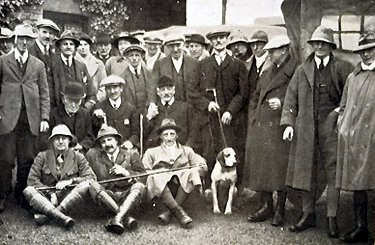
By the early years of the last century, the fame of the Mardale Shepherds Meet had spread and visiting sportsman often attended and participated.
For years the Mardale Meet’s popularity relied on the reputation of Joe Bowman (Hunty or Auld Joe) and his Ullswater Foxhounds. Visitors travelled to the meet from all parts of the country and some the world, they travelled in a variety of ways-“Rolls-Royces, carriages, horseback and on foot walking over the high mountain passes sometimes in bad weather (snow was not uncommon) and my Great Uncle Brait and Trimmer his hound actually got lost on the tops in bad weather. Trimmer subsequently won his trail. Expensive furs, kid gloves and silver mounted walking sticks mingled at the meet with woollen clothing, hand made walking sticks and fustian jackets. Most people walked and the general view was summed up by Tommy Fishwick who was once heard to say to a friend “Yan wants nowt wi’ riding as lang as yan legs ‘ell carry yan.â€
Hinchcliffe quotes that after a good days sport, huntsmen, shepherds, visitors, sheep dogs and terriers (hounds were not admitted) all turn towards the Dun Bull for a meal.
In the evening, a smoking contest took place. Skelton records “ the main portion of the pack, cast off in the large dining room and every room in the house filled with overflow meetings-or rather concertsâ€
The big room was the focal point, a tray was sent round and money subscribed for the evening’s refreshment. Each individual orders his choice of drink and the chairman pays out of the general pool. Toast’s and song follow in quick succession. The chairman selects the singer and everyone is supposed to sing at least one song and there was an element of pride in singing one that had not already been sung that evening. If the song had a good swing or chorus the men got particularly enthusiastic, the shepherds beating the tables with their sticks in time to the tune and the sheep-dogs and terriers howling either in enthusiasm or execration, no man knows which.
One song often sung paid tribute to the renowned local huntsman.
JOE BOWMAN
Down at Howtown we met with Joe Bowman at dawn,
The grey hills echoed back the glad sound of his horn,
And the charm of it’s note sent the mist far away
And the fox to his lair at the dawn of the day.
Chorus
When the fire’s on the hearth and good cheer abounds
We’ll drink to Joe Bowman and his Ullswater hounds,
For we’ll never forget how he woke us at dawn
With the crack of his whip and the sound of his horn.
Then with steps that were light and with hearts that were gay
To a right smickle spot we all hasten away,
The voice of Joe Bowman, how it rings like a bell
As he cast off his hounds by the side of Swarth Fell.
The shout of the hunters it startled the stag
As the fox came to view on the lofty Brook crag,
“Tally-Ho†cried Joe Bowman, “the hounds are away,
O’er the hills let us follow their musical bayâ€.
Master Reynard was anxious his brush for to keep,
So he followed the wind oe’r the high mountain steep,
Past the deep silent tarn to the bright running beck,
Where he hoped by his cunning to give us a check.
Though he took us oe’r Kidsey we held to his track,
For we hunted my lads with the Ullswater Pack
Who caught the fox and effected a kill,
By the silvery stream of the bonny Ramps Gill.
Now his head’s on the crook and the bowl is below,
And we‘re gathered around by the fire’s warming glow,
Our songs they are merry, our choruses high,
As we drink to the hunters who joined in the cry.
When this song is sung at Ullswater, the third verse should be given as follows:
The shout of the hunters it startled the stag,
As the fox came to view on the lofty Brook Crag,
“Tally-Ho†We’re away, o’er the rise and the fell,
Joe Bowman, Kit Farrar, Will Milcrest and all.
La Peregrina 16th century natural pearl; diamond bail early 19th century; natural pearl, diamond, ruby and cultured pearl necklace by Cartier 1972, formerly the property of Phillip II of Spain and his Spanish successors 1500s-1808, Joseph Bonaparte, Louis Napoleon, the Duke and Duchess of Abercorn, and Elizabeth Taylor.
Tomorrow night, at Rockefeller Center, Christie’s will be selling as the 12th lot of the Collection of Legendary Jewels Belonging to Elizabeth Taylor, the “La Peregrina” Pearl, one of the oldest and best-documented historical jewels.
La Peregrina, possibly the most valuable pearl in the world and certainly one of the absolutely largest (more than 50 carats) natural pear-shaped pearls ever recorded, was found near the island of Santa Margarita in the Gulf of Panama by an African slave sometime in the early to mid-16th century.
The story is that the pearl came from an oyster so small that its finder nearly did not bother to open it.
The Governor of Panama, Don Pedro de Temez, acquired the treasure and rewarded the slave with his freedom for finding it.
Temez presented the enormous pearl to King Phillip II of Spain who gave it to Mary I of England at the time of their marriage in 1554, but it returned to the possession of the Spanish crown after her death in 1558. It was one of the favorite and best-known pieces of the Spanish crown jewels, and is visible in portrait after portrait of Queen Consorts.
After Richard Burton bought it for $37,000 at a Sotheby’s sale and presented it to Taylor as a Valentine’s Day present, it fell into the jaws of one of the actress’s Lhasa Apsos. 2:33 video
The probable sales price, despite the economic times, will confirm just what a good investment Burton made.
Newt Gingrich was criticized at Saturday’s debate by Ron Paul and Mitt Romney for making an unfashionable, non-politically-correct historical observation about the Palestinian claim to nationhood. Both of Gingrich’s rivals scolded the former Speaker for unnecessarily inflaming the situation by stating a truth our adversaries do not like to hear.
Gingrich responded by observing that Ronald Reagan has gone down in history for doing exactly the same thing.
Rafal Heydel-Makoo forwarded on Facebook this morning a very apt video of Margaret Thatcher, another great leader of the past, indulging in the kind of candor which is so frowned upon by conventional, mediocre politicians. “They’re a weak lot in Europe… Weak. Feeble.” says Thatcher with unconcealed contempt.