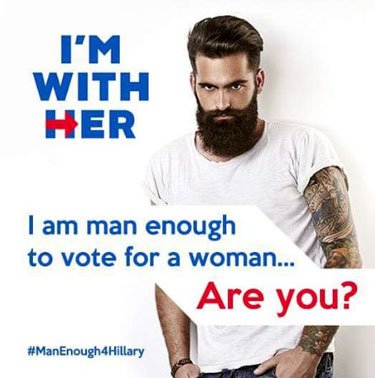
By any measure, the funniest political image since Pajama Boy. That beard, the tattoos, the model-fit appearance, Man Enough? This guy is obviously as queer as a three-dollar bill.
——————————
UPDATE: Awww! Ed Driscoll reveals that the ad is actually a spoof.
Hilarious North Korean propaganda videos showing fanatical pilots taking off in 40 to 60 year old Russian jets to crush their American adversaries, pretty ladies shopping in friendly stores packed with merchandise, advertising the automobile of which they have successfully produced 1000 examples in 16 years, depicting the long-promised “Three-Day-War” in which North Korea completely routs South Korea and her American ally, and so on.
Nick Valencia (CNN Reporter):”What is it like, explain to our viewers exactly what it’s like to be a young, black man, growing up in Baltimore.”
Jamal: “We gotta struggle. We gotta grind. You know, everything that you get, you gotta earn it. Nobody…”
Nick: “What does that mean? What does that mean? Explain, don’t speak in abstract.”
Jamal: “You gotta earn it. Like… like if there’s food over there, and they’re saying you can’t have it, you gotta take it. Sometimes, you gotta… if it’s yours, you gotta take it.”
Christie’s bullshit is so totally audacious that the listener’s mind boggles at the notion that anyone with that kind of money would be stupid enough to buy it.
*And do note the spelling error!
Daily Paywall (not working today, but quoted by Fred Lapides) was appropriately skeptical.
Among the many records set at Christie’s astonishing $852.9m contemporary art sale in New York…, one has so far gone strangely unreported; the highest price ever paid for a urinal.
Robert Gober’s 1988 installation Three Urinals sold for $3.52m, which works out at just over $1m per urinal. They do not actually work – that is, they only take the proverbial in a figurative sense. But this is a good thing, for according to Christie’s their “smooth contours invite the viewer’s touchâ€, and hand sanitiser was not included in the price.
That a urinal by an artist you have probably never heard of is worth more than a masterpiece by one you have (a Gober urinal will buy you a fine Rubens) is down to the unique way in which the contemporary art world functions. There, the merit of works such as Gober’s is not judged in any traditional and objective artistic sense, but by value.
Expensive, say the experts, equals good. After all, Three Urinals is indistinguishable from three actual urinals except by virtue of its price, and several paragraphs of impenetrable art-speak in a catalogue. And if Gober’s urinals are worth $3.5m, then one of his sinks (he does a whole range of toilet ware) must also be worth millions.
In other words, we have collectively lost the ability to assess art for ourselves and on its own merits. Instead, we follow such indicators as fashion, price, and, in this case, hype. You may say it was ever thus. But the result today, when allied with an ever wealthier elite for whom buying contemporary art has become a form of conspicuous consumption, is an unprecedented art boom. Can it last?
Normally, speculative bubbles end when an underlying financial reality hits home. The subprime boom ended when homeowners stopped making repayments. But in the art world there are few such constraints. The only requirement is that works keep edging up in value.
David Ruenzel: Guy Who Made A Living Excusing Black Criminality Just Got Murdered By Two Black Oakland Males
A prominent writer for the Southern Poverty Law Center was gunned down by two black males while hiking in Oakland, reports NBC Bay Area News:
A man who was fatally shot at a park in the Oakland hills on Tuesday afternoon has been identified as David Ruenzel of Oakland, East Bay Regional Park District police said Wednesday.
. . . They said they are investigating robbery as a possible motive for the crime.
Ruenzel’s son in a statement said his dad was a loving father, grandfather and best friend. He also described Ruenzel as a brilliant writer and educator who touched the lives of many.
. . . Police said one of the suspects is described as a man who is black or possibly of mixed race and in his late 20s or early 30s with dreadlocks, a medium complexion, high cheek bones, a narrow face, a thin build and was wearing dark clothing.
Police said the other suspect is described as a black man who is 6 feet tall, weighs about 240 pounds, is clean shaven with short hair and was wearing dark clothes and a black backpack. Witnesses described the man as being out of shape and “overly friendly,†police said.
Why did he have his life taken away from him? The suspected reason is robbery.
As a writer for the Southern Poverty Law Center, one of this favorite topics was rooting out racism. And how white racism is permanent. White racism is everywhere. And white racism explains everything.
This mantra of the Critical Race Theory and the Southern Poverty Law Center applied to all white people because, even if they were not personally cracking the whips, or breaking the skulls, white people benefitted from a racist system that did all that — and a lot more.
The greater irony, as Flaherty astutely states, is that Ruenzel was basically an “enabler of black violence†who for whatever reason believed that he was somehow magically “exempt from it.â€
This came out last month, but I only saw it yesterday. Hillary Clinton, woman of the people. Country Western Hillary. Farmers, cowboys, and Harley owners for Hillary! This is the funniest damn video I’ve seen in a long time.
Appearing on Friday at a Boston rally in support of behind-9-points-in-the polls Democrat gubernatorial candidate Martha Coakley at the Park Plaza Hotel, Hillary Clinton dismissed the idea that businesses create jobs. I guess Hillary must simply be projecting her family’s life experience, that all wealth is derived from politics, onto universal reality.
Poor innocent 18-year-old Michael Brown, shortly before he was shot by an obviously racially-biased police officer.
Helpfully, in the New Republic, Julia Ioffe warns that African Americans in Ferguson, Missouri have been excessively self critical.
This self-criticism—or self-flagellation—is nothing new. It’s the return of a phenomenon that is referred to by African-American historians as the “politics of respectability.” “During times of unrest, black writers going back to the early 20th century have argued that the reason blacks are facing discrimination or police brutality is because they have not been acting properly in public—particularly young, poor people,†says Michael Dawson, a political scientist and director of the Center for the Study of Race, Politics, and Culture at the University of Chicago. “In the last 20 years, it’s been a criticism of baggy pants, rap music, hair styles. Back in my generation, it was Afros. I remember my grandparents telling me, ‘you should cut your hair.’â€
Respectability, in essence, is about policing the behavior in your community to make sure people are behaving “properly,†so as to not attract unwelcome attention from whites—“with ‘properly’ being a normatively white middle class presentation,†says Dawson. In feminist discourse, a similar phenomenon among women is described as internalizing the patriarchal gaze.
Concerned citizens in Ferguson, Missouri protesting police violence and militarization of the police.
Jessica Valenti argues, in the Guardian, that the world owes her some tampons.
For too many girls, the products that mark “becoming a woman†are luxuries, not givens. And for young women worldwide, getting your period means new expenses, days away from school and risking regular infections. All because too many governments don’t recognize feminine hygiene as a health issue.
We need to move beyond the stigma of “that time of the month†– women’s feminine hygiene products should be free for all, all the time.
Sanitary products are vital for the health, well-being and full participation of women and girls across the globe. The United Nations and Human Rights Watch, for example, have both linked menstrual hygiene to human rights. Earlier this year, Jyoti Sanghera, chief of the UN Human Rights Office on Economic and Social Issues, called the stigma around menstrual hygiene “a violation of several human rights, most importantly the right to human dignityâ€. …
But this is less an issue of costliness than it is of principle: menstrual care is health care, and should be treated as such. But much in the same way insurance coverage or subsidies for birth control are mocked or met with outrage, the idea of women even getting small tax breaks for menstrual products provokes incredulousness because some people lack an incredible amount of empathy … and because it has something to do with vaginas. Affordable access to sanitary products is rarely talked about outside of NGOs – and when it is, it’s with shame or derision.
In 1986, Gloria Steinem wrote that if men got periods, they “would brag about how long and how muchâ€: that boys would talk about their menstruation as the beginning of their manhood, that there would be “gifts, religious ceremonies†and sanitary supplies would be “federally funded and freeâ€. I could live without the menstrual bragging – though mine is particularly impressive – and ceremonial parties, but seriously: Why aren’t tampons free?