Andrea Widburg puts the Kamala Harris choice into its correct perspective.
Biden’s choice of Kamala Harris to be his running mate shows the shallowness of the Democrats’ talent pool. Biden handicapped himself by explicitly pledging to ignore men and then implicitly bowing to the demand that his female choice be black. However, it’s still somewhat shocking that, out of all the black, female, Democrat politicians in America, the best he could do was Kamala.
What’s most striking about Kamala is that, like Barack Obama, she has nothing in common with the American black experience. Despite her slamming the race card on the table, the only thing she shares with the generic “black vote” is skin color.
Kamala did not come from a family that has traveled through generations of the American black experience. There’s no history of Southern slavery, no Reconstruction, and no being part of the endless variety of post-Reconstruction stories. Some blacks struggled through the Jim Crow South, some reveled in the Harlem Renaissance, some roped cows in the Wild West, some were part of the single biggest American migration when they moved to the upper Midwest, some embraced the middle class, and some got sucked into the undertow of the underclass. Each is an American story.
Kamala’s bio, by contrast, brings her closer to me: like me, she’s a first-generation immigrant who is the child of very educated parents (although her upbringing was more affluent than mine). Her mother is a high-caste East Indian breast cancer scientist, while her father is a Jamaican-born economist who is an emeritus professor at Stanford. Like me, Kamala grew up in liberal enclaves that were anything but racist (although Kamala also spent many years growing up outside the U.S. in Montreal).
Other than that, the only differences are that her skin is dark and she’s a leftist, while my skin is light and I’m conservative. And I never slept my way to the middle the way she did. But other than that…
The Daily Beast reports on academic activists rallying to the defense of the latest recognized marginalized minority.
Michael Eisen, editor of eLife—a well-regarded open access scientific journal for the biomedical and life sciences—made a joke about a humble roundworm, thereby cracking open the seventh seal and ushering forth… wormageddon. …
Most people took the joke in stride, or used it as an opportunity to spread the good word about nematodes. But the worm gang runs deep. Multiple researchers were not amused by Dr. Eisen’s joke, and their responses spiraled off in increasingly disproportionate directions. Some of these were scoldings about the propriety of using the word “fuck†in a public context, and whether “Academic Twitter†upholds appropriate levels of professionalism by accepting “frat boy†humor. One team went so far as to publicly reconsider submitting a paper to eLife. Others complained that the editor of a journal was publicly disparaging a study species. …
[A] day after Eisen had opened the can of titular worms, and amid the flood of C. elegans jokes washing around Twitter—things had escalated in a bizarre direction. As mystified observers raised the question over whether C. elegans researchers were taking the whole thing a bit seriously, a small handful of researchers responded by arguing that jokes about worms were in some way equivalent to jokes about women and people of color. …
By far the most prolific poster in this vein was Ahna Skop, associate professor of genetics at the University of Wisconsin-Madison and previous recipient of a Diversity, Equality and Inclusion-based award in 2018. Dr. Skop—who did not respond to a request for comment by The Daily Beast—argued extensively that making jokes about worms was merely the tip of the iceberg when it came to making jokes about marginalized identities, or an example of a ‘bystander effect’, a psychological theory arguing that individuals are less likely to offer help to a victim in a crowd. (For is it not said: First they came for the worm people, and I said nothing, as I was not a worm person?)
In the resulting threads, Dr. Skop—who identifies as “part Eastern Band Cherokee†and “disabled with EDSâ€â€”and others consistently failed to publicly respond to Black scientists like herpetologist Chelsea Connor, who tried to point out that this was a ridiculous conflation. In a private communication Connor shared with The Daily Beast, Skop doubled down, arguing that as she had previously been harmed by entrenched sexism, her concerns regarding the worm joke were justified.
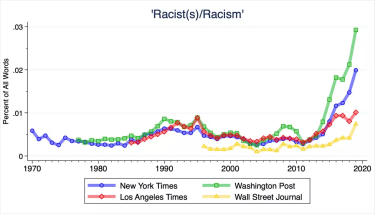
The usage of the terms “racist(s)†and “racism†as a percentage of all words in four of the nation’s largest newspapers from (depending on the publication) 1970 through 2019.
Zach Goldberg, in Tablet Magazine, documents the sudden rise to mainstream acceptance of the radical Marxist viewpoint on American History and society.
In the wake of the protests, riots, and general upheaval sparked by the police killing of George Floyd in Minneapolis, the United States is experiencing a racial reckoning. The response from America’s elite liberal institutions suggests that many have embraced the ideology of the protesters. Here, for instance, is a sampling of the titles of opinion pieces and news stories published over the past month by the country’s two most influential newspapers, The Washington Post and The New York Times:
“When black people are in pain, white people just join book clubsâ€
“Black Activists Wonder: Is Protesting Just Trendy for White People?â€
“To White People Who Want to Be ‘One of the Good Ones’â€
“America’s Enduring Caste System: Our founding ideals promise liberty and equality for all. Our reality is an enduring racial hierarchy that has persisted for centuries.â€
The last entry on the list, a lengthy feature on America’s “caste system†in The New York Times Magazine, explicitly compares the United States to Nazi Germany.
Countless articles have been published in recent weeks, often under the guise of straight news reporting, in which journalists take for granted the legitimacy of novel theories about race and identity. Such articles illustrate a prevailing new political morality on questions of race and justice that has taken power at the Times and Post—a worldview sometimes abbreviated as “wokeness†that combines the sensibilities of highly educated and hyperliberal white professionals with elements of Black nationalism and academic critical race theory. But the media’s embrace of “wokeness†did not begin in response to the death of George Floyd. This racial ideology first began to take hold at leading liberal media institutions years before the arrival of Donald Trump and, in fact, heavily influenced the journalistic response to the protest movements of recent years and their critique of American society.
Starting well before Donald Trump’s rise to power, while President Obama was still in office, terms like “microaggression†and “white privilege†were picked up by liberal journalists. These terms went from being obscure fragments of academic jargon to commonplace journalistic language in only a few years—a process that I document here in detail. During this same period, while exotic new phrases were entering the discourse, universally recognizable words like “racism†were being radically redefined. Along with the new language came ideas and beliefs animating a new moral-political framework to apply to public life and American society.
There was a time when the New Yorker viewed itself as the voice of an imaginary top-hatted and monocled urban sophisticate of impeccable White Anglo-Saxon pedigree, whimsically named Eustace Tilley, whose costume hinted at residence in an imaginary Regency Manhattan, drawn scrutinizing skeptically a passing butterfly, evidently attempting to determine if its quality rises to a level worthy of his recognition and acquaintance.
Today’s New Yorker of almost a century later, like the American Establishment it speaks to, and for, has changed most remarkably.
Its authors are still dyed-in-the-wool representatives of the community of fashion, channeling the Zeitgeist and delivering up the intellectual results of educations at the finest universities in the land, like Yale, just for instance. But, where the old New Yorker was devoted to the eternal quest for top quality writing and exhibitions of high intelligence, today’s New Yorker is an angry, self-righteous fanatic, a Savanarola or Robespierre, devoted to the Revolution in which the likes of Eustace Tilley will be indicted for limitless historical crimes against a constellation of Identity Groups, convicted and guillotined in Manhattan’s version of the Place de la Concorde.
The magazine’s pages will, henceforth, be devoted to organizing and agitating on behalf of all officially-recognized Oppressed Categories; denouncing and destroying Eustace, everything he stands for, and all his relations; and negotiating the precise future status and power relations of every category of victim in the new Majority.
E. Tammy Kim, in the latest New Yorker, is endeavoring to book some advantageous accommodations on Karl Marx’s Arc for Koreans like herself, when the Rising Tide of Color in the imminent future sweeps away the white American majority, the Founding Fathers, God, apple pie, and the entire former canon of Western History and Culture.
The most recent time I was mistaken for white was a few weeks ago, on that most ignoble medium of Zoom. This time, it was a virtual organizing meeting for a tenant-rights group in New York. The handful of people on the call were mostly friends, all of us concerned about protecting neighbors from eviction, particularly during the pandemic. As we discussed the welfare of longtime renters, and as Black Lives Matter protests erupted a few blocks away, a new member of the group tried to thoughtfully turn the lens.
“We’re talking gentrification, but everyone on this call is white,†she said.
“Actually, I’m not white,†I replied.
“Oh, I just meant that we have no people of color,†she said. “No Black or brown people.â€
I nodded to clear the air and because I found the exchange more intriguing than discomfiting. Though our organizing group included people of all races, it was true that this particular meeting was overwhelmingly white. The woman had thus invoked “people of color†and “Black and brown†to mean renters who were Black or Latinx, older and lower-income. I wondered if she would have said the same thing if younger, wealthier newcomers who happened to have dark skin had been on the call. Would they qualify as “people of color�
I want to clarify that I do not look white. I am Korean-American and appear very much the part. So the woman’s mistake was not centered in her visual cortex but, rather, in whatever organs of intellect and affect tell us that one thing is not like the other. It was a short, mundane encounter of the kind I’ve had many times before, with both Black and white people.
E. Tammy Kim, strangely enough to my own mind, emerged from dear old Yale, Philosophy degree in hand, apparently astonishingly well versed on the opinions of every minor communist academic crackpot at every cow college in the country. She can quote chapter and verse concerning every real and suppositious grievance for every malcontent identity group, but she somehow overlooks entirely the sunny side of life.
Personally, I think she might forgive America its 19th Century Ban on Chinese Immigration and our insufficient wage payments to migrant labor and poor whites when she considers that America also saved half of her ancestral homeland from Communist despotism and slavery and, despite all our racism and White Supremacy, let her family come here, where instead of digging ditches and eating turnips like the typical North Korean, she got to revel in the luxury of Yale’s Trumbull College and publish regularly in the Times and the New Yorker.
One asks oneself: What does it take to satisfy this chick?
[A] growing number of activists and commentators say that “people of color†no longer works. The central point of Black Lives Matter, after all, has been to condemn the mortal threat of anti-Black racism and name the particular experiences of the Black community. “People of color,†by grouping all non-whites in the United States, if not the world, fails to capture the disproportionate per-capita harm to Blacks at the hands of the state. The practical use of “people of color†has also devolved into “diversity†rhetoric, invoked by a white managerial class that may be willing to hire fair-skinned Latinx or Asian expats but not Black people, or by non-Black minorities who lean on the term only when it’s convenient. Say Black if you mean Black. S. Neyooxet Greymorning, a professor of anthropology and Native American studies at the University of Montana, told me that “people of color†tends to blot out the concerns of not only Black people but those who claim the “political,†non-racial category of indigenous. “The problem is, even when you have those kinds of alliances, normally one group will rise to the top and dominate the other groups,†he said.
To be clear, Greymorning did not mean to contest the present focus on Black lives. He applauded it and noted that every mobilization needs a definable aim; ending all discriminatory violence would be too large and blurry a goal to structure a movement. But it’s also the case that—since the emergence of the Black Lives Matter movement, in 2013—some intellectuals and activists have contended that anti-Blackness alone can explain U.S. history, and that all other campaigns for racial and social justice are tributaries of the Black liberation struggle. Rejecting the term “people of color†may be of little consequence, but rejecting the solidarity it implies can result in an inaccurate and unduly limiting world view.
As Margo Okazawa-Rey, a professor emerita at San Francisco State University who participated in the Black feminist Combahee River Collective of the nineteen-seventies, put it, “The history of this country is told from the East Coast,†thereby privileging the Black-white binary. This lens is foundational, and central to our racial imaginary, but it should not be the only one. The enslavement of Black people on this continent—and the caste system devised to maintain it—cannot fully explain the attempted genocide of indigenous peoples, a decades-long ban on Chinese immigration, the mass deportations and lynching of Mexican migrant workers, the crackdown on Arab and Muslim communities after 9/11, or our wars in the Philippines and Iraq. The wealth of the United States owes not only to slavery but also the exploitation of migrant workers and poor whites, and the theft of land and natural resources here and abroad. And although it is now common to attribute the passage of the Immigration and Nationality Act of 1965 solely to the civil-rights movement, its more proximate cause was the injunction of anti-Communist foreign policy.
Clearly, as we see below, it takes, speaking as a member of the current European-descended majority, nothing less than our replacement, supplanting, defeat and cultural and political elimination.
This cute little Asian girl is really a raving communist and a spectacularly virulent racist.
What seems obvious is: Considering her views, why doesn’t she just go to Cuba, or North Korea, where she doesn’t need to organize, agitate, or struggle at all. Her vision of “universal liberation, across race and class, against white supremacy and U.S. empire” is already perfectly in place in those countries.
The problem with sorting based on the dominant racial binary, according to the philosopher Linda MartÃn Alcoff, of Hunter College, is that it creates a defeatist paradigm “in which a very large white majority confronts a relatively small Black minorityâ€â€”when, in fact, whites in the U.S. will soon be outnumbered by people of color.
The American dream is that any citizen, regardless of sex, race, creed, or color, can rise on his determination and merit. History is littered with examples of the reformers who worked to realize that dream, pushing the most influential institutions in the country to prize talent and hard work over wealth and connections.
The introduction of standardized testing, accessible to all American teens, was part of that push. Harvard University began administering a standardized test to all applicants in 1905. Its effect was profound and immediate: historically a landing spot for the Protestant upper crust, the school began admitting far more public school kids, Catholics, and Jews. …
In the name of racial equality, the woke now seek to dismantle meritocratic norms and return to the quota systems that practices like standardized testing were designed to relegate to the trash heap of history. …
The New York Times’s classical music critic, Anthony Tommasini, is calling for the end of the blind symphony audition, which drove a tripling of women’s representation in the field, so that conductors can make race-based selections. The University of Connecticut School of Medicine, where merit is literally a matter of life or death, recently suspended admissions to its honor society because the GPA-based admissions criterion did not produce an honor society that, as Bill Clinton said, “looked like America.”
The SAT—which measures intellect better and more fairly than do intangible heuristics—is under fire. University of California president and former Obama official Janet Napolitano has joined the chorus of administrators at elite universities who complain that race-blind admissions aren’t producing the desired results.
Those calling for “progress” usually want to forfeit someone else’s job. Tommasini is a white man, as are all his listed colleagues at the Times‘s “music” section. So is the L.A. Times’s Mark Swed, and Washington Post music critic Michael Brodeur, who recently penned a news report about classical music’s “long overdue reckoning with racism.”
All are curiously quiet on the “racism” of their clique. None seem ready to give up their own position for indigenous or trans critics, who surely exist! Surely they are waiting somewhere for the call from the New York Times that their turn has come, merit be damned!
NYT Classical Music Critic Anthony Tommasini says “ensembles [need] to reflect the communities they serve, [and] the [hiring] audition process [for musicians] should take into account race, gender and other factors.”
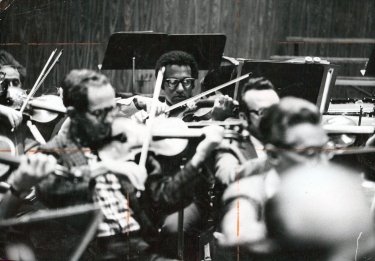
During the tumultuous summer of 1969, two Black musicians accused the New York Philharmonic of discrimination. Earl Madison, a cellist, and J. Arthur Davis, a bassist, said they had been rejected for positions because of their race.
The city’s Commission on Human Rights decided against the musicians, but found that aspects of the orchestra’s hiring system, especially regarding substitute and extra players, functioned as an old boys’ network and were discriminatory. The ruling helped prod American orchestras, finally, to try and deal with the biases that had kept them overwhelmingly white and male. The Philharmonic, and many other ensembles, began to hold auditions behind a screen, so that factors like race and gender wouldn’t influence strictly musical appraisals.
Blind auditions, as they became known, proved transformative. The percentage of women in orchestras, which hovered under 6 percent in 1970, grew. Today, women make up a third of the Boston Symphony Orchestra, and they are half the New York Philharmonic. Blind auditions changed the face of American orchestras.
But not enough.
American orchestras remain among the nation’s least racially diverse institutions, especially in regard to Black and Latino artists. In a 2014 study, only 1.8 percent of the players in top ensembles were Black; just 2.5 percent were Latino. At the time of the Philharmonic’s 1969 discrimination case, it had one Black player, the first it ever hired: Sanford Allen, a violinist. Today, in a city that is a quarter Black, just one out of 106 full-time players is Black: Anthony McGill, the principal clarinet.
The status quo is not working. If things are to change, ensembles must be able to take proactive steps to address the appalling racial imbalance that remains in their ranks. Blind auditions are no longer tenable.
Can there be any notion more preposterous, more incapable of surviving intellectual scrutiny, than today’s liberal shibboleth of “Diversity”?
Diversity requires abandonment of standards of merit, achievement, and genuine equality of opportunity, accompanied by lots of rationalizations, denial, and outright lying about what is needed to produce sufficient representation of members of various privileged victim identity groups. Note how Mr. Tommasini assures NYT readers that there is
remarkably little difference between players at the top tier. There is an athletic component to playing an instrument, and as with sprinters, gymnasts and tennis pros, the basic level of technical skill among American instrumentalists has steadily risen. A typical orchestral audition might end up attracting dozens of people who are essentially indistinguishable in their musicianship and technique.
But this begs the question: are there actually many representatives of underclass minorities in that “top tier”? Obviously, there are not, because, if there were, then blind auditions would work to achieve their hiring just fine.
Mr. Tommasini fails also to explain why “diversity” in the sense of more African-Americans in classical orchestras is an urgent problem, while massive over-representation of African-Americans in professional sports is no problem at all.
Why, I often wonder, are blacks, Mexicans and Puerto Ricans, and homosexuals important for “Diversity” but not Finns, Ukrainians, or Belgians? If the answer is that a sob story about past hardships is required, then how come Jews, Appalachian hillbillies, and all those ethnic Catholic blue collar communities count for nothing in the Diversity sweepstakes? Tell us, Mr. Tommasini: what percentage of classical orchestra ensembles are made up of Southern Italians from the Outer Boroughs of New York?
————-
You can imagine what I thought when I looked up Mr. Tommasini and found that he is a Yale classmate of mine.
Unbelievable. Not only did they *arrest* a child merely for saying ugly things to a celebrity of color, but they're *bragging* about having arrested a child for words. Ugly words, yes, but words. He's 12 years old. What are you, @wmpolice, the Stasi? https://t.co/z1ENthqT8r
Now here is something downright exceptional from last year.
Nebal Maysaud (a Lebanese composer of the Sodomitical persuasion) complains that Western Classical Music oppresses persons of color and colonizes Third World cultures operating as an agent of cultural change. All this is the fault of Capitalism. (Personally, I thought most of the really good Classical Music was created by the patronage of pre-capitalist monarchs and aristocrats. Prince Esterhazy did not engage in trade.)
There comes a point in some abusive relationships where the victim wakes up out of their Stockholm syndrome and learns that they need to plan an escape. As you communicate with others and you get a taste of freedom, you learn that the force you thought was protecting you is in truth keeping you in danger.
For those who haven’t encountered abusive relationships, you may support the abuser, or wonder why the victim doesn’t just leave. But you don’t know what it’s like to live in a world where you can’t tell truth from myth.
For the victims who aren’t ready, you may have an urge to push away those of us seeking to help you and stay with your abuser, believing them to be a source of protection.
Unfortunately, not everyone can escape. But having the knowledge that your abuser is an abuser itself can be freeing. It can help you find the next step in your journey towards liberation. But you need a community to fall back on. You need people to talk to so that they can keep you safe, so that they can help you understand the truth, and so that they can teach you the abuser’s techniques and how to fight them.
My fellow musicians of color: it is time to accept that we are in an abusive relationship with classical music.
In my previous articles, I laid out my experiences and reasoning for coming to this conclusion. I started with “Am I Not a Minority?†to explain the everyday racism people of color experience and how it manifests on an institutional level. If you haven’t read it already, I encourage you to explore how institutions uphold their power by choosing which minorities to give access to.
The few scraps given to minorities are overwhelmingly white–occupied by white cisgender women or LGBT+ individuals. The few PoC who are given access to institutional space are most often light skinned and non-Black while also exoticised and tokenised.
And that led me to my second article, “Escaping the Mold of Oriental Fantasy“–a personal history of isolation and colonization, of how Western classical music participates in the act of destroying culture and replaces it with its own white supremacist narrative.
Finally, I shared my attempts at reviving my culture and my tradition, along with the barriers I faced on this journey. My third article, “I’m Learning Middle Eastern Music the Wrong Way,†chronicles the difficulties (and the near impossibility) of engaging with my own cultural musical practices in a proper, authentic way.
From three angles I shared my attempts at being an authentic composer. These articles bring to light the many ways in which the dreams of low-income people of color are obstructed in the Western classical tradition.
Western classical music is not about culture. It’s about whiteness. It’s a combination of European traditions which serve the specious belief that whiteness has a culture—one that is superior to all others. Its main purpose is to be a cultural anchor for the myth of white supremacy. In that regard, people of color can never truly be pioneers of Western classical music. The best we can be are exotic guests: entertainment for the white audiences and an example of how Western classical music is more elite than the cultures of people of color.
After the Revolution, you see, a benevolent Central Committee will see to it that persons of color, like Nebal here — and whites as well (!) –, are amply funded to produce music in their native cultural traditions. Everyone will be liberated!
Unless, of course, the State is having production problems, and all those aspiring creatives are marched off to labor camps to mine salt.
In this time of Cancel Culture, not all exhibitions of self-indulgent racial melodrama win Pulitzer Prizes. This recent Harvard grad posted the above rant on TikTok, and was consequently fired by Deloitte.
Their HR Department, alas! poor girl, took her rather-extreme metaphor literally as a “threat.” I’m sure that she actually had no intention of stabbing anyone, but her personal participation in contemporary group psychosis does have plenty of unfortunate real world consequences.
The African-American pattern of persecution fantasy functions to justify unearned and undeserved favoritism and privilege as “compensation.” It operates as an excuse for the suppression of free speech and honest debate. And it fuels a demented and overwheening self-importance, persuading silly people that they are special and specially-entitled on the basis of historical victimhood, that nobody has suffered as they’ve suffered (and are still suffering!) and nobody else can possibly compete in status and entitlement and nobody else can possibly understand how they’ve suffered (and are still suffering!). Being the ultimate entitled victim and at the same time a haute bourgeois elite Ivy League graduate is nice work if you can get it.
Fueling and participating in this nonsense is intellectually dishonest and socially and politically destructive. This fantasy corrupts society, fosters limitless injustice, and sews bitter divisiveness. Stupid people, even some who did not go to Harvard, will swallow this feel-good, addictive poison and proceed to act on it. Last year, just for instance, 23-year-old Temar Bishop raped and beat a 20-year-old white college student to avenge his historical group grievances.
She was a white girl. She deserved it because us minorities have been through slavery.â€
“This is what they used to do to us,†he allegedly told the witness, according to the criminal complaint. “This is what they did to us during slavery. They used to beat us and whip us.â€
The victim suffered a broken nose and teeth, and vomited blood after the attack.
I thought it was sad that she lost her job for a private opinion and because her figure of speech was taken literally, but there is the consolatory thought that she obviously would not feel a bit sorry if the shoe were on the other foot, and some opponent of her Racialist Agitation had his career carpet-bombed due to some social media indiscretion. On the contrary, I have every expectation that she would gloat.
The New York Times publishes the worst nonsense these days. Yesterday, for instance, they served up this spectacular exercise is self-pity from Affirmative Action poet Caroline Randall Williams.
I have rape-colored skin. My light-brown-blackness is a living testament to the rules, the practices, the causes of the Old South.
If there are those who want to remember the legacy of the Confederacy, if they want monuments, well, then, my body is a monument. My skin is a monument. …
I am a black, Southern woman, and of my immediate white male ancestors, all of them were rapists. My very existence is a relic of slavery and Jim Crow.
According to the rule of hypodescent (the social and legal practice of assigning a genetically mixed-race person to the race with less social power) I am the daughter of two black people, the granddaughter of four black people, the great-granddaughter of eight black people. Go back one more generation and it gets less straightforward, and more sinister. As far as family history has always told, and as modern DNA testing has allowed me to confirm, I am the descendant of black women who were domestic servants and white men who raped their help.
It is an extraordinary truth of my life that I am biologically more than half white, and yet I have no white people in my genealogy in living memory. No. Voluntary. Whiteness. I am more than half white, and none of it was consensual. White Southern men — my ancestors — took what they wanted from women they did not love, over whom they had extraordinary power, and then failed to claim their children.
Obviously, the author knows no such thing. history is complicated, far more complicated than imaginary ideal grievance narratives can possibly reflect.
When Henry Louis Gates, on the popular PBS television program Finding Your Roots, looked into the genealogies of African Americans, with massive funding and plenty of professional research assistance, he found one black family that had been free immemorially right back to the 17th century (Tonya Lewis Lee‘s paternal line — Season 4, Episode 6).
He found several black celebrities (including Lionel Richie) descended from ancestors who received state pensions for Confederate military service. He also found one person was descended from a white Confederate soldier who lived, in complete defiance of the mores of the time, with a black woman as man and wife.
Reducing, in the fevered left-wing imagination, all amorous relations between representatives of different races to rape simply travesties reality.
We know from countless depictions of Antebellum Life in the Southern States that African American house servants lived essentially as members of their owners’ extended family. White children were raised by black Mammies, and white and black children grew up as playmates and friends. So, with millions of people living in such intimate and affectionate contact, do you really think that mutual sexual attraction never occurred?
Obviously, it did, because, despite powerful social taboos, some white men really did simply defy Society and live with women of color.
Beyond that, of course, not all African Americans grew up to be pillars of the community and a credit to their race. There was obviously a black underclass way back when, just as there is today. Mixed racial descent could possibly result from the unintended consequences of the practice of the Oldest Profession. Rather than some cruel rapist master, Caroline Randall Williams’ white ancestor may simply have been a lonely chap who wandered off into the sinful part of town one Saturday evening while celebrating.
Of course, it is true as well that current African American hysterical complaints about what they imagine occurred more than a century and a half ago, in addition to lacking a serious factual foundation, are patently ridiculous simply due to the great distance and remoteness of the supposed events.
What happened to your fourth or fifth times great grandparent obviously has very small connection to you. Everybody, white or black or whatever, has some potential historical sob stories. A major portion of today’s US population (including myself) has no ancestors present during, or before, the War Between the States. If Simon Legree, with lascivious intent, chased Little Nell across those ice flows, I had nothing to do with it.
Actually, if we go back before 1850, the ancestors of a lot of white Americans were, if not actual serfs, still peasants with a labor obligation to a socially superior landlord and no meaningful rights.
Caroline Randall Williams, do us all a favor and grow up and get over yourself. Black America’s constant whining and complaining, its excessive chauvinism and racial animosities have a lot to do with the violence and crimes perpetrated by its lower class representatives. It’s long past time to stop all this.
Fat cat Columbia Journalism School prof, New Yorker writer, endless beneficiary of racial favoritism and diversity hiring, Jelani Cobb who makes a terrific living typing out fantastical complaints and brazen expressions of ethnic chauvinism dashed off a little piece in Slate, commenting bitterly in support of the recent rebellion of Woke minority hires at the New York Times.
How much extra do you suppose the establishment organs that performed all sorts of intellectual acrobatics to justify awarding special platforms and positions to pseudo-educated tokens and paying them professional salaries to produce this kind of tripe need to add to make up for all that “additional, unpaid, and invisible work of making [the] workplaces more equitable”?
First published in 1918, the slender book was written by William Strunk Jr., then overhauled and expanded by E. B. White in 1959. Generations of students and writers have kept well-thumbed copies of Strunk and White, as the revised work is commonly known, by their desks. As of 2016, a database that tracks these things found that it was the single most-often-assigned text in college syllabuses. “I’ll tell you right now that every aspiring writer should read The Elements of Style,†Stephen King once wrote, failing to notice that the first six words of this sentence are superfluous, indicating neglect of Strunk and White’s famous injunction, “Omit needless words.â€
Yet Jones quit days later in a huff, leaving the book on the CEO’s desk as she did so. She considered the gift “insulting,†according to a New York Times report. “With its suggestion that her own language skills were lacking, the gift struck Ms. Jones as a microaggression,†informed sources told the Times. Stunned, Lynch told the paper, “I really only had the intention — like every time I’ve given it before — for it to be a helpful resource, as it has been for me. I still use it today. I’m really sorry if she interpreted it that way.â€
Assuming that’s all there is to this story, the young assistant looks like an unfortunate example of the kind of fragile, self-sabotaging young adult our colleges are sending out into the workplace. Our campuses turn young people into cultural hemophiliacs who, if someone bumps into them on the sidewalk, are likely to rupture a blood vessel and bleed out. Having spent four years being coached on the perniciousness and prevalence of “microaggressions,†with platoons of campus diversity guardians vowing to champion them in every micro-dispute, young people have learned to look for slights everywhere.
Cassie Jones quit the most prestigious magazine-publishing company in America because she was insulted by being given a common style guide. She was confident enough in her status as a victim that she told others about this. And on her way out the door, she dropped the book on her boss’s desk as a symbol of her grievance. A moment’s research would have provided her with ample evidence that millions of people have kindly given, and gratefully accepted, this elegant and useful little book.
“It was a really proud moment,” Jones told Insider of getting hired for the role.
But the position wasn’t exactly what she thought it would be. By the fall, Jones has reached what she described as a breaking point. “Little things had happened that made me question if this was the right fit for me,” she said, adding that she felt anxious every day at work.
Things came to a head on November 20, according to Jones. Lynch asked Jones to come into his office, and he gave her “The Elements of Style” by William Strunk Jr. and E.B. White, a guide to standard English typically used for writing. Lynch said Jones could “benefit” from reading it, according to three people with knowledge of the situation who spoke to The Times.
As he gave her the book, Jones told Insider that Lynch referenced a few emails in which Jones had made minuscule grammatical errors. According to Jones, Lynch then told her that she represented him and his office, implying that her language skills needed improvement if she was going to continue to work for him.
According to The Times’ sources, the incident “struck Jones as a microaggression,” though she told Insider that she wasn’t familiar with the term until a week ago. “To say it was insulting is not even the right word,” Jones said of Lynch giving her the book. “I had lost my confidence as a person and as a worker. And I’ve worked for a lot of people. I’ve never had someone do something like that.”
Jones said she went to the company’s HR department the same day to complain about the incident. She then quit within a week of Lynch giving her the book, leaving it on his desk before she left the office. …
Jones also said she’s never had a manager complain about her communication skills until she started working for Lynch, adding that her coworkers often call her the “people whisperer” because of her way of making everyone around her feel at ease. …