The Onion has figured out the answer of how to achieve an enduring Middle East peace.
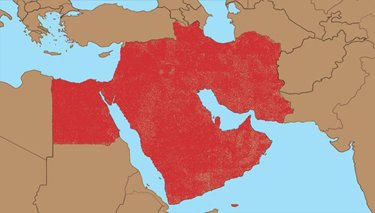
NEW YORK—Marking the latest and most ambitious attempt to bring stability to the region, the United Nations announced Wednesday that every single person in the Middle East will receive his or her own sovereign nation as part of a historic 317,000,000-state solution.
The broad and extensive compromise, which affects more than 3,000,000 square miles formerly occupied by the territories of Israel, the West Bank, Gaza, Syria, Iraq, Iran, Saudi Arabia, Lebanon, Oman, Yemen, Egypt, and Jordan, will reportedly draw over 750,000,000 new borders in what experts claim will help drastically curb sectarian violence.
“Given the incredibly complex and volatile sociopolitical landscape throughout the Middle East, a 317,000,000-state solution is the only realistic means of achieving lasting peace,†said U.N. Security Council president Eugène-Richard Gasana, noting that the treaty was reached after lengthy negotiations, which brought together each of the more than 300,000,000 independent factions. …
“We are confident that with every man, woman, and child possessing his or her own autonomous area of sovereignty to run as he or she sees fit, we will avoid many of the conflicts that have plagued this part of the world for centuries and left countless dead,†Gasana added. “This is a bright new future for the Middle East.â€
According to U.N. officials, the newly demarcated Middle East now consists of 8,000,000 independent Jewish states, 4,000,000 independent Palestinian states, 112,000,000 Shi’ite Islamic republics, 156,000,000 Sunni Islamic republics, and 19,000,000 Kurdish nations, as well as approximately 18,000,000 territories that include various Christian, Bahá’Ã, Druze, Zoroastrian, and secular countries.
Popular among handgun-owners, pistols are defined by their built-in barrel and short stock. They are the most commonly recovered firearm type reported by the ATF. With more than 119,000 pistols found at crime scenes in 2012, this handgun model holds an unfortunately solid first place in criminal weaponry.
One of the most popular pistols is the Glock, a short-recoil operated, semi-automatic pistol produced by Glock Ges.m.b.H. in Deutsch-Wagram, Austria. Glocks comprise 65 percent of the market share of handguns for United States law enforcement agencies and are also frequently used by international law-enforcement.”
Rolling Stones’ The 5 Most Dangerous Guns in America photoessay lists “Pistols, Revolvers, Rifles, Shotguns, and Derringers” as the five firearms “causing the most harm.” Rolling Stone journalists don’t seem to understand that Derringers and Revolvers are pistols, and they provoked a sardonic smile on my part by using a photo (above) of a Phoenix HP-22 to illustrate the pistol tirade which talks all about Glocks. I guess they don’t actually know what a Glock is either.
Good thing inanimate objects do not sue, or all those guns would be in a position to win a libel case based on being blamed for causing harm. I feel perfectly sure that not a single gun ever caused any harm absent human intervention.
Rolling Stone set a kind of new record for ignorant vapidity, and that accomplishment did not go unnoticed and unmocked. There was by last night already a Twitchy page featuring parodies.
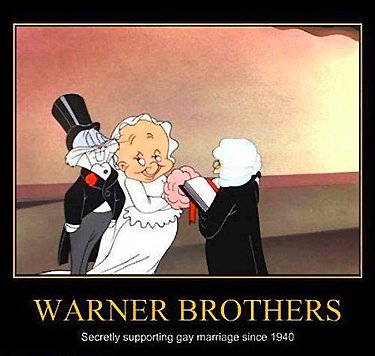
James Lileks defends the classic Warner brothers cartoons against an attack in (now wanting to charge you money) STALE magazine by LGBTQ-expert Mark Joseph Stern bemoaning how brutal the old cartoons were and finding their comedic violence “appallingly macabre” by noting just how ahead-of-their-time Bugs, Elmer, Daffy and the rest were in championing self-construction of identity and same-sex marriage.
But no kids’ show today would ever treat firearms or gun deaths so lightly, with such zany exuberance, as Looney Tunes once did. That jaunty disregard of the consequences of violence is part of what made the show so bizarrely delightful. In a post-Newtown world, however, what was once strangely funny now registers as appallingly macabre.
Yes —- if you’ve had your sense of humor surgically removed, and replaced with an oversized gland that produces chemicals responsible for compulsive frowning. Otherwise you might continue to find them strangely funny, oddly funny, audaciously funny, or perhaps just hilarious. There are still some, I hope, who can smile at the sight of Daffy’s beak blown clear around to the other side of his head after Fudd loosed a blunderbuss blast. There is no pain involved; only irritation and annoyance. He readjusts his beak with an audible squeaking sound, and stomps off to yell at Bugs, instigator of the incident.
But that very episode — “Duck! Rabbit, Duck!†— contains messages that should hearten the heart of a Slate writer, for it contains a very modern message about identity. As you may recall, the plot concerns Fudd’s confusion over which season it is: Wabbit, or Duck? The signage is confusing. Daffy self-identifies as a duck, and this being the ’40s, he is locked in a fixed identity, a product of a culture that says if it walks like a duck and talks like a duck it is a duck. But as we now know, “species†is as fluid as any other form of identity.
And that’s something Bugs reveals in a very subversive sequence. Daffy uses colloquial expressions to describe his mood, noting that he feels like a goat. Whereupon Bugs produces a sign that says it is Goat Season. Fudd unloads accordingly. It may look like violence. But it’s really acceptance. If Daffy says he is a goat then he is a goat. He may suffer the consequences, but Fudd has affirmed his statement of identity. Over the course of the cartoon Daffy identifies with various species, and in each instance Bugs has an appropriate placard to nudge Fudd toward accepting the fluid spectrum on which Daffy may choose to locate himself.
Half a century before Facebook’s 57 genders, Warner Brothers was laying the groundwork.
It’s not an isolated example of progressive themes in Looney Tunes. “Hillbilly Hare†contains a wealth of sociological insight. The main characters are two rural archetypes mired in poverty, wandering the backwoods shoeless, engaged in a pointless blood feud. You could almost call it “What’s the Matter with the Ozarks,†for instead of concentrating their enmity against the 1 percent that has exploited their labor and resources, they are pitted against each other in a pointless struggle.
Into this world comes Bugs, who draws their attention by dressing up as a seductive female rabbit — a transgressive statement that manages to lampoon heteronormative behavior (transgender Bugs feigns interest in the males) and reinforces the worst sort of cross-dressing stereotypes, as female-identified Bugs is all lipstick and hip-cocking sashay exaggeration. But for the time it was groundbreaking. To a youth who sat in the theater in 1948 it may have said, Yes, it is possible to break the confines of biological gender, and to do so with such confidence and style that people who would otherwise fricassee you for supper would follow your every suggestion.
And what a suggestion! In a hilarious set piece, Bugs calls a square-dance tune whose instructions aren’t the usual do-si-do, bow-to-your-left, but consist entirely of commands to inflict escalating levels of retributive violence. The men, socially and culturally conditioned to follow any command the square-dance caller makes, are not only helpless to assert their own will, they end up dancing with each other. This redefines the courtship ritual of the dance — a means of channeling and controlling sexual energy — into a fiercely homoerotic ballet.
“Hit ’im again, the critter ain’t dead.†It’s safe to assume Bugs is talking about the stifling hand of religious intolerance and centuries of marriage inequality. With a tidy couplet he brushes away the pope’s objections: Promenade like a bride and groom, he calls, and that they do. …
Bugs would return to the idea of same-sex marriage in one of the most popular and enduring cartoons, the one based on the “Barber of Seville.†While most of the cartoon involves the usual violence — much of which seems macabre and inappropriate in light of the fact that someone could be murdered at La Scala, some day — it ends with the whirlwind courtship of Bugs and Fudd. They point guns of increasing size at each other, a metaphor for the escalating divisions of contemporary politics — but Bugs utterly defuses the situation by presenting Fudd with flowers, and Elmer promptly changes into a wedding dress.
If ever there was a marvelous rendition of the swiftness with which the debate on marriage equality changed, it’s that. Granted, Bugs picks up Elmer and drops him from a great height, but the course of true love never did run smoothly.
Kevin D. Williamson considers the implications of applying the principles behind Obamacare more widely.
I have heard it argued that the San Francisco Bay Area is not only the nation’s but the world’s most desirable metropolis. I don’t buy that for a minute, but it’s not entirely implausible. There’s great natural beauty, and many of the world’s most creative people and institutions choose to make the area their home. It’s pricey by American standards but still a bargain by global standards. Like New York City in its golden age, it is a glorious collision between culture and money.
Let’s assume that the Bay Area partisans are correct in their high estimation of the metropolis. What might we do with that information? Why not pass a law requiring everybody in the United States to live there? As with the Affordable Care Act’s approach to health insurance, we wouldn’t be forcing an inferior product on people; we’d be forcing them to drop their second-rate cities for something better. Sorry, Cleveland — you can’t keep your crappy city, so deal with it. There would be some great economies of scale at work, and there are well-known economic benefits associated with population density, which we’d have in spades with a population of 300 million. (Though if we define the Bay Area broadly, we’d still have a lower population density than Manhattan, on average.) We could drop altogether thousands and thousands of redundancies — of school districts, police departments, fire departments, planning and zoning codes, tax laws, city councils. The rest of the country could be turned into farmland or left to revert to wilderness. Think of the efficiency we could achieve.
Once we’ve decided where everybody should live, we can move on to the question of what they should eat.