“Dean of College Rakesh Khurana attempts to gain the attention of the participants of Primal Scream by climbing onto the shoulders of a Primal Scream runner Thursday in Harvard Yard. Other students organized a protest in response to recent police brutality [in Ferguson, Missouri] that attempted to delay the start of the run.”
Primal Scream is a fairly recent (streaking era) Harvard tradition in which, on the last night of reading period, just before final exams start, Harvard students run naked across and then around Harvard Yard.
This year about 30 left-wing holier-than-thous tried to arrange a four-and-a-half minutes of silence prior to the Primal Scream naked run to protest the shooting of poor Michael Brown. Unfortunately, the more typical drunken and unruly Harvard students, bent upon streaking, objected to interference with the naked run, and proceeded to defy them, initiating the run, and chanting “USA!, USA!” while running.
The lefties grew angry and tried to block the naked runners, chanting “Black lives matter!”, while runners responded with obscenities and “USA!”, while ignoring them.
A number of Harvard administrators turned up to assist the protestors (not to run naked), and the best moment of comedy occurred when Harvard College Dean Rakesh Khurana climbed atop the shoulders of a naked young man, bullhorn in hand, tried, but failed, to persuade the crown to bow to the wishes of the leftie bedwetters,
Members of the protest said that they were upset by the reactions of the student streakers.
Amanda D. Bradley ’15, who helped organize the protest, said that while she did not know the intentions of the primal screamers, she felt disgusted by what they were chanting.
“For people to say black lives matter, and for the crowd to shout back ‘U.S.A.,’ which is upholding a system that is oppressing black people, I think that that is problematic,†she said.
Sasanka N. Jinadasa ’15 said she was appalled by what she called a disrespect both for Khurana and the protestors.
“I think that for many students of color, particularly black students, there’s always a fear of what white retaliation looks like,†she said, citing obscene gestures and language toward protesters.
Keyanna Y. Wigglesworth ’16, another protester, said she was “disturbed†and “angered†by reactions to the protest, especially from those in the front of the crowd of streakers who she believed could hear the calls for silence.
But, never fear, the pinkos at the Crimson were never going to let it be said that the left was defeated by youthful high spirits. It was all really a misunderstanding, you see.
Skip L. Rosamilia ’17, a Primal Scream participant, said that he could not hear or see through the crowd of streakers.
“I’m sad because it…look[ed] like there was one group who was for [the demonstration] and a huge group that wasn’t, and I don’t think that was the case,†he said, calling the interaction between the protest and the streakers a “huge egregious misunderstanding.â€
Khurana also said many runners told him that they would have joined the protesting students if they had known about the demonstration.
“I think what it was, is just…a tight physical space and a relatively loosely structured event without actually clear planning,†Khurana said, noting that it was difficult for him mediate between the two groups of people.
Some students voiced similar concerns before the demonstration on the Facebook post for the event, saying that the protest would be disruptive to the College tradition of Primal Scream and potentially would risk student safety. As a result, organizers posted an update on the protest’s Facebook page saying that they had changed the nature of the protest from a die-in to a moment of silence out of safety concerns and in an effort to preserve the Primal Scream tradition.
Though Walker, one of four principal organizers of the protest, acknowledged Thursday afternoon that there “was some confusion as to what was going on and not a lot of individuals knew what was happening,†he said he thought the protest was a success.
“The event was successful because it started a conversation in communities that haven’t been talking about this.â€
Robert Tracinski was challenged to identify one thing the Left could learn from Ayn Rand. Naturally, he felt initially at a loss to restrict the list to one thing. So he thought and thought, and concluded in the end that the left really needed to learn to think critically.
The War on Poverty has spent trillions of dollars over 50 years and has merely fixed poverty into place. Yet if you advocate the expansion of the welfare state, you are regarded as proving how deeply you care about the plight of the poor. Criticize the welfare state, and you are regarded as callous and indifferent to all human suffering.
If your brain is now feeding you a torrent of counter-arguments, half-remembered bits of Paul Krugman columns about how European socialism or the Great Society was really a roaring success—all I’m asking is that you take a few moments to stop that process and really, genuinely consider whether those of us on the right might have a valid point to make about the achievements of capitalism or the shortcomings of the welfare state. Assess how comfortable you are doing this. Assess whether you’re even able to do it, whether you’ve ever bothered to find out enough about our counter-arguments to fairly consider them.
Then ask yourself this. Which big-government regulatory or welfare programs would you choose to eliminate? Realistically, they can’t all be successful. Any task requires a certain amount of trial and error, and certainly there must be some programs where the costs have overwhelmed any conceivable benefit. Can you name such a program? Would you campaign to eliminate it if a politician proposed its repeal?
If you can’t name such a program, if you’ve never really asked yourself the question, ask yourself why.
The gap between the left’s laudatory self-image and the less-than-spectacular results of its programs is widely interpreted on the right as evidence that smug self-congratulation is the real purpose. It doesn’t matter whether a government program actually works, so long as you can pat yourself on the back for being progressive enough to vote for it. But I’m beginning to wonder whether the actual goal is the avoidance of evil thoughts. Ask yourself: how much of your political self-image is tied up in regarding yourself as better and purer than those wicked “deniers†on the right?
The US Bank Tower, formerly the Library Tower (left), and the Financial District of Los Angeles: still there.
Marc Thiessen factually refuted the claim that enhanced interrogations were ineffective back in April of 2009 using government memos revealing that Downtown LA is still there only because KSM talked after being waterboarded.
The Justice Department memo of May 30, 2005… notes that “the CIA believes ‘the intelligence acquired from these interrogations has been a key reason why al Qaeda has failed to launch a spectacular attack in the West since 11 September 2001.’ . . . In particular, the CIA believes that it would have been unable to obtain critical information from numerous detainees, including [Khalid Sheik Mohammed] and Abu Zubaydah, without these enhanced techniques.” The memo continues: “Before the CIA used enhanced techniques . . . KSM resisted giving any answers to questions about future attacks, simply noting, ‘Soon you will find out.’ ” Once the techniques were applied, “interrogations have led to specific, actionable intelligence, as well as a general increase in the amount of intelligence regarding al Qaeda and its affiliates.”
Specifically, interrogation with enhanced techniques “led to the discovery of a KSM plot, the ‘Second Wave,’ ‘to use East Asian operatives to crash a hijacked airliner into’ a building in Los Angeles.” KSM later acknowledged before a military commission at Guantanamo Bay that the target was the Library Tower, the tallest building on the West Coast. …
[And] there is more information confirming the program’s effectiveness. The Office of Legal Counsel memo states “we discuss only a small fraction of the important intelligence CIA interrogators have obtained from KSM” and notes that “intelligence derived from CIA detainees has resulted in more than 6,000 intelligence reports and, in 2004, accounted for approximately half of the [Counterterrorism Center’s] reporting on al Qaeda.” The memos refer to other classified documents — including an “Effectiveness Memo” and an “IG Report,” which explain how “the use of enhanced techniques in the interrogations of KSM, Zubaydah and others . . . has yielded critical information.” Why didn’t Obama officials release this information as well? Because they know that if the public could see the details of the techniques side by side with evidence that the program saved American lives, the vast majority would support continuing it.
Critics claim that enhanced techniques do not produce good intelligence because people will say anything to get the techniques to stop. But the memos note that, “as Abu Zubaydah himself explained with respect to enhanced techniques, ‘brothers who are captured and interrogated are permitted by Allah to provide information when they believe they have reached the limit of their ability to withhold it in the face of psychological and physical hardship.” In other words, the terrorists are called by their faith to resist as far as they can — and once they have done so, they are free to tell everything they know. This is because of their belief that “Islam will ultimately dominate the world and that this victory is inevitable.” The job of the interrogator is to safely help the terrorist do his duty to Allah, so he then feels liberated to speak freely.
1. The infliction of excruciating pain, as practised by cruel tyrants, savages, brigands, etc. from a delight in watching the agony of a victim, in hatred or revenge, or as a means of extortion; specifically judicial torture, inflicted by a judicial or quasi-judicial authority, for the purpose of forcing an accused or suspected person to confess, or an unwilling witness to to give evidence or information; a form of this (often in plural). To put to (the) torture, to inflict torture upon, to torture. …
historical examples of usage omitted
2. Severe or excruciating pain or suffering of mind or body; anguish, agony, torment; the infliction of such. …
figurative meanings omitted
— Oxford English Dictionary, 1971, p. 3357.
————————————————-
The left has loudly and persistently accused the Bush Administration of violating International Law, the US Constitution, the Geneva Convention, and conventional standards of human decency by torturing detainees.
These accusations have been advanced by a large variety of allied voices at every level of print and electronic publication employing the same inflammatory characterizations, the same reliance on preassumed conclusions, and the same intimidating tone of exaggerated emotionalism.
The left’s punditocracy naturally avoids ever questioning whether modest forms of coercion, such as waterboarding, slaps to the face or abdomen, sleep deprivation, and deliberately-caused temperature discomfort, etc., carefully and deliberately calculated to stop short of inflicting any enduring harm to the subject, actually do rise to the level of meeting the normal (non-figurative) definition of torture.
A slap to the face may be painful, humiliating, and unpleasant, but it is really “excruciating” or “severe?” Most of us (of the older generation, at least) actually have been slapped in the face in childhood by other children and even by adults. My elementary school principal did not like an angry letter to the editor about her school policies I had composed in the 8th grade and slapped me across the face. I can’t say that I ever thought of myself as a torture victim or an appropriate case for an investigation by some International Committee on Human Rights.
When I read over the list of coercive measures sanctioned by the Bush Administration for use in extracting information from only three of the most important participants in a conspiracy which brought about the violent deaths of more than 3000 innocent American civilians and which was actively in the process attempting further such attacks on an even greater scale, most of them remind me of the ordinary cruelties inflicted on small children commonly by schoolyard bullies.
Waterboarding amounts to the victim being briefly deprived of breath by facial immersion in an attempt to use fear of drowning to compel cooperation. Is there really anyone in America who didn’t have his or her head held underwater at least once by a larger bully or childhood playmate?
Abu Zubaydah was placed by CIA interrogators into close propinquity with a caterpillar. I’m afraid that when I search my own conscience I can recall dropping a caterpillar down the back of at least one female classmate back in the third grade myself.
The controversial coercive interrogation methods were employed by the Bush Administration against, we must remember, only three spectacularly guilty murderers whose hands were dripping with innocent blood, and were clearly not excruciating. They were capable of, and intended to, induce discomfort, probably even anguish, but not agony.
Severe is a relative term, I suppose. But, in the context of forcible interrogation, surely a severe form of coercion would be a practice capable of producing permanent injury or death.
What traditionally defined real torture, more specifically than the OED’s definition, was the permanence of the result. Someone would not be refered to as “tortured,” who had been beaten up or simply slapped around. A person referred to as having been tortured would have to have suffered, at the very least, lasting serious injury.
Torture has always conceptually involved pieces of one’s anatomy being cut or burned, fingernails pulled out, bones broken, and joints dislocated. Having your head dunked or your face slapped or being confronted by a caterpillar may be unpleasant, but only in the context of figurative speech is it torture.
A common perspective on the subject is that real torture has to include an ultimate threat of ending with death. The audience finds credible this viewpoint as illustrated in the 1941 John Huston film version of The Maltese Falcon.
Sam Spade finding himself unarmed in the presence of Caspar Guttman and his criminal allies successfully defies threats of torture because his adversaries can’t afford to kill him.
Joel Cairo: You seem to forget that you are not in a position to insist upon anything.
Caspar Cuttman: Now, come, gentlemen. Let’s keep our discussion on a friendly basis.
There certainly is something in what Mr. Cairo said…
Sam Spade: If you kill me, how are you gonna get the bird? If I know you can’t afford to kill me, how’ll you scare me into giving it to you?
Caspar Guttman: Sir, there are other means of persuasion besides killing and threatening to kill.
Sam Spade: Yes, that’s…That’s true. But none of them are any good unless the threat of death is behind them.
You see what I mean?
If you start something, I’ll make it a matter of your having to kill me or call it off.
Caspar Guttman: That’s an attitude, sir, that calls for the most delicate judgement on both sides. Because, as you know, in the heat of action, men are likely to forget where their best interests lie, and let their emotions carry them away.
Look at the first definition again. The coercive tactics employed by the Bush Administration did not produce “excruciating pain.” The US Administration was not a cruel tyranny (whatever the infantile left may chose to think). Our intelligence officers were not savages or brigands, though the three interrogation subjects certainly were. The discomforts inflicted on the three interrogation subjects were not done out of hatred or revenge, but to protect innocent lives. The only small portion of the Oxford Dictionary’s definition which fits is the purpose of causing unwilling witnesses to provide information. But that is only a descriptive portion of the definition, and the vital and key “excruciating pain” element of the definition is completely missing.
QED: The coercive tactics employed by the Bush Administration against three Al Qaeda detainees were not torture, not by the best dictionary definition of the word, and not by our conventional “ordinary language” understanding of the meaning of the word.
Dan Greenfield points to the divisions in the democrat party which are likely to ensure that Republicans can continue to win.
There are really two Democratic parties.
One is the old corrupt party of thieves and crooks. Its politicians, black and white, are the products of political machines. They believe in absolutely nothing. They can go from being Dixiecrats to crying racism, from running on family values to pushing gay marriage and the War on Women.
They will say absolutely anything to get elected.
Cunning, but not bright, they are able campaigners. Reformers underestimate them at their own peril because they are determined to win at all costs.
The other Democratic Party is progressive. Its members are radical leftists working within the system. They are natural technocrats and their agendas are full of big projects. They function as community organizers, radicalizing and transforming neighborhoods, cities, states and even the country.
They want to win, but it’s a subset of their bigger agenda. Their goal is to transform the country. If they can do that by winning elections, they’ll win them. But if they can’t, they’ll still follow their agenda.
Sometimes the two Democratic parties blend together really well. Bill Clinton combined the good ol’ boy corruption and radical leftist politics of both parties into one package. The secret to his success was that he understood that most Democrats, voters or politicians, didn’t care about his politics, they wanted more practical things. He made sure that his leftist radicalism played second fiddle to their corruption.
Bill Clinton convinced old Dems that he was their man first. Obama stopped pretending to be anything but a hard core progressive. …
The left isn’t interested in being a political flirtation. It nukes any attempt at centrism to send the message that its allies will not be allowed any other alternative except to live or die by its agenda. …
[In the 2014 election,] Republicans benefited from a Democratic civil war. They were running a traditional campaign against a more traditional part of the Democratic Party. They didn’t really beat the left. They beat the old Dems.
The old Dems were crippled by the progressive agenda. They were pretending to be moderates while ObamaCare, illegal alien amnesty and gay marriage were looking over their shoulders. They married Obama and it was too late for them to get a divorce. And it doesn’t look any better down the road. …
The old Dems have no ideas and no agenda. The progressives want to get as much of their agenda done even if it’s by executive order and even if it makes them even more unpopular than they are now. The old Dems have realized that they are the ones who will pay a political price for progressive radicalism.
Barack Obama was a unique event. Along came a smooth-taking leftist radical with pop star quality, able on the basis of his mixed racial heritage to push our national race-obsessed buttons.
Prior to the arrival of Obama, the GOP seemed to have a perennial winning hand, based simply on the fact that the democrat party nationally would always find itself under the thumb of its radical left-wing base and was doomed therefore to nominate national candidates too left-wing ever to win in a center-right country.
Barack Obama broke the democrat’s logjam by adding intense pop cultural appeal to the political mix. Barack Obama was not just another left-wing democrat. He was the flavor-of-the-month, an instant pop culture star, embodying all sorts of powerful impulses deeply rooted in the national subconscious. Electing Barack Obama would not just be voting for another politician. Electing him would be voting down the nation’s guilt for slavery and segregation. Electing him would be voting for a dazzling new post-racial future in which America’s promise would be finally realized and all men would live as brothers. Normally, only a certain typically older, politically-engaged portion of the population votes. For Obama, all of Hollywood, all the readers of supermarket tabloids, all the student idealists, all the 15-year-old girls of every age turned out to vote.
But they have just one Obama and he is now a lame duck president. After Obama, we’re going right back to the old dynamic in which the democrat base forces that party to nominate ordinary mortal non-celebrities who are too far left politically to win nationally. The portion of the Obama electoral base which made the difference and won him his elections will not be interested in participating in ordinary elections.
Jed Perl gets down to some serious chin-stroking in the New Republic about the contemporary Left’s preference for ideology over aesthetic considerations.
Back in 1950, in the preface to The Liberal Imagination, Lionel Trilling worried that liberalism’s “vision of a general enlargement and freedom and rational direction of human life . . . drifts toward a denial of the emotions and the imagination.†Liberalism, he argued, “in the very interest of affirming its confidence in the power of the mind . . . inclines to constrict and make mechanical its conception of the nature of the mind.†In the sixty-four years since Trilling published those words the process of constriction and mechanization has only become more pronounced. This process is reflected in the ever-growing obsession with polls, surveys, and sundry forms of bureaucratic analysis, which threaten to reduce all art’s unruly richness to a set of data points. Instead of viewing life’s unquantifiable artistic experiences as a check on quantification, the well-intended impulse among many liberal commentators is to try and quantify the unquantifiable. But the power of art, which is so personal and so particular, is finally unquantifiable—and therefore a source of embarrassment to the rationalizing mind. What is at stake is art’s freestanding power.
I suppose it is the casualness with which that freestanding power can now be dismissed that struck me in what was on the face of it a fairly off-the-cuff observation in a review that Alex Ross published in The New Yorker not too long ago. Ross is a winningly fluid writer, and he knows how to report on the musical performances that mean the most to him in such a way that his readers become as excited as he is; we share his avidity, his intentness, his keen pleasure. He is a friend of the arts, and he obviously cares passionately about the musical arts. This is why a passing remark in a piece about the Russian conductor Valery Gergiev has held my attention. In the midst of a discussion of Gergiev—who was conducting the opening night of Eugene Onegin at the Metropolitan Opera, and had voiced his strong support for Putin in spite of the Putin regime’s abhorrent support of homophobic legislation in Russia—Ross complained that Gergiev “dabbles in politics, yet insists that politics stops at the doors of art.†And then—and this is the remark that pulled me up short—Ross announced, referring to the idea that politics stops at the doors of art: “This is an old illusion.†There was something in the mingled broadness and offhandedness of Ross’s comment—the sense that this was not just an illusion but an old illusion—that set me to wondering and worrying.
Note that there is no place in contemporary culture for conservatives. We will be lucky, at best, as Auden put it, to be pardoned.
Time that is intolerant
Of the brave and the innocent,
And indifferent in a week
To a beautiful physique,
Worships language and forgives
Everyone by whom it lives;
Pardons cowardice, conceit,
Lays its honours at their feet.
Time that with this strange excuse
Pardoned Kipling and his views,
And will pardon Paul Claudel,
Pardons him for writing well.
So, liberal friends and neighbors, how’s everybody liking their one-size-fits-all, federally dominated model of health care this week? A wee bit less than you were liking it Monday morning, I’d wager. I understand, completely: Most of my problems are of my own making, too, so no judgment, no gloating, no schadenfreude (okay, maybe just a taste — dang, that felt good!), because I understand how these mistakes get made. You’re naturally inclined to want to put government in charge of everything because you forget — wishful thinking, maybe? — that there are a whole lot of us knuckle-dragging right-wingers in the world, and, every now and then, we’re going to win one.
I’m trying to be charitable, here, but I really can’t see how you keep failing to learn that lesson. I remember the presidency of George W. Bush, which wasn’t that long ago, and you people went macadamias-and-almonds over a few signing statements. But then — poof! — you decided that the president could unilaterally amend federal legislation on the fly, set aside great swaths of it, and effectively have Congress deputize him to fill in the blanks on a half-finished piece of legislation passed in a frenzy. Now that that precedent has been established, I invite you to think of a Republican president in 2017 named Rick; you can pick your own surname, but I guarantee that you will not think of one that’s going to make you happy.
In the wake of the Hobby Lobby case, suddenly liberals are wising up to the fact that it’s kind of stupid to have your health insurance tied to your employer who may — get this — have a whole different set of financial incentives and values than you yourself have. That’s not just obvious — it’s John McCain obvious. I myself like Sarah Palin, but I know how you guys feel about her, so sit down for a minute and quietly chew over the fact that the guy who put Sarah Palin on the 2008 Republican ticket figured out that employer-based health insurance was a bad idea a long time before it started dawning on you guys. …
[I]f a lot of mostly voluntary participation is a good thing, then universal and mandatory participation is an excellent thing, thus the Affordable Care Act’s employer mandate. But progressives are so used to getting their way in court that they sometimes forget that there are other laws, and that some of them, such as the Religious Freedom Restoration Act, passed by a near-unanimous Congress and signed into law by Bill Clinton, are pretty plain. It’s hard to see how anybody familiar with both the English language and the text of the RFRA could have been surprised by the Hobby Lobby decision, but the Left was deliciously unhinged to such an extent that conservatives could very well have whiled away the afternoon mixing martinis out of their tears. (If that were the sort of people we were.) (Come to think of it . . . )
David French, at National Review, notes that the Dolchßtoss*-ing left-wing commentariat are in no position to blame other people for things going badly in Iraq now.
Rarely have so many people felt so cocky about leaving a genocidal dictator in place. Rarely have so many people felt so sure about the completely unprovable and speculative claim that this hostile genocidal dictator’s next eleven years in power would have been better for America than the decision to depose him. And rarely have these same people been so cocky about working so hard to ensure the failure of the course of action they opposed, then crowed about their success even as they blamed their ideological opponents for the resulting human toll.
This I believe: America made some profound mistakes at the beginning of the war, bad choices that if made differently could have had a material, beneficial effect on the course and conduct of the war. In hindsight, I believe we shouldn’t have disbanded Iraq’s military and its civil service. In hindsight, we shouldn’t have limited our footprint on the ground. In hindsight, we shouldn’t have waited so long to adopt the counterinsurgency tactics of the Surge. The list of mistakes could go on, but war is hard, the enemy always has a vote, and sometimes only cruel experience can teach us the right lessons.
This I know: America has made profound — and far more costly — mistakes at the beginning of virtually every war. The opening months of World War II were a national nightmare, rendered more palatable to the public only through large-scale censorship that sometimes blocked the American people’s knowledge of defeats that cost more lives in one night than America would lose in entire years in Iraq or Afghanistan. In the Korean War, profound diplomatic and intelligence failures led to headlong retreats and mass-scale slaughters of unprepared soldiers. In the Civil War, poor tactics and dreadful leadership almost destroyed the nation less than one century after its founding, as a Union with immense manpower and industrial benefits arguably came within a few improper orders and missed battlefield opportunities from crumbling in the face of the Army of Northern Virginia. The list of horrifying mistakes could go on, but — as I just said — war is hard, the enemy always has a vote, and sometimes only cruel experience can teach us the right lessons.
This I also know, because I was there: In Iraq, we learned from our mistakes, and the Iraq we left — even as early as late September 2008, when I flew home — was a far, far better place than it is today, a far better place than it was under Saddam, and an actual ally of the United States. …
We are all responsible for our words and actions. Even though my influence is minimal (especially compared to my colleagues posting here on NRO and syndicated nationally) I sometimes agonize over individual words in blog posts. And I still think every day about the choices I made in Iraq. But if I’m responsible — as a supporter of the war from the beginning and a veteran of that same conflict — for what I say and do, so are the victory lappers. And I would not trade places with a group that helped manufacture the “war weariness†that gripped an American public that has, apart from a tiny minority, sacrificed nothing for this conflict and would continue to sacrifice nothing even if we maintained the small force in Iraq necessary to secure our gains.
You helped America leave, and in so doing, you helped waste the sacrifice of those few who served.
Dan Greenfield has another brilliant essay which identifies precisely the absurd intellectual underpinnings of the left’s only-too-successful moral jiu-jitsu.
The rhetoric of equality asserts a just cause while overlooking the social good. Rights are demanded. The demand is absolute and the logic for it remains left behind in a desk drawer on the wrong side of the table. Instead there are calls for empathy. “If you only knew a gay couple.” Hysterical condemnations. “I’m pretty sure you’re the devil”, one recent email to me began. And a whole lot of vague promises about the good things that will follow once we’re all paying for it.
We aren’t truly moving toward anarchy or some libertarian order, but a calculated form of repression in which shrill demands substitute for legal guidelines and those who scream the loudest get the most rights.
The new freedoms are largely random and chaotic. Donate enough money to the right people while helping out the left and a special addition to the marriage split-level house will be carved out for you. Why? Because there will be a lot of yelling. Naturally. And if the polygamists yell loudly enough and donate enough money, they’ll get their own marriage expansion as well because that is how things work now.
There is no longer a fixed notion of rights. The trappings of equality and angry causes are hollow. The legal doctrine on which courts make their decisions are targets in search of arrows, emotions hunting around for precedents to wrap them in. These decisions are not rational, but rather rationalizations. Their only anchor is a new role for government in protecting any group that is officially marginalized.
The old Bill of Rights extended rights irrespective of group membership. The new one wipes out universal rights and replaces them with particular privileges. Entire amendments may sink beneath the waves, but a few groups get comfortable deck chairs on the Titanic.
Why is one group protected rather than another? Why do gay activists get a government-bonded right, complete with Federal enforcement, while polygamy is outlawed? The only answers are rationalizations. With morality sinking fast and few common values that the people in charge will accept, there is no longer a common value system to rely on.
Progressive morality is constantly being reshaped in tune to the whims of the left. It can’t be relied upon, because it isn’t there. The only thing fixed about it is the need to fight for the oppressed, which not coincidentally at all is also the shaky civil rights era legal doctrine on which the whole modern house of cards rests.
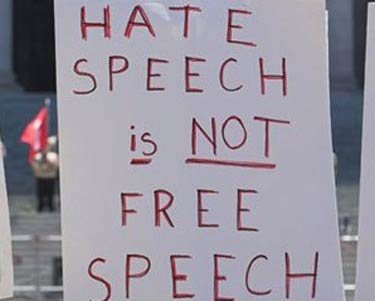
Mark Steyn identifies recent landmarks in the International Left’s gradual elimination of free speech.
These days, pretty much every story is really the same story:
In Galway, at the National University of Ireland, a speaker who attempts to argue against the BDS (Boycott, Divestment and Sanctions) programme against Israel is shouted down with cries of ‘Fucking Zionist, fucking pricks… Get the fuck off our campus.’
In California, Mozilla’s chief executive is forced to resign because he once made a political donation in support of the pre-revisionist definition of marriage.
At Westminster, the House of Commons Science and Technology Committee declares that the BBC should seek ‘special clearance’ before it interviews climate sceptics, such as fringe wacko extremists like former Chancellor Nigel Lawson.
In Massachusetts, Brandeis University withdraws its offer of an honorary degree to a black feminist atheist human rights campaigner from Somalia.
In London, a multitude of liberal journalists and artists responsible for everything from Monty Python to Downton Abbey sign an open letter in favour of the first state restraints on the British press in three and a quarter centuries.
And in Canberra the government is planning to repeal Section 18C — whoa, don’t worry, not all of it, just three or four adjectives; or maybe only two, or whatever it’s down to by now, after what Gay Alcorn in the Age described as the ongoing debate about ‘where to strike the balance between free speech in a democracy and protection against racial abuse in a multicultural society’.
I heard a lot of that kind of talk during my battles with the Canadian ‘human rights’ commissions a few years ago: of course, we all believe in free speech, but it’s a question of how you ‘strike the balance’, where you ‘draw the line’… which all sounds terribly reasonable and Canadian, and apparently Australian, too. But in reality the point of free speech is for the stuff that’s over the line, and strikingly unbalanced. If free speech is only for polite persons of mild temperament within government-policed parameters, it isn’t free at all. So screw that.
But I don’t really think that many people these days are genuinely interested in ‘striking the balance’; they’ve drawn the line and they’re increasingly unashamed about which side of it they stand. What all the above stories have in common, whether nominally about Israel, gay marriage, climate change, Islam, or even freedom of the press, is that one side has cheerfully swapped that apocryphal Voltaire quote about disagreeing with what you say but defending to the death your right to say it for the pithier Ring Lardner line: ‘“Shut up,†he explained.’