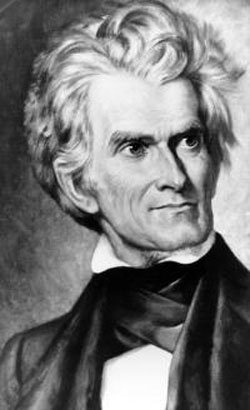
John Caldwell Calhoun; Y’ 1804; Vice President of the United States, 1825-1832; Secretary of State, 1844-1845; Secretary of War, 1817-1825; Senator from South Carolina, 1832-1843 and 1845-1850; Member House of Representatives representing 6th District of South Carolina, 1811-1817; Author, Disquisition on Government (1849), Discourse on the Constitution and Government of the United States (1851); defender of States’ Rights and proponent of the “Concurrent Majority” doctrine holding that minorities ought to have the right in extremis to block majority rule; and member of the all-time Great Triumvirate of the U.S. Senate.
1) Calhoun College stays Calhoun College.
Yale President Salovey announced yesterday afternoon, the Oldest College Daily reported, that the residential college named for Yale’s greatest political thinker and statesman would retain its name, despite John C. Calhoun having held, in the first half of the 19th century, positions on Slavery and inherent Racial Inferiority generally regarded with abhorrence today.
Salovey justified this decision on the part of the Administration and the Corporation, saying:
Removing Calhoun’s name obscures the legacy of slavery rather than addressing it. Erasing Calhoun’s name from a much-beloved residential college risks masking this past, downplaying the lasting effects of slavery and substituting a false and misleading narrative, albeit one that might allow us to feel complacent or, even, self-congratulatory.â€
I suspect that, unreported, unacknowledged, and unsung, somewhere in the decision-making meeting rooms in Woodbridge Hall a dramatic last stand was taken by someone on behalf on history, tradition, and sanity, and that there must have been some terrible threat of a grand financial legacy being withheld were Calhoun’s name to be removed.
——————————–
Master’s House, Trumbull College
2) The Title of “Master” of a Residential College Will Be Changed to “Head.”
The use of “master†as a title at Yale is a legacy of the college systems at Oxford and Cambridge. The term derives from the Latin magister, meaning “chief, head, director, teacher,†and it appears in the titles of university degrees (master of arts, master of science, and others) and in many aspects of the larger culture (master craftsman, master builder). Some members of our community argued that discarding the term “master†would interject into an ancient collegiate tradition a racial narrative that has never been associated with its use in the academy. Others maintained that regardless of its history of use in the academy, the title—especially when applied to an authority figure—carries a painful and unwelcome connotation that can be difficult or impossible for some students and residential college staff to ignore.
Among the many comments considered on this matter, the thoughts and recommendations of the current Council of Masters, the twelve heads of the existing residential colleges, were especially salient. The council deliberated at length, informed by a multitude of discussions with students, staff, faculty, and fellows, as well as by reflections submitted to an online site open to all members of each residential college community. The council also monitored similar discussions at other colleges and universities, although its members were determined to arrive at their recommendations bearing in mind Yale’s distinctive traditions and culture.
The council found that making a recommendation to change the title was far from simple. People held a wide range of views, not as strongly correlated as some might have predicted with circumstances of age, race, or position in the college community. Nothing about the term itself is intrinsically tied to Yale’s history prior to 1930, or to the relationships that students of each generation have formed or will form with the individuals who lead their colleges. Moreover, a decision to stop using the term “master†does not compromise the study of larger historical issues. In short, the reasons to change the title of “master†proved more compelling than the reasons to keep it, and the current masters themselves no longer felt it appropriate to be addressed in that manner.
Not incidental to the discussion was the task of finding an alternative title that speaks to the definition and responsibilities of the office. In this respect, “head of college†is the most logical and straightforward choice. In its favor is that archival records show that “head†and “headship†were placeholders for the title in the original planning documents. Heads of college may be addressed as professor, doctor, or Mr. or Ms., as applicable or as they prefer.
Alumni, particularly those of Calhoun College, actually cared about their college’s name being changed. Nobody particularly cared about the Master title, so Master was obviously the perfect sacrifice to fling upon the PC bonfire to appease the mob.
Yalies tend to be pedantic and good at research, so one does wonder why Peter Salovey and his powers-that-be confreres did not trouble themselves to consider “Warden,” “Rector,” or even “President” (as at Magdalen College, Oxford), but instead followed sheepishly along in the lame footsteps of Harvard and Princeton in changing that title to “Head.” It rankles, I think, that the pathetic creature occupying the chair in which John Hersey once sat, set the contemptible policy which the entire set of residential college will be proceeding to follow.
——————————–
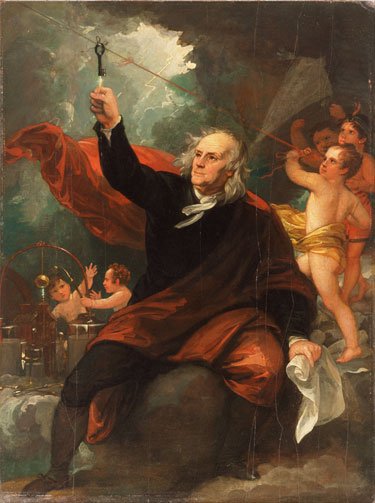
Benjamin West, Benjamin Franklin Drawing Electricity from the Sky, 1816, Philadelphia Museum of Art
3. The new residential colleges will be named for Benjamin Franklin and Pauli Murray (whoever the hell she is).
Peter Salovey explained:
Benjamin Franklin College will recognize the recipient of a Yale honorary degree (1753 Hon. M.A.) whose immense accomplishments span the arts, the sciences, government, and service to society. The 41 published volumes of his papers, which contain the record of Benjamin Franklin’s life correspondence, are among the Yale University Library’s most important collections. The Franklin Papers represent the work of many Yale scholars and editors and, among the historical insights they offer, shed light on Franklin’s relationship with Yale University. He carried on a decades-long correspondence with Yale President Ezra Stiles on subjects ranging from scientific research to the growing collections of Yale’s library.
John Adams, I guess, would have disagreed with this choice. He said of Dr. Franklin, in a 1783 letter to James Warren: “His whole life has been one continued insult to good manners and to decency.â€
But most of us today are nowhere nearly as censorious of Franklin’s illegitimate son and illegitimate grandson or of Franklin’s (1747) The Speech of Polly Baker, defending a fictional woman for bearing illegitimate children.
Franklin’s accomplishments in literature and scientific experiments and as a founder of the United States are so great that nobody could deny his worthiness as the namesake of a college.
The only problem is that he really had no genuine substantive connection to Yale.
Apparently, what really went on here was was explained in a letter from Salovey:
[A]dopting his name for one of the new colleges, we honor as well the generosity of Charles B. Johnson ’54 B.A., who considers Franklin a personal role model. Mr. Johnson’s contribution to enable the construction of the new colleges is the single largest gift made to Yale. Pauli Murray College and Benjamin Franklin College, which will open Yale’s doors to thousands of additional future students, would not have been possible without his philanthropic vision.
Money talks. It isn’t really appropriate, but the man paid for the piper, so he gets to call the tune. It could be worse. We could have a residential college named “Pforzheimer.”
——————————–
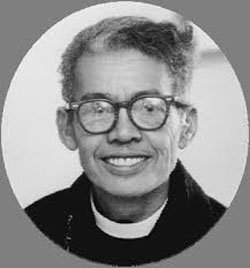
Anna Pauline “Pauli” Murray, Y ’65 J.S.D., ’79 Hon. D.Div., four-fer, maybe five-fer
The northern-most college, sited closest to Science Hill, Pauli Murray College will honor a Yale alumna (’65 J.S.D., ’79 Hon. D.Div.) noted for her achievements in law and religion, and for her leadership in civil rights and the advancement of women. Pauli Murray enrolled at Hunter College in the 1920s, graduating in 1933 after deferring her studies following the Great Depression. Later, she began an unsuccessful campaign to enter the all-white University of North Carolina. Murray’s case received national publicity, and she became widely recognized as a civil rights activist.
A graduate of Howard Law School, Murray had an extraordinary legal career as a champion of racial and gender equity. United States Supreme Court Justice Thurgood Marshall cited her book, States’ Laws on Race and Color, for its influence on the lawyers fighting segregation laws. President John F. Kennedy appointed her to the Committee on Civil and Political Rights of the President’s Commission on the Status of Women.
Awarded a fellowship by the Ford Foundation, Murray pursued a doctorate in law at Yale in order to further her scholarly work on gender and racial justice. She co-authored Jane Crow and the Law: Sex Discrimination and Title VII, in which she drew parallels between gender-based discrimination and Jim Crow laws. In 1965, she received her J.S.D. from Yale Law School, the first African-American to do so. Her dissertation was entitled, Roots of the Racial Crisis: Prologue to Policy. Immediately thereafter, she served as counsel in White v. Crook, which successfully challenged discrimination on the basis of sex and race in jury selection. She was a cofounder, with thirty-one others, of the National Organization for Women.
Murray was a vice president of Benedict College in Columbia, South Carolina; she left to become a professor at Brandeis University, where she earned tenure and taught until 1973. She was the first person to teach African-American studies and women’s studies at Brandeis.
The final stage of Murray’s career continued a life marked by confronting challenges and breaking down barriers. At age 63, inspired by her connections with other women in the Episcopal Church, she left Brandeis and enrolled at the General Theological Seminary. She became the first African-American woman ordained as an Episcopal priest..
And you’ve got to hand it to Salovey, the Yale Administration, and the Corporation. When they set out to truckle and to pander to contemporary whiny left-wing identity groups, they do it good and proper. Obviously, in reality, there are no females, there are no African-Americans associated with Yale so eminent or of such accomplishment as to be even close to being genuinely worthy of being the namesake of a Yale College. Hilariously, as well, nobody outside the organized left has ever actually heard of Pauli Murray but, upon looking her up, one finds that, if you are going to pander, she is the cat’s pajamas. Pauli Murray was merely a minor left-wing public nuisance and lived and died in obscurity, but she combines in one small dusky package absolutely everything: she was female, African-American, queer, an Episcopalian priestess, and a transgender wannabee. What a deal! Let’s hope Yale, in future, treats Murray College as its own equivalent of California, and sends all of its commies, fruits, and nuts to go live there at the remote extremity of the campus.
Roofline of Berkeley College Master’s House at Yale. Don’t you love those Tudor chimneys?
The Oldest College Daily happily reports that Yale is currently well along in the process of following the examples set by Harvard and Princeton in eliminating the title of Master for the heads of undergraduate residential colleges or houses.
Apparently, a majority of current students have gradually fallen into line in support of the demands of the radical lunatic fringe that the title be changed. In their wake, hastening to come on board, can be found the actual adults making up both the Yale Administration and the Yale Corporation.
A small racially-obsessed group of leftists, quite recently, decided that 150 years after the elimination of Slavery in the United States, it must be actively painful and humiliating for students-of-color to have occasion to address a head of college as “Master.” The memories and associations, you see, are just too painful. (sob!)
At Yale, the nonsense started last year, when the current Master of Pierson College, a hyper-sensitive creep named Stephen Davis found his new title unacceptable, and sent a letter to the college urging students to eschew tradition and address him merely as “Dr.” or “Professor” Davis.
One has to bear in mind that the title of Master has nothing whatsoever to do with Antebellum Slavery. It has everything to do with Anglophilic tradition and Pretension.
19th century Yale students were members of a single college (Yale College) or (if banausic) of the Sheffield Scientific School. The poor lived off-campus in rented hovels, the better-off in rooms in college residential buildings called “halls,” then much resembling architecturally orphanages or reformatories.
Where the Master business came from was via the philanthropy of Edward Harkness, a member of the Class of 1897. Harkness was the scion of a Standard Oil fortune. He had money like God has money, and cheerfully volunteered to pay for the transformation of both Harvard and Yale into residential colleges, i.e., fantasy imitations of the colleges at Oxford and Cambridge Universities, designed at Yale by his classmate James Gamble Rogers. Yale’s student body was divided among ten (later twelve) residential college and its grim Victorian architecture was augmented by a new campus of whimsical Tudor and Georgian design.
The heads of Yale residential colleges and Harvard houses were called “Masters” in pure imitation of the practice of the majority of Oxbridge Colleges. Master, in this case, is a purely academical title, an anglicized version of the Latin “Magister.” It has no connection to Slavery. Nor does it imply domination of anything. A College Master at Yale has traditionally been a distinguished senior faculty member who lives in a mansion associated with a residential college and who functions essentially as that college’s master of ceremonies. The College Master is formally administrative head of the college, but he has a Dean and a bunch of secretaries and student aids to do all the shit work. The Master smiles at students, presides over functions, throws parties, and thinks up new, nice things he can do for the benefit of the undergraduates in his college.
There would be no opportunity for this particular politically correct grand gesture today, of course, had the presidents of Yale and Harvard in the early 1930s possessed crystal balls. They would then have foreseen all this, and taken care to call heads of residential colleges (or houses) “Rector” instead (as is the practice at Exeter College, Oxford and King’s College, Cambridge) or “Warden” (All Souls College, Oxford and Robinson College, Cambridge). Upon reflection, though, having to address the head of one’s housing unit as “Warden” could very possibly also have become a major issue for contemporary Ivy League students-of-color.
The Yale Administration recently piously removed three portraits of the former Vice President for whom one of Yale’s twelve residential colleges had been named for most of a century. John C. Calhoun’s first-half-of-the-19th-century defense of Slavery has been found to offend the amour propre of Yale students of servile descent, admitted typically on the basis of special favoritism.
In response to a little arm-twisting by Barack Obama’s radical-packed DOJ, Yale has adopted preposterously-expansive definitions of sexual misconduct stretching well beyond what the DOJ crazies demanded, created its own Inquisitorial system for sniffing out offenders, and has a bureaucracy publishing annual reports detailing the minutiae of the Sexual Reign of Terror at Yale.
I feel bound to remark: the atmosphere between girls and boys was a lot pleasanter and less stressful back in my day.
Peak warmism has already hit and the global warming movement is now on its long glide path through loss of government funding, budget and hiring cuts, less media attention, on the way to unfashionability, embarrassment, and eventually obscurity, a historical footnote like phrenology.
Business Insider reports that the crybullies at Yale have successfully driven away the Silliman College Associate Master who provoked mass demonstrations and hysterical confrontations between screaming snowflakes of color and Yale administrators by having the temerity to question an edict demanding Halloween costume self-censorship issued by the Yale cultural centers’ collective politburo.
Erika Christakis, the faculty member at the center of a racially charged debate at Yale, has decided not to teach at the Ivy League school going forward.
“I will not be teaching at Yale in the future,” she told Business Insider in an email Thursday.
Christakis’ decision came after weeks of backlash against the lecturer and administrator over an email she sent to students suggesting that Yale shouldn’t tell them not to wear offensive Halloween costumes.
That backlash included an open letter criticizing her signed by hundreds of members of the Yale community.
Recently, 49 faculty members wrote their own open letter defending Christakis against allegations of racism.
Douglas Stone, a colleague who wrote the open letter, told Business Insider that “aggressive tactics” used against Christakis spurred her to decide to stop teaching.
“Last year over 300 students expressed interest in her courses, she is an acclaimed teacher, and she was planning extra sections this year to accommodate more students,” Stone wrote Business Insider in an email message. “The unfair and ad hominem attacks she has endured have measurably reduced student academic choice at Yale. There is a cost to allowing this behavior to go unchallenged.”
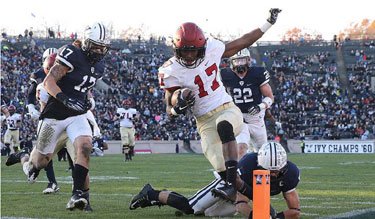
Harvard had more points but we had a more diverse defensive line. Does that mean we won?”
Reply:
“Yes. Because that diverse line didn’t inhibit Harvard’s freedom of expression and opposition to our view they should not score more points than us and win, but was allowed to express and implement that point of view at will with almost no resistance from us.”
Ross Douthat obviously does not agree with the crybullying of today’s radicalized college students, but he recognizes that it was the same academic establishment they are insulting and revolting against which made the corrupt bargain with the revolutionary left that is responsible for the presence of the toxins within the national educational system which produced the current infatuated mobs howling at their doors. There are the crazed students, heads full of Marxist agitprop, filled with passionate intensity confronting the empty-headed and empty-hearted liberals who never believed there could be such a thing as an enemy to the left.
The protesters at Yale and Missouri and a longer list of schools stand accused of being spoiled, silly, self-dramatizing — and many of them are. But they’re also dealing with a university system that’s genuinely corrupt, and that’s long relied on rote appeals to the activists’ own left-wing pieties to cloak its utter lack of higher purpose.
And within this system, the contemporary college student is actually a strange blend of the pampered and the exploited.
This is true of the college football recruit who’s a god on campus but also an unpaid cog in a lucrative football franchise that has a public college vestigially attached.
It’s true of the liberal arts student who’s saddled with absurd debts to pay for an education that doesn’t even try to pass along any version of Matthew Arnold’s “ best which has been thought and said,†and often just induces mental breakdowns in the pursuit of worldly success.
It’s true of the working class or minority student who’s expected to lend a patina of diversity to a campus organized to deliver good times to rich kids whose parents pay full freight. And then it’s true of the rich girl who discovers the same university that promised her a carefree Rumspringa (justified on high feminist principle, of course) doesn’t want to hear a word about what happened to her at that frat party over the weekend.
The protesters may be obnoxious enemies of free debate, in other words, but they aren’t wrong to smell the rot around them. And they’re vindicated every time they push and an administrator caves: It’s proof that they have a monopoly on moral spine, and that any small-l liberal alternative is simply hollow.
Or as the great Walter Sobchak might have put it: “Say what you want about the tenets of political correctness, Dude, at least it’s an ethos.â€
Which might turn out to be the only epitaph for the modern university anybody needs to write.
On a Ricochet podcast (requires subscription), Rob Long captures the current situation on campus in a nutshell: “It’s like the Barney the Dinosaur version of Orwell.”
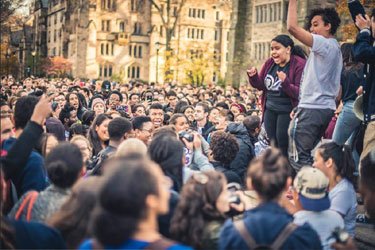
At close to midnight on Thursday night, roughly 200 students marched to University President Peter Salovey’s home on Hillhouse Avenue under a new name — Next Yale — wielding a new set of demands.
The students said the new movement will hold Yale accountable to its students of color and that a diverse coalition of students crafted the new demands. …
Salovey told the News that University leaders will “seriously†review the new set of demands and reiterated that a response to them will be issued next week.
Salovey said he considers the manner by which the students delivered the demands entirely acceptable and in compliance with University policy.
“This was a peaceful group of students visiting me at my home at a somewhat late hour, completely consistent with University protest policy,†he said.
Next Yale’s six demands each involved several parts. The first, which focuses on ethnic studies, demands that all Yale undergraduates be required to fulfill an ethnic studies distributional requirement and that the Ethnicity, Race and Migration Program be given departmental status immediately.
The second demand centered on mental health services, a topic that has been prominent in campus discussions and forums over the past two weeks. Next Yale calls for the University to hire mental health professionals in each of the four cultural centers, as well as increased mental health professionals of color at Yale Mental Health and Counseling.
Another demand asked for an increase of $2 million to the current annual operating budget of each cultural center, as well as five full-time staff members for each.
The students also demanded that Calhoun College be renamed and that the two new residential colleges be named after people of color. Under this demand, they also asked for the abolishment of the title “master†and the building of a monument on Cross Campus to acknowledge that Yale was founded on stolen indigenous land.
After the gathering, Salovey told the News that decisions about renaming and naming residential colleges fall under the domain of the Yale Corporation, the governing board and policy-making body for Yale.
The fifth demand, directly addressing recent racial controversies on campus, called for the removal of Nicholas and Erika Christakis from their administrative positions. The final demand focused on allocating resources to support the physical well-being of international, first-generation, low-income and undocumented students.
————————————-
Robert Long, at Ricochet, looks on the bright side of all this.
At Yale, a group of students has exploited their overseers’ weak and pathetic need to appear “inclusive†and “nurturing†and “safe.†We’ve all seen the pictures: thoughtful and intellectually accomplished professors and administrators begging their charges for forgiveness, covering themselves in shame and remorse, confessing to all sorts of crimes and shortcomings. …
[P]retty impressive for a group of students at one of the most elite universities in the world. Think of the exams they’ve been able to get cancelled! Think of the late term papers that won’t be penalized!
Let’s total up the life skills on display here: 1. brilliant use of financial leverage; 2. exploiting an opponent’s weakness and cowardice; 3. remorselessly demanding that heads roll; 4. and here’s the best one: Doing it all on someone else’s dime!
I don’t know about you, but those seem like some pretty impressive life and business skills. I don’t know about you, but if I were a college recruiter from, say, Goldman Sachs, I’d have to say that these are exactly the skills I’m looking for.
Economics, financial statistics, that sort of thing you can learn in a webinar. But an instinct for blood and power? That’s some powerful innate stuff right there.
My advice? Hire those brats. Hire them at Goldman and JP Morgan Chase and Cravath. Pay them really well the first year in order to get them hooked on being members of the power elite — there’s nothing that shakes off progressive ideology like a fat end-of-year bonus — and watch those killer instincts go into motion.
Just make sure to stay on their good side. You wouldn’t like to see them angry.
Fifteen minutes of fame have been awarded to Yale’s own “Shrieking Girl”, Silliman senior and Master’s aide Jerelyn Luther, who hails from nearby affluent, suburban Fairfield, Connecticut.
I was amused myself at just how rapidly Yale loudest tricoteuses, editorialist Jencey Paz of the Yale Herald, “who did not want to debate, but only wanted to talk about her pain,” and Jerelyn Luther, who told Silliman Master Christakis to “shut up” and demanded that he resign, when they found that their publicly-taken positions had become widely-discussed news items, removed their presences on the web, retreated from the national stage, and went instantly into hiding. So much for the courage of their convictions.
It’s no accident that people wedded to fabulously-self-indulgent, paranoid, and hysterical posturing feel that they need “safe spaces” where no analysis of or dissent from their nonsense is permitted in order to spout off.
I had predicted to my wife that any young lady so obviously extraordinarily spoiled and self-infatuated, with no manners and no respect for her elders and university officials, would be found inevitably to have come, not The Hood, but from some especially comfortable enclave of upper middle class privilege.