
06 Apr 2021
Matt Taibbi on “Content Moderation”
Big Tech Censorship, Free Speech, Mainstream Media, Matt Taibbi


Matt Taibbi is still a man of the Left, but he wasn’t Woke enough for Rolling Stone, so being a victim of Cancel Culture himself, he’s basically on the right side on Free Speech and Censorship at the hands of Establishment Media and Big Tech. Here’s his latest:
For blue-leaning audiences, news that companies like Facebook and Google had begun shutting down or de-ranking accounts in ways we’d never seen before was, to my initial shock, mostly perceived as a good thing. In the wake of Trump’s election, many Democrats believed something had to be done about “fake news,” Russian trolls, and, especially, inflammatory right-wing speech.
Polls showed 40% of millennials believed the government should be allowed to limit speech offensive to minorities, a number significantly higher than the one for either Baby Boomers (23%) or GenXers (27%). If those levels of support among younger voters existed for outright government censorship, how would that audience ever be convinced to care about private companies zapping political accounts?
The issue was such a non-starter with younger, blue-leaning audiences that when I did a feature about Facebook’s 2018 purges of so-called “inauthentic” accounts, Rolling Stone headlined the piece, “Who Will Fix Facebook?”, as if to disguise what the story was actually about. (I got letters from disappointed readers who’d been drawn in by the headline, hoping to read a story demanding that Facebook wipe out more right-wing/conspiratorial content). After the expulsion of Alex Jones and Infowars from Apple, Facebook, Google, and Spotify, it seemed many younger readers didn’t see a problem with increased content moderation. If anything, Silicon Valley didn’t remove enough obnoxious content.
Conservative readers from the start have been significantly more unnerved by the content moderation movement, for the obvious reason that most higher-profile targets of tech crackdowns have been right-wing figures. After years of decisions like kicking Donald Trump off Twitter, suspending or banning figures like James Woods and Milo Yiannopoulis, and intervening to block access to the New York Post’s expose on Hunter Biden, the censorship issue in conservative media has usually been pitched as being a problem exclusive to them.
After the Hunter Biden story was blocked, Republican politicians like Mississippi Senator Roger Wicker and Colorado’s Cory Gardner hauled tech CEOs to Washington to face accusations of “bias.” At the much-covered hearing in October, Wicker railed at Twitter CEO Jack Dorsey. “Mr. Dorsey, your platform allows foreign dictators to post propaganda, typically without restriction,” he said, “yet you typically restrict the president of the United States.” Read the rest of this entry »
05 Apr 2021
Tweet of the Day
Hunter Biden, Joe Biden, Twitter
Hunter Biden said he smoked Parmesan cheese thinking it was crack.
Joe Biden said that Hunter is the smartest person he knows.
I’ll just leave that one right there..
— Catturd ™ (@catturd2) April 5, 2021
05 Apr 2021
Doors of the Pantheon
Architecture, Hadrian, Pantheon, Rome
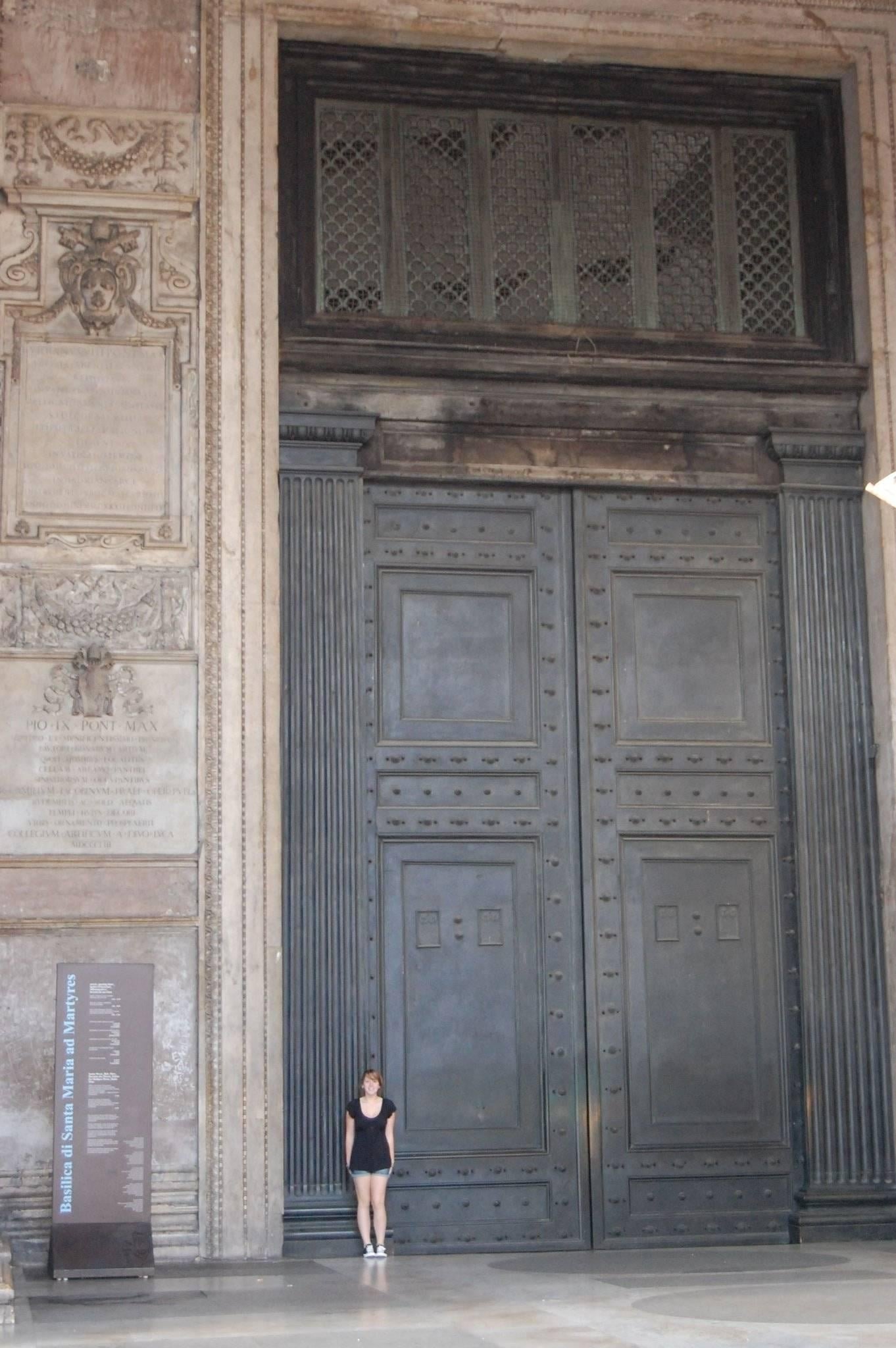
“The oldest doors still in use in Rome. Cast in bronze for emperor Hadrian’s rebuilding, they date from about 115 AD.
Each door is solid bronze seven and a half feet wide & twenty-five feet high, yet so well balanced they can be pushed or pulled open easily by one person.
Becky for scale.”
HT: Kimball Corson.
Wikipedia Pantheon article.
05 Apr 2021
“Roman Authorities Investigating Jesus For Violating Stay-In-Tomb Order”
Babylon Bee, COVID-19, Easter, Satire
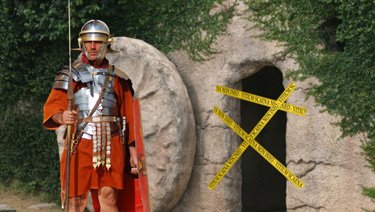
JERUSALEM—Roman authorities are investigating controversial religious leader Jesus of Nazareth for violating the Empire’s clear “stay in tomb” order. After crucifying him and laying him in the tomb, Roman guards put Him under strict orders to stay there and not come back, rising victorious over sin and death.
But Jesus, answering to a higher authority, refused to stay dead and busted out of the tomb, establishing a kingdom that would never end — again, in clear violation of the government’s orders.
“Jesus is a dangerous rebel, refusing to bend the knee to Caesar and not abiding by the law of sin and death,” said one Roman official. “He clearly broke the law by leaving the tomb, and we’re going to be issuing a citation and placing him under mandatory quarantine for these crimes.”
05 Apr 2021
Let me die a youngman’s death
Poetry, Roger McGough, The Right Stuff

Let me die a youngman’s death
Let me die a youngman’s death
not a clean and inbetween
the sheets holywater death
not a famous-last-words
peaceful out of breath death
When I’m 73
and in constant good tumour
may I be mown down at dawn
by a bright red sports car
on my way home
from an allnight party
Or when I’m 91
with silver hair
and sitting in a barber’s chair
may rival gangsters
with hamfisted tommyguns burst in
and give me a short back and insides
Or when I’m 104
and banned from the Cavern
may my mistress
catching me in bed with her daughter
and fearing for her son
cut me up into little pieces
and throw away every piece but one
Let me die a youngman’s death
not a free from sin tiptoe in
candle wax and waning death
not a curtains drawn by angels borne
‘what a nice way to go’ death
— Roger McGough
HT: Vanderleun.
————–
Personally, I think John Buchan imagined “the best death” even better in his 1900 novel, “The Half-Hearted.”
04 Apr 2021
Easter
Easter, History, Traditions
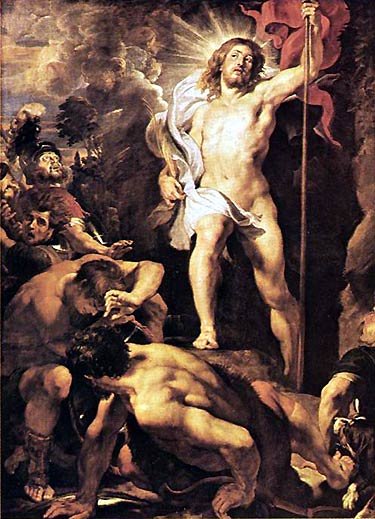
Peter Paul Rubens, The Resurrection of Christ, 1611-1612, Vrouwekathedraal, Antwerp
From Robert Chambers, The Book of Days, 1869:
Easter
Easter, the anniversary of our Lord’s resurrection from the dead, is one of the three great festivals of the Christian year,—the other two being Christmas and Whitsuntide. From the earliest period of Christianity down to the present day, it has always been celebrated by believers with the greatest joy, and accounted the Queen of Festivals. In primitive times it was usual for Christians to salute each other on the morning of this day by exclaiming, ‘Christ is risen;’ to which the person saluted replied, ‘Christ is risen indeed,’ or else, ‘ And hath appeared unto Simon;’—a custom still retained in the Greek Church. Easter retains many religious customs today but there are also many commercial aspects to the holiday. The Easter bunny, Easter candy and Easter baskets are all part of the celebration. Giving Easter baskets filled with candy is a joyous family activity, but it is important to remember the true meaning of the Easter holiday. Read the rest of this entry »

02 Apr 2021
A Bit of History From Our Mississippi House
Cedarhurst, Civil War, Earl Van Dorn, History, Mississippi, Sherwood Bonner, Ulysses Grant

“Cedarhurst”.
A neighbor forwarded a newspaper item involving some of our new house’s Civil War history.
Grant occupied Holly Springs in late November or early December of 1862. He made the town his new supply base for the Siege of Vicksburg.
On December 18th, Confederate General Earl Van Dorn raided the Union base at Holly Springs with 3500 cavalry, capturing 1500 Union troops and burning Grant’s supplies.
Lacking supplies, Grant was compelled to retreat for a time, and Vicksburg remained uncaptured until the following July.
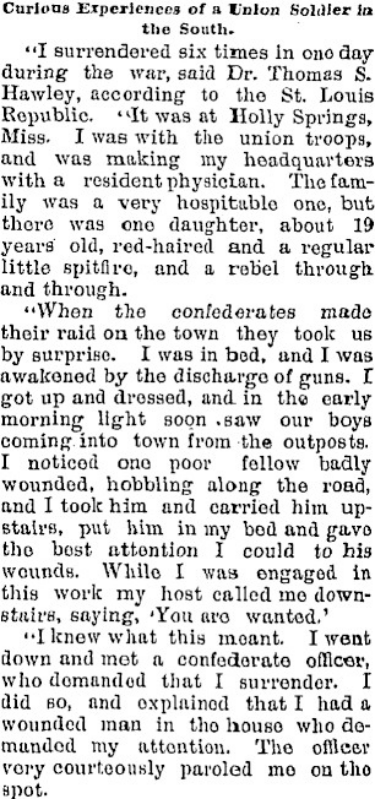
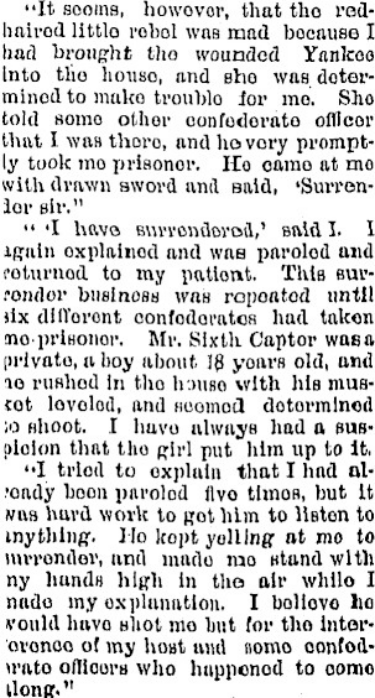
The fiery rebel was Catherine Sherwood Bonner, who later became secretary and muse to Henry Wadsworth Longfellow and a successful novelist and regional author in her own right.

Many thanks to Bobby Mitchell!
31 Mar 2021
Cedarhurst’s Kitchen & Servants’ Quarters Will Be Next
Cedarhurst, History, Mississippi, National Park Service

National Park Service Team
Our neighbor in Mississippi, Phillip Kyle Knecht yesterday posted on Facebook:
“For the last week, a team from the National Park Service’s National Center for Preservation Technology and Training has been in Holly Springs, documenting and scanning various extant slave quarters, slave cabins and tenant/sharecropper housing. The team used a really fancy 3D laser scanner, that will create 3D images of the exterior and interior of these structures. Eventually, they will be able to create “virtual reality” tours of these structures.
Thank you to the members of the team, Isabella Jones, Sreya Chakraborty, and Ina Sthapit, for coming to town and performing this invaluable service. Thank you also to Pam Zelman, with Preserve Marshall County and Holly Springs, Inc., who did much of the heavy lifting locally, arranging access to all of these sites. Thank you to the homeowners who graciously opened their doors to the team. I acted as a sort of local historical advisor at a few of their stops. Chelius Carter, with PMCHS, was instrumental in getting the team to town, and allowed the team to stay in the Hugh Craft House.
The team has a few more stops before they leave town on Friday, so if you see them around, welcome them to town! This is really important historical and preservation work.”
Our new home, Cedarhurst, has the old Antebellum kitchen and servants’ quarters in the backyard, remodeled in recent years with little architectural regard, alas! into an auxiliary apartment.
Karen contacted the Park Service team, and they are going to survey the Cedarhurst kitchen next!


30 Mar 2021
Nice Object
Antiquities, Auction Sales, Christie's, Leopard
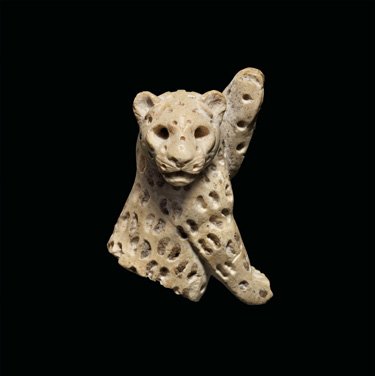
I receive a lot of email notices of auction sales. This morning an email circular from Christie’s had this fragment of a leopard serving as the illustration at the top. I liked it enough that I decided to look, unlikely as the chance would be, just in case it might be selling for only a few hundred dollars. I thought Karen would enjoy owning it as a decorative bibelot.
Clicking on the image, though, only took me to a sanctimonious pledge about carbon neutral auctioneering. Pah!
So I decided to capture the image and give it a search.
And I found it, as you see below.
I must admit: I have expensive tastes.
———————————————–
Via Alain R. Truong:
Lot 33. A Mesopotamian inlaid limestone leopard, Late Uruk – Jemdet Nasr period, circa 3300-2900 B.C.; 2 ¼ in. (5.8 cm.) high. Estimate GBP 150,000 – GBP 250,000. Price realised GBP 212,500.
Provenance: Private collection, New York, 1960s.
with Mathias Komor, New York.
Leo Mildenberg (1913-2001) collection, Zurich, acquired from the above in the mid-1970s.
A Peaceable Kingdom: The Leo Mildenberg Collection of Ancient Animals; Christie’s, London, 26-27 October 2004, lot 153.
Exhibited: The Cleveland Museum of Art, Animals in Ancient Art from the Leo Mildenberg Collection, 21 October-29 November 1981.
Munich, Prähistorische Staatssammlung; Mannheim, Reiss-Museum; Jerusalem, Bible Lands Museum; Bonn, Akademisches Kunstmuseum; Stendal, Winckelmann-Museum, Out of Noah’s Ark: Animals in Ancient Art from the Leo Mildenberg Collection, 11 October 1996-28 June 1999.
Published: A. P. Kozloff, ed., Animals in Ancient Art from the Leo Mildenberg Collection, Cleveland, 1981, no. 2.
P. E. Mottahedeh (ed.), Out of Noah’s Ark, Animals in Ancient Art from the Leo Mildenberg Collection, Bible Lands Museum, Jerusalem, 1997, no. 91.
Note: This Sumerian leopard with a ‘beauty spot’ (the remains of an ‘Egyptian blue’ inlay) on his cheek was affectionately named “Omar” by Mildenberg after the film star, Omar Sharif.
Only the upper section of the leopard is preserved, finely carved in the round in the heraldic rampant pose. While the body is shown in profile, the head is turned towards the viewer, snarling.
The mottling of the fur is rendered with a series of drilled holes, once inlaid with Egyptian blue (of which only one survives). The use of this typically Egyptian pigment is documented in Egypt from the Predynastic period, while contemporaneous similar-looking blue stones in Mesopotamia have been traditionally described as lapis lazuli. This single surviving inlay then represents one of the earliest appearances of Egyptian blue in the region.
According to Kozloff, the animal represented might be the Arabian leopard, now critically endangered and once found throughout the Arabian peninsula and the Sinai.
The use of coloured inlays to add detail to sculptures is well documented in Sumerian art. For a finely carved limestone bull showing drilled holes for now-lost inlays and also dated to the Jemdet Nasr Period, cf. Sumer. Assur. Babylone. Catalogue of the exhibition at the Musée du Petit Palais, 24 March – 14 June 1981, Paris, 1980, p. 38, no. 41.
Christie’s. Antiquities, London, 3 July 2019



