Michael Barone finds the Transatlantic elite response to its political defeats in 2016 is identical to the response of the Bourbons to the Revolution in France. They are determined to learn nothing and forget nothing.
It was no coincidence that Donald Trump scheduled a trip to Britain, purportedly to inspect one of his golf courses in Scotland, on June 23, 2016. That was the day of the Brexit referendum, in which 52 percent of the electorate — 17.4 million voters — voted for their nation to leave the European Union.
Candidate Trump’s earlier endorsement of Brexit was criticized by elevated opinion as an unfriendly interference in another nation’s internal affairs. Few if any of the scoffers had similarly criticized former President Barack Obama for urging Britons to vote “remain,” even threatening that if they voted “leave” they would go “to the back of the queue†in seeking a free trade deal with the United States.
Thirteen months before Trump’s trip and the British vote, few thought there was any possibility of a Trump candidacy or a Brexit referendum. The shock of Brexit in June and Trump’s victory in November has not been fully absorbed by British or American financial, media, and political elites in all the time since.
30 Democrats in Puerto Rico with 109 lobbyists for weekend despite shutdown
As the gifted British political analyst Douglas Murray writes in National Review, “Instead of accepting the votes and trying to learn from them, elites have expended almost all their available energies trying to pretend that voters in 2016 were bad or duped. The past two years could have been spent trying to learn something or build something. Instead, the best minds of Left and Right have spent their time making claims of ‘racism,’ ‘Russia,’ and ‘Cambridge Analytica.’â€
The unlearning continues. Here, the government (actually, less than one-quarter of the federal government) is “shut down†over Democrats’ resistance to Trump’s demand for funding the border wall — er, barrier — which he negligently failed for two years to obtain from the Republican-majority Congress.
Most Democratic politicians — and, polls show, many Democratic voters — favored border barriers before Trump’s victory. Now, they insist walls are “immoral†and ineffective.
Richard Fernandez is skeptical, but nonetheless willing to take the establishment’s Russian-conspiracy theory and run with it.
The outbreak of unrest [of the rebellion of the commons against the elites from Britain to France to the USA] … is so vast …. that the Washington Post had an op-ed explaining it: Putin at work. The hand of Russian collusion is seen everywhere. “From Brexit to NATO and the shutdown, Putin is winning so much he might get tired of winning,” it said.
We don’t know exactly how much Moscow spent supporting influence operations to impact the U.K. and U.S. elections in 2016, but it seems hard to overstate how good the Kremlin’s return has been on what Western intelligence agencies believe was a relatively modest investment.
Russian efforts to manipulate American voters during the last presidential campaign have been aggressively covered in this space, but the Kremlin’s bid to boost Brexit was perhaps even more brazen. The Democratic members of the Senate Foreign Relations Committee released a meaty report last week about Russian influence operations overseas, but it was entirely overshadowed by the latest bombshells stemming from special counsel Bob Mueller’s investigation. The 206-page report outlines Russian disinformation campaigns across 19 countries. It highlights loopholes in U.K. campaign finance laws that might have allowed an influx of Russian money to boost the referendum. That’s not to mention the propaganda from Russian-run Twitter and Facebook accounts, plus state-funded media.
It’s worldwide conspiracy. If anything the problem with the Mueller investigation is it is too small — like sending a rowboat after a megalodon. If the op-ed is right then they’re going to need a bigger special prosecutor. The alternative explanation for the perfect political storm now rocking the West is that a substantial number of people actually voted for Brexit, Donald Trump and are angry with the policies of Emmanuel Macron, reflecting some kind of global revolt by the Western ‘have nots’ against the ‘haves’.
This possibility was advanced by Glenn Reynolds writing in USA Today. “Donald Trump is a symptom of a new kind of class warfare raging at home and abroad.” It’s the Deplorables versus the New Class.
Yugoslav dissident Milovan Djilas called these party hacks the “New Class,†noting that instead of workers and peasants against capitalists, it was now a case of workers and peasants being ruled by a managerial new class of technocrats who, while purporting to act for the benefit of the workers and peasants, somehow wound up with the lion’s share of the goodies. …
But the New Class isn’t limited to communist countries, really. Around the world in the postwar era, power was taken up by unelected professional and managerial elites. To understand what’s going on with President Donald Trump and his opposition, and in other countries as diverse as France, Hungary, Italy and Brazil, it’s important to realize that the post-World War II institutional arrangements of the Western democracies are being renegotiated, and that those democracies’ professional and managerial elites don’t like that very much, because they have done very well under those arrangements. And, like all elites who are doing very well, they don’t want that to change.
Corporate advertisers traditionally flatter potential customers, assuring them with gratifying images that the mere choice of the given product proves that the customer is handsome, sophisticated, successful, desirable to beautiful women, capable of appreciating, and worthy of, the best things.
My own favorite examples would be Paul Gerding’s Duesenberg ads that ran in upscale magazines like Vanity Fair and The Sportsman in the 1930s.
But Pankaj Bhalla, Gillette brand director for North America, decided a different approach was needed to cement the company’s ties to Pabst-swilling, tattooed, and pussified millennial metrosexuals. (He seems not to have noticed that they are usually bearded.)
The shaving giant Gillette knew that its new ad addressing the #MeToo movement would be divisive. But the brand still went ahead with it hoping to appeal to future generations of customers.
The ad is part of a broader brand repositioning that turns Gillette’s 30-year-old tagline, “The Best a Man Can Get,” on its head, making it a call for men to take an inward look and placing the onus on them to be the best versions of themselves.
Pankaj Bhalla, the brand director for Gillette and Venus, called it “a statement of self-reflection” from the brand.
Gillette first started brainstorming the repositioning last spring, and it ran several qualitative tests before running it.
Gillette was well aware that its new ad would ruffle some feathers.
But it still went ahead with it because it felt it needed to reposition itself to continue to resonate with the next generation of its customers and wanted to leverage its position as a 117-year-old brand and a market leader to spark dialogue.
“We knew that this particular commercial would trigger a conversation,” Pankaj Bhalla, the brand director for Gillette and Venus, told Business Insider. “The idea was to get people thinking, because the belief was that good advertising does trigger a healthy debate.”
——————————
Skeptics are doubtless snapping up Unilever stock (owner of Dollar Shave Club), but there is, after all, nothing new under the sun.
Pankaj Bhalla, armed with a Bachelor degree (Hons.) in Commerce and Business Economics, 2000, from Hyderabad, and a Post Graduate Diploma in Brand Management from Ahmedabad, 2003, must have deduced that today’s rising generation in America resembles in some uncanny way the generation coming of age in New England in the 1740s, another time in which people desired not to be flattered and praised, but threatened and abused.
For his next Gillette commercial, I’d recommend that Grey Group consider adapting some of the text of this sermon delivered by Jonathan Edwards, Yale 1720, 8 July 1741 at Enfield, Connecticut:
[excerpt]
The God that holds you over the pit of hell, much as one holds a spider, or some loathsome insect over the fire, abhors you, and is dreadfully provoked: his wrath towards you burns like fire; he looks upon you as worthy of nothing else, but to be cast into the fire; he is of purer eyes than to bear to have you in his sight; you are ten thousand times more abominable in his eyes, than the most hateful venomous serpent is in ours. You have offended him infinitely more than ever a stubborn rebel did his prince; and yet it is nothing but his hand that holds you from falling into the fire every moment. It is to be ascribed to nothing else, that you did not go to hell the last night; that you were suffered to awake again in this world, after you closed your eyes to sleep. And there is no other reason to be given, why you have not dropped into hell since you arose in the morning, but that God’s hand has held you up. There is no other reason to be given why you have not gone to hell, since you have sat here in the house of God, provoking his pure eyes by your sinful wicked manner of attending his solemn worship. Yea, there is nothing else that is to be given as a reason why you do not this very moment drop down into hell.
O sinner! Consider the fearful danger you are in: it is a great furnace of wrath, a wide and bottomless pit, full of the fire of wrath, that you are held over in the hand of that God, whose wrath is provoked and incensed as much against you, as against many of the damned in hell. You hang by a slender thread, with the flames of divine wrath flashing about it, and ready every moment to singe it, and burn it asunder; and you have no interest in any Mediator, and nothing to lay hold of to save yourself, nothing to keep off the flames of wrath, nothing of your own, nothing that you ever have done, nothing that you can do, to induce God to spare you one moment.
Victor Davis Hanson marvels at how things have changed. Once upon a time, Americans of immigrant or minority background Americanized their names and whitened their skins and tried hard to pass as members of the American White Anglo-Saxon Protestant majority. Today, Barack Obama’s African identity won him the presidency, the Irish “Beto” O’Rourke pretended to be Hispanic in order to win a seat in the Senate, and Elizabeth Warren leveraged imaginary Cherokee blood into a Harvard professorship.
[I]n a multiracial society like ours no one is usually quite sure of any ancestry that he claims (ancestry companies run TV ads precisely on the notion that we will all be surprised by our DNA results). And when superficial appearance is no guarantee either of minority status (given that we have not yet established DNA badges or quite reestablished Old Confederate racial purity standards), almost anyone can say he is anyone he pleases. Nor is class much help, since thankfully it has become more or less divorced from race and ethnicity. (Most white deplorables and irredeemables did not grow up in upscale neighborhoods nor did they have educated parents like those of Harris and Ocasio-Cortez.)
Is race then becoming a mere construct that we put on and take off as though it were a suit of clothes? In our collective effort to create difference where it does not always exists, we would have to invent an Elizabeth Warren or Ward Churchill if they did not exist—given the perceived advantages of white suburbanites in gaining a part time minority cachet deemed advantageous in terms of career and psychological well-being.
How odd that our establishment insists that being “white†is synonymous with unearned “white privilege,†while millions of whites in job and college applications for decades have been trying to con fake minority-identities and while upscale minorities have no desire—even when intermarried, assimilated, and integrated into the majority culture—of emphasizing the partial white ancestry that is so frequently part of their heritage. The old idea of “passing†now means hoping to be tagged as non-white, not white. The effort is certainly similar to the lunatic racial obsessions of the past, but the conditions under which advantage is measured have flipped completely. ….
Minority identity has become a brand for the upper middle class in the manner of a luxury car. One strives to drive a Mercedes or Jaguar not because it is more reliable or even all that much more drivable than a Toyota or Honda, but because it signals a particular cachet. And so too wealthy suburbanites often find emphasizing non-white identities useful even if it means occasionally constructing them.
Most of the constructed identity movement is deeply embedded within progressive and identity politics of the Left. In our strange society, a Shaun King, who appears to be as white as his birth certificate seems to suggest, is considered a more authentic African-American than a conservative and quite darker Supreme Justice Clarence Thomas, who grew up in poverty and discrimination in the Jim Crow South and yet is often despised by progressives as inauthentic. ….
In the past, immigrants of all classes and backgrounds sought to identify as Americans and did so authentically, on the premise that one left one’s old country for a reason and had no wish to replicate its failures in a new and preferred homeland.
Now many immigrants and natives often wish to distance themselves from the perception of belonging to American majority culture—but many do so as inauthentically as their less well off forefathers once authentically sought to join it.
Bronze horse and rider, found in the sea off Cape Artemision. Late Hellenistic sculpture, National Archaeological Museum in Athens, Greece, 150-125 BC.
Eve Browning recommends reading Xenophon’s Anabasis, an all-time great military memoir coincidentally set in much the same territory that US troops also recently traversed.
The band of mercenary soldiers had been on the move through hostile territory for several months when they were told they had enlisted under a lie. They weren’t marching to put down a rebellion; they were instead marching in rebellion. Offers of special duty pay from their leader, Cyrus the Younger, however, calmed their anger and doubt, and on they advanced, dusty boots through the desert, as the heat of late-summer Persia rose around them in shimmering waves. The villages they passed by were hostile and strange: alien languages, customs, religions. There was little fresh water.
They has assembled under Cyrus in order to overthrow his brother and rival, Artaxerxes II, king of Persia. Before they reached his defensive line, they were harried on their flanks and from behind, depleting morale and using up their supplies. At a small village named Canaxa 50 miles north of Baghdad, they finally met the Persian king’s forces, on a day when the noon temperature could have fried a pork chop. As the battle began, Cyrus rashly charged Artaxerxes himself. He was pierced through by a javelin thrown by one of Artaxerxes’ guards, and died on the spot.
With heavy casualties and no reason to continue fighting, the mercenaries fell back. They were bleeding deserters. Those who had been recruited near Sardis and Smyrna, and who spoke some of the local languages, melted away. The remainders built camp and waited, parlayed, moved camp, skirmished, and waited some more. In the pitiless heat, now without communication or direction, they discussed their next moves with no particular conviction. After nearly a month of this, an envoy came: would their unit leaders please come to Artaxerxes’ tent and converse about their plans? The leaders agreed. The encamped troops waited for word on the parley. It was not until they saw Artaxerxes’ riders carrying the heads of their former leaders that the truth dawned on them. The campaign was lost. In order to survive, they must disperse.
So began this band of about 10,000 mercenaries’ two-year journey out of hostile country, from the heart of Persia to the shores of the Black Sea. Among the most important of the new leaders was a youngish Greek named Xenophon. By journey’s end, when he finally returned to Athens, Xenophon would have served the equivalent of six consecutive modern deployments and, like any modern soldier sent repeatedly into combat zones, he would be marked for life by what he experienced on that doomed expedition and the subsequent long march through winter mountains to the sea.
I read it recently myself (in the Greek, using a translation open on my knee for a trot) with considerable pleasure.
Xenophon, who also wrote treatises on Hunting and Horsemanship and Cavalry Tactics, was a gentleman who would have been right at home in a British Imperial regimental mess.
Just before the battle at Canaxa, Cyrus notices the Greek mercenaries whispering among themselves. The would-be-king becomes suspicious and asks Xenophon the Athenian: “What were they whispering about?”
“They were only exchanging the watchwords.” explains Xenophon.
“What were those?” inquires Cyrus.
“Zeus Soter kai Nike.” [Zeus the Savior and Victory!], Xenophon repies.
Zman is often just a rhetorically clever dispenser of self-flattering Alt Right delusions, but when he is right, he can nail it.
As a practical matter, so-called “third wave anti-racism†is really just a demand by non-whites that whites mitigate the realities of biology. They can’t say that so they have to use weird language and comical neologisms. The demand is that whites exhaust themselves maintaining a white bourgeois society, so that non-whites can enjoy first world comfort, without actually having to maintain it themselves. The new white man’s burden is whites living as despised helots in the societies they created.
For example, whites are supposed to solve the black crime problem, but not notice that black men commit a lot of crime. No one is supposed to mention that blacks don’t cooperate with police. The justification for the former is the history of racism, while the latter is excused as blacks not wanting to attract attention to the black community. Whites are supposed to work around the realities of the black community, while mitigating the realities of the black community. This is impossible and unreasonable.
Another example is how non-whites expect to be allowed into elite schools. In the name of diversity, the elite colleges decorate each class with vibrancy. The professors are expected to make sure these students graduate and never mention that they make up the bottom third of the class. Once out in the world, the process starts over as law firms hoover up non-whites to meet their diversity quota. Of course, no one is supposed to notice that these lawyers are not very good at being lawyers.
Then you have the central tenet of third wave anti-racism, which is that whites, just by being white, are a burden on non-whites. Because whites want the best for their kids and want to live in safe neighborhoods, it means they live in places without convenient bus service. This is a burden on non-whites, as they don’t have easy access to whites and the societies they create. This is so-called white privilege. The only way to eliminate this is to eliminate white behavior, which would end the modern society.
Instead, the new anti-racism regime is one where every white person is born guilty, tainted by the original sin of white racism. Therefore, just as man was condemned to toil outside of the Garden of Eden for eternity, whites are now condemned to pay the jizya in order to keep non-whites in comfortable modern lifestyles. That means open borders for formerly white countries and a metastasizing set of rules to govern the thoughts and speech of whites. The American jizya is about keeping non-whites happy.
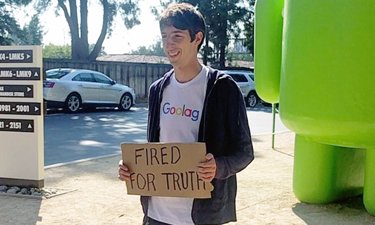
PJ Media’s Debra Heine passes along TiredOfLying4Google Reddit confessions.
I helped Google screw over James Damore:
I was involved in the internal decisions involving James Damore’s memo, and it’s terrible what we did to him.
First of all, we knew about the memo a month before it went viral. HR sent it up the reporting chain when he gave it as internal feedback, but we did nothing. There wasn’t anything we could do, except admit to wrongdoing and lying to our employees. We just hoped that no one else would see his document.
Unfortunately, the memo started spreading within the company. The floodgates opened and previously silent employees started talking. To quell dissent, we: told executives to write to their employees condemning the memo; manipulated our internal Memegen to bias the ratings towards anti-Damore posts (the head of Memegen is an “ally” to the diversity cause); and gave every manager talking points on what to tell their reports about the memo. In all our communications, we concentrated on how hurt employees purportedly were and diverted attention from Google’s discriminatory employment practices and political hegemony, never mind the science.
We needed to make an example of Damore. Looking for some excuse to fire him, we spied on his phone and computer. We didn’t find anything, although our spying probably made his devices unusably slow, preventing him from organizing support within the company. When we did fire him, our reputation and integrity took a hit, but at least other employees were now afraid to speak up.
Firing him without an NDA was a huge risk though. He was a top performer and knew too many compromising secrets, like Dragonfly, the secret censored search project in China. He had also reported several legally dubious practices in Search that still exist. Only God knows why he never leaked Dragonfly or the other issues, but I think it’s because he actually cared about Google.
Our response after we fired him was equally disgraceful. We were supposed to have a Town Hall TGIF to answer employees’ questions about the controversy. However, after questions started coming in that we couldn’t reasonably answer, we had to cancel it. We shifted the blame onto “alt-right trolls” and have avoided talking about it openly since then.
To control the narrative, we planted stories with journalists and flexed Google’s muscles where necessary. In exchange for insider access and preferential treatment, all we ask for is their loyalty. For online media, Google’s ads pay their paycheck and our search brings their customers, so our influence shouldn’t be underestimated.
We dealt with his NLRB case in a similar way. People are ultimately lazy, so we found a sympathetic lawyer in the NLRB and wrote the internal NLRB memo for her. No one wanted to spend the effort to oppose it, despite it being laughably weak. Then, after Damore dropped his NLRB case and filed a class action lawsuit, we had the NLRB publicly release their memo. Our PR firms sent press releases saying “the NLRB ruled the firing legal”, which was, of course, manufactured bullshit.
All of our scheming was over the phone, in deleted emails, or through an external PR firm, so we can deny all of it. Now that we’ve forced him into arbitration, we’re close to screwing him over completely.