A flintlock shot gun was found inside a tree harvested on Cape York, the northernmost point in Australia, in the course of it being milled into boards. The gun is supposed to have been left in the fork of the tree and the tree grown around it over many years.
Brett Stevens points out that, in an Age of Leftism, everyone wants to be a victim.
It is amazing how many people will approve of a concept that “sounds good†without understanding what it means. Take, for example, the term “equality.â€
On the surface, equality sounds like this: treat everyone the same regardless of their background, or in other words, be fair. People think that is all that it means, but forget that life does not happen in a single step, but in cycles.
Here is the equality cycle: when we declare equality, we are setting ourselves up for failure if results are unequal despite fair treatment. For that reason, we give the people who are not succeeding a little nudge, hoping it will make them rise at least to the middle.
If we do not do that, then unequal results make us question the term “equality†at all. When people talk about inequality in wages despite different rates of individual productivity, they are caught in this stage. Results did not match expectations, and so people seek to inject subsidies in the mix.
These subsidies can be as simple as giving the poor kid more leeway in grading his papers at school, as moderate as social services which are free but mostly used by lower-income people, or as extreme as taxing the upper half of society to subsidize the lower half. Yet they always seem to drift toward that level.
In that, we see the feedback loop: each time results do not match the theory, we tip the scales a bit, but that does not work either. We tip the scales more in consequence, and then begin the cycle again. It never ends until something like full Communism comes around the bend, and then everyone is finally equal in theory.
For those caught in the middle of these loops, only one solution presents itself: be a victim.
We know that “equality†invariably and inevitably becomes a pathology of taking from the strong to give to the weak, so the only safety is in finding some way to be weak. You can be a minority, gay, disabled, abused, addicted, ill or mentally ill, or even just depressed, but you need something or the mob of the weak will come for you.
Thus we create a culture of entitlement and victimhood where the victims are entitled and therefore being a victim is valuable if for nothing else in fending off the demands of others who want subsidies with what you have.
Soup plate from the Coronation Service of Augustus II “the Strong”, King of Poland 1697-1706, 1709-1733, bearing, quartered, the arms of Poland and Lithuania.
Hampel Fine Art Auctions, April 12, 2018, 10:00 AM CET, Munich, Germany, Lot 332: Estimated price: €3,000 – €5,000.
Augustus sheltered the alchemist Johann Friedrich Böttger, after he escaped captivity at the hands of Frederick I of Prussia, but then imprisoned him himself in order to force him to produce gold.
Efforts at producing gold proving unsuccessful, Augustus put Böttger to work on discovering the secret of Chinese porcelain. The correct method of producing hard-paste porcelain was discovered in 1708, leading to the establishment of the famous factory in Meissen in 1710. Böttger died in 1719.
Lampshade. Japan, circa 1905. Plique à jour enamel, silver. height 20.5 cm.
A plique à jour enamel lampshade with a rounded hexagonal bell-shaped body and petalled rim worked in white enamel with stylized flowers and foliate scrolls on a pale blue-grey ground. Applied with silver rims. Text and image via Khalili Collection.
It is said that it was Ando Jubei who introduced the technique of plique à jour (shotai jippo) to Japan; supposedly he first saw such work, made by Fernand Thesmar (see FR 284), at the Paris Exposition of 1900. But this cannot be true since the Walters Art Gallery in Baltimore has a piece (inv. no. 44.156) in the technique labeled Namikawa Sosuke, and there is one in the 1896 Sosuke book (see E 7) said to have been exhibited at Chicago in 1893.
This technique, where the supporting metal is removed after firing to leave the glass and the wire alone, is notoriously difficult. It was an astonishing feat to acquire the skill so quickly and from such a slender source. Large pieces are particularly difficult to make as it is almost impossible to avoid some small cracks during the cooling process.
O. Impey, M. Fairley (eds.), Meiji No Takara: Treasures Of Imperial Japan: Enamel, London 1994, cat. 76.
J. Earle, Splendors of Imperial Japan: Arts of the Meiji period from the Khalili Collection, London 2002, cat. 234, p. 327.
Something attacked my son while he was sledding in the woods. But what?
My child went sledding alone and emerged from the trees bloody and dazed. He still can’t remember what happened. …
The doctors’ conclusion, shared with us the next day, is that Beckett was attacked by a large bird of prey, probably a great horned owl. He likely encroached, unknowingly, on the bird’s nest and was blindsided with such force that he was knocked unconscious. The image of our son alone, face down in the snow, is haunting. We wonder what might have happened if he hadn’t managed to stagger to his feet and find his way home.
DO A LITTLE GOOGLING and you’ll discover that violent attacks of this sort aren’t common, but they do happen, usually in places where raptors and humans are forced to coexist, such as ski areas, golf courses, and suburban parks. Some victims compare the blitzkrieg to being hit in the head with a baseball bat.
The Fells includes hiking trails, meadows, and reservoirs, and over the years, we’ve encountered a lot of wildlife, including deer, foxes, coyotes, turkeys, hawks, and, once or twice, an owl with tufted ears and a storybook scowl, perched in a tree.
Andrew Vitz, the state ornithologist, tells me the Fells is home to raptors, including several types of hawks. But because hawks nest in the late spring and summer, they typically don’t behave aggressively in winter. If they do strike, Vitz says, hawks don’t inflict the sort of damage that was done to Beckett.
But great horned owls, which also reside in the Fells, are another matter. They nest in the winter and they’re bigger, more powerful birds, weighing about 4 pounds and capable of flying 40 miles per hour. Great horned owls are notorious for their stealth and strength. They strike without warning — their feathers are adapted to minimize noise during flight — and their long, needle-sharp talons can apply sufficient pressure to snap the spine of their prey.
“The great horned owl is a large, very strong bird, and when it strikes, it’s almost always at the head,†Vitz tells me. “What happened to your son is consistent with an owl attack.â€
I am a 53-year-old lawyer who lives in a trendy neighborhood in a large diverse city with my wife and three kids. I have never owned a gun. In fact, even though I grew up in Louisiana (“Sportsman’s Paradise”), I have never even pulled the trigger of any weapon except a BB gun.
Yet, last week, I became a proud member of the NRA for the first time. I did so because the anti-gun hysteria that I’ve witnessed is dangerous, alarming, and ignores the facts. I’ve joined the NRA to stand up for them when they are viciously attacked, since the organization is a convenient scapegoat, not a cause of what happened in Florida.
I’m fed up. …
[I]nstead of focusing on … social issues and law enforcement breakdowns, we’ve seen unbridled hatred and rage directed toward responsible gun owners. I’ve seen this personally by my friends on the Left. The simple facts are these: overall gun violence is down markedly over the last 20 years, even as more guns are in circulation and the Supreme Court has given greater backing to individual rights to own a firearm. …
It seems to me, however, that the Left is not interested in sensible changes to existing gun laws, such as strengthening background checks, employing more armed security at schools, and better identification and separation of troubled youths. Rather, the Left wants to destroy the NRA and repeal the Second Amendment, as articulated recently by former Supreme Court Justice John Paul Stevens.
An 1812 log cabin somewhere in the middle of nowhere.
Salena Zito takes personal exception to the coastal urban elites’ condescension toward people who would rather live in the real America.
Earlier this year, Bill Kristol, editor at large at the Weekly Standard, tweeted ahead of the Super Bowl that it was too bad two Acela Corridor teams, the New England Patriots and the Philadelphia Eagles, had to play their matchup “in the middle of nowhere.â€
It was a reference to the host city of Minneapolis’ location in the Midwest, far from the “civilized worlds” of Boston and Philadelphia – the assumption being that unless you are on the East Coast, your town’s sophistication and glamour could not live up to the modern amenities of a cosmopolitan city.
In my estimation, there is no patch of geography in this country that is the “middle of nowhere.” This is America; everywhere is the middle of somewhere.
Whether it is Tightwad, Mo., Mooresville, Ala., Hyder, Alaska, Oatman, Ariz., or right here in Lost River, W.Va., every place, large or small, depressed or thriving, or down to one mailbox on one lonely road, is somewhere.
We are all equals; we all contribute to the culture, diversity, dialect, and importance of this country. We build things, we serve in our communities, we serve in our military, we create families, businesses, and technology no matter where we are – we find a way to make each village and town and city a unique snapshot of this country.
It is an idea and an ideal that Hillary Clinton not only got wrong in the last election, but is still getting wrong; her remarks in India in March reinforced that.
“If you look at the map of the United States, there’s all that red in the middle where Trump won,” she said. “I win the coast, I win, you know, Illinois and Minnesota, places like that.”
She went on to say that where she won, America is thriving: “I won the places that represent two-thirds of America’s gross domestic product. So, I won the places that are optimistic, diverse, dynamic, moving forward. And his whole campaign, ‘Make America Great Again,’ was looking backwards.”
Clinton is not the only person to hold that contempt. Many of her supporters have gone on to agree with her and to hold those same strident positions – and their condescension for half of the country has only deepened since November 2016.
No one has learned anything; no one cares to. Everyone wants to hold on to their bigotry towards the people who live and work and worship and go on with the business of life outside of “the places that represent two thirds of America’s gross domestic product.”
They don’t get that they are just as optimistic, just as diverse, just as dynamic, and deal with the same issues of gender, sexuality, and race just as often as they do. They just don’t make slick commercials of their lives to reinforce their worthiness.
They deal with these issues with dignity, not fanfare.
The response last week to Roseanne Barr’s return to ABC primetime television floored these same elites – the two-episode premiere attracted an astounding 18.2 million viewers, over-performing in the very middle of America, in states like Oklahoma, Ohio, and Pennsylvania where towns like Claremore, Center of the World, and Intercourse are always beating back the notion they are in the middle of nowhere.
Cities like New York and Los Angeles did not even crack the top 20.
Those “middle of somewhere” places showed everyone they are a viable and prosperous force to be reckoned with and that whether they supported Trump or not, they are tired of rarely finding an American family who looked just like them on television – when they do, those shows are often canceled too quickly.
Politics, government, Hollywood, and popular culture have long overlooked the middle of America – diversity focuses of the last generation have been on color and gender, leaving behind the religious, cultural, and economic diversity of the Midwest.
Their role has been to be a butt of a joke, or mocked, or sneered at, or all three.
Our current political populism has been a pushback against larger institutions like Hollywood and its disconnect with the heartland – and it has also been a pushback against establishment politicians, like Clinton and her unmasked contempt for those who live here.
It is only once the people in power understand that Trump was the result of this movement, and not the cause, that maybe they’ll start calling all of America the middle of somewhere.
John Gray is dismayed at the way the politics of identity has replaced Liberalism with intolerant and totalitarian hyper-liberalism.
It would be easy to say that liberalism has now been abandoned. Practices of toleration that used to be seen as essential to freedom are being deconstructed and dismissed as structures of repression, and any ideas or beliefs that stand in the way of this process banned from public discourse. Judged by old-fashioned standards, this is the opposite of what liberals have stood for. But what has happened in higher education is not that liberalism has been supplanted by some other ruling philosÂophy. Instead, a hyper-liberal ideology has developed that aims to purge society of any trace of other views of the world. If a regime of censorship prevails in universities, it is because they have become vehicles for this project. When students from China study in Western countries one of the lessons they learn is that the enforcement of intellectual orthodoxy does not require an authoritarian govÂernment. In institutions that proclaim their commitment to critical inquiry, censorship is most effective when it is self-imposed. A defining feature of tyranny, the policing of opinion is now established practice in societies that believe themselves to be freer than they have ever been.
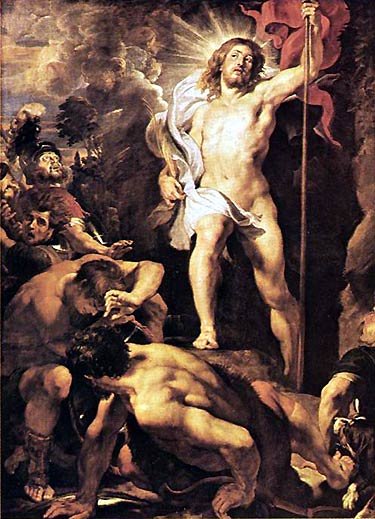
Peter Paul Rubens, The Resurrection of Christ, 1611-1612, Vrouwekathedraal, Antwerp
From Robert Chambers, The Book of Days, 1869:
Easter
Easter, the anniversary of our Lord’s resurrection from the dead, is one of the three great festivals of the Christian year,—the other two being Christmas and Whitsuntide. From the earliest period of Christianity down to the present day, it has always been celebrated by believers with the greatest joy, and accounted the Queen of Festivals. In primitive times it was usual for Christians to salute each other on the morning of this day by exclaiming, ‘Christ is risen;’ to which the person saluted replied, ‘Christ is risen indeed,’ or else, ‘And hath appeared unto Simon;’—a custom still retained in the Greek Church.
The common name of this festival in the East was the Paschal Feast, because kept at the same time as the Pascha, or Jewish passover, and in some measure succeeding to it. In the sixth of the Ancyran Canons it is called the Great Day. Our own name Easter is derived, as some suppose, from Eostre, the name of a Saxon deity, whose feast was celebrated every year in the spring, about the same time as the Christian festival—the name being retained when the character of the feast was changed; or, as others suppose, from Oster, which signifies rising. If the latter supposition be correct, Easter is in name, as well as reality, the feast of the resurrection.
Though there has never been any difference of opinion in the Christian church as to why Easter is kept, there has been a good deal as to when it ought to be kept. It is one of the moveable feasts; that is, it is not fixed to one particular day—like Christmas Day, e. g., which is always kept on the 25th of December—but moves backwards or forwards according as the full moon next after the vernal equinox falls nearer or further from the equinox. The rule given at the beginning of the Prayer-book to find Easter is this: ‘Easter-day is always the first Sunday after the full moon which happens upon or next after the twenty-first day of March; and if the full moon happens upon a Sunday, Easter-day is the Sunday after.’
The paschal controversy, which for a time divided Christendom, grew out of a diversity of custom. The churches of Asia Minor, among whom were many Judaizing Christians, kept their paschal feast on the same day as the Jews kept their passover; i. e., on the 14th of Nisan, the Jewish month corresponding to our March or April. But the churches of the West, remembering that our Lord’s resurrection took place on the Sunday, kept their festival on the Sunday following the 14th of Nisan. By this means they hoped not only to commemorate the resurrection on the day on which it actually occurred, but also to distinguish themselves more effectually from the Jews. For a time this difference was borne with mutual forbearance and charity. And when disputes began to arise, we find that Polycarp, the venerable bishop of Smyrna, when on a visit to Rome, took the opportunity of conferring with Anicetas, bishop of that city, upon the question. Polycarp pleaded the practice of St. Philip and St. John, with the latter of whom he had lived, conversed, and joined in its celebration; while Anicetas adduced the practice of St. Peter and St. Paul. Concession came from neither side, and so the matter dropped; but the two bishops continued in Christian friendship and concord. This was about A.D. 158.
Towards the end of the century, however, Victor, bishop of Rome, resolved on compelling the Eastern churches to conform to the Western practice, and wrote an imperious letter to the prelates of Asia, commanding them to keep the festival of Easter at the time observed by the Western churches. They very naturally resented such an interference, and declared their resolution to keep Easter at the time they had been accustomed to do. The dispute hence-forward gathered strength, and was the source of much bitterness during the next century. The East was divided from the West, and all who, after the example of the Asiatics, kept Easter-day on the 14th, whether that day were Sunday or not, were styled Qiccertodecimans by those who adopted the Roman custom.
One cause of this strife was the imperfection of the Jewish calendar. The ordinary year of the Jews consisted of 12 lunar months of 292 days each, or of 29 and 30 days alternately; that is, of 354 days. To make up the 11 days’ deficiency, they intercalated a thirteenth month of 30 days every third year. But even then they would be in advance of the true time without other intercalations; so that they often kept their passover before the vernal equinox. But the Western Christians considered the vernal equinox the commencement of the natural year, and objected to a mode of reckoning which might sometimes cause them to hold their paschal feast twice in one year and omit it altogether the next. To obviate this, the fifth of the apostolic canons decreed that, ’ If any bishop, priest, or deacon, celebrated the Holy Feast of Easter before the vernal equinox, as the Jews do, let him be deposed.’
At the beginning of the fourth century, matters had gone to such a length, that the Emperor Constantine thought it his duty to take steps to allay the controversy, and to insure uniformity of practice for the future. For this purpose, he got a canon passed in the great Ecumenical Council of Nice (A.D. 325), that everywhere the great feast of Easter should be observed upon one and the same day; and that not the day of the Jewish passover, but, as had been generally observed, upon the Sunday afterwards. And to prevent all future disputes as to the time, the following rules were also laid down:
‘That the twenty-first day of March shall be accounted the vernal equinox.’
‘That the full moon happening upon or next after the twenty-first of March, shall be taken for the full moon of Nisan.’
‘That the Lord’s-day next following that full moon be Easter-day.’
‘But if the full moon happen upon a Sunday, Easter-day shall be the Sunday after.’
As the Egyptians at that time excelled in astronomy, the Bishop of Alexandria was appointed to give notice of Easter-day to the Pope and other patriarchs. But it was evident that this arrangement could not last long; it was too inconvenient and liable to interruptions. The fathers of the next age began, therefore, to adopt the golden numbers of the Metonic cycle, and to place them in the calendar against those days in each month on which the new moons should fall during that year of the cycle. The Metonie cycle was a period of nineteen years. It had been observed by Meton, an Athenian philosopher, that the moon returns to have her changes on the same month and day of the month in the solar year after a lapse of nineteen years, and so, as it were, to run in a circle. He published his discovery at the Olympic Games, B.C. 433, and the cycle has ever since borne his name. The fathers hoped by this cycle to be able always to know the moon’s age; and as the vernal equinox was now fixed to the 21st of March, to find Easter for ever. But though the new moon really happened on the same day of the year after a space of nineteen years as it did before, it fell an hour earlier on that day, which, in the course of time, created a serious error in their calculations.
A cycle was then framed at Rome for 84 years, and generally received by the Western church, for it was then thought that in this space of time the moon’s changes would return not only to the same day of the month, but of the week also. Wheatley tells us that, ‘During the time that Easter was kept according to this cycle, Britain was separated from the Roman empire, and the British churches for some time after that separation continued to keep Easter according to this table of 84 years. But soon after that separation, the Church of Rome and several others discovered great deficiencies in this account, and therefore left it for another which was more perfect.’—Book on the Common Prayer, p. 40. This was the Victorian period of 532 years. But he is clearly in error here. The Victorian period was only drawn up about the year 457, and was not adopted by the Church till the Fourth Council of Orleans, A.D. 541.
Now from the time the Romans finally left Britain (A.D. 426), when he supposes both churches to be using the cycle of 84 years, till the arrival of St. Augustine (A.D. 596), the error can hardly have amounted to a difference worth disputing about. And yet the time the Britons kept Easter must have varied considerably from that of the Roman missionaries to have given rise to the statement that they were Quartodecimans, which they certainly were not; for it is a well-known fact that British bishops were at the Council of Nice, and doubtless adopted and brought home with them the rule laid down by that assembly. Dr. Hooke’s account is far more probable, that the British and Irish churches adhered to the Alexandrian rule, according to which the Easter festival could not begin before the 8th of March; while according to the rule adopted at Rome and generally in the West, it began as early as the fifth. ‘They (the Celts) were manifestly in error,’ he says; ‘but owing to the haughtiness with which the Italians had demanded an alteration in their calendar, they doggedly determined not to change.’—Lives of the Archbishops of Canterbury, vol. i. p. 14.
After a good deal of disputation had taken place, with more in prospect, Oswy, King of Northumbria, determined to take the matter in hand. He summoned the leaders of the contending parties to a conference at Whitby, A.D. 664, at which he himself presided. Colman, bishop of Lindisfarne, represented the British church. The Romish party were headed by Agilbert, bishop of Dorchester, and Wilfrid, a young Saxon. Wilfrid was spokesman. The arguments were characteristic of the age; but the manner in which the king decided irresistibly provokes a smile, and makes one doubt whether he were in jest or earnest. Colman spoke first, and urged that the custom of the Celtic church ought not to be changed, because it had been inherited from their forefathers, men beloved of God, &c. Wilfrid followed:
‘The Easter which we observe I saw celebrated by all at Rome: there, where the blessed apostles, Peter and Paul, lived, taught, suffered, and were buried.’ And concluded a really powerful speech with these words: ‘And if, after all, that Columba of yours were, which I will not deny, a holy man, gifted with the power of working miracles, is he, I ask, to be preferred before the most blessed Prince of the Apostles, to whom our Lord said, “Thou art Peter, and upon this rock will I build my church, and the gates of hell shall not prevail against it; and to thee will I give the keys of the kingdom of heaven†?’
The King, turning to Colman, asked him, ‘Is it true or not, Colman, that these words were spoken to Peter by our Lord?’ Colman, who seems to have been completely cowed, could not deny it. ‘It is true, 0 King.’ ‘Then,’ said the King, ‘can you shew me any such power given to your Columba? ’ Colman answered, ’ No.’ ‘You are both, then, agreed,’ continued the King, are you not, that these words were addressed principally to Peter, and that to him were given the keys of heaven by our Lord?’ Both assented. ‘Then,’ said the King, ‘I tell you plainly, I shall not stand opposed to the door-keeper of the kingdom of heaven; I desire, as far as in me lies, to adhere to his precepts and obey his commands, lest by offending him who keepeth the keys, I should, when I present myself at the gate, find no one to open to me.’
This settled the controversy, though poor honest Colman resigned his see rather than submit to such a decision.
On Easter-day depend all the moveable feasts and fasts throughout the year. The nine Sundays before, and the eight following after, are all dependent upon it, and form, as it were, a body-guard to this Queen of Festivals. The nine preceding are the six Sundays in Lent, Quinquagesima, Sexagesima, and Septuagesima; the eight following are the five Sundays after Easter, the Sunday after Ascension Day, Whit Sunday, and Trinity Sunday.
EASTER CUSTOMS
The old Easter customs which still linger among us vary considerably in form in different parts of the kingdom. The custom of distributing the ‘pace’ or ‘pasche ege,’ which was once almost universal among Christians, is still observed by children, and by the peasantry in Lancashire. Even in Scotland, where the great festivals have for centuries been suppressed, the young people still get their hard-boiled dyed eggs, which they roll about, or throw, and finally eat. In Lancashire, and in Cheshire, Staffordshire, and Warwickshire, and perhaps in other counties, the ridiculous custom of ‘lifting’ or ‘heaving’ is practised.
On Easter Monday the men lift the women, and on Easter Tuesday the women lift or heave the men. The process is performed by two lusty men or women joining their hands across each other’s wrists; then, making the person to be heaved sit down on their arms, they lift him up aloft two or three times, and often carry him several yards along a street. A grave clergyman who happened to be passing through a town in Lancashire on an Easter Tuesday, and having to stay an hour or two at an inn, was astonished by three or four lusty women rushing into his room, exclaiming they had come ‘to lift him.’ ‘To lift me!’ repeated the amazed divine; ‘what can you mean?’ ‘Why, your reverence, we’re come to lift you, ‘cause it’s Easter Tuesday.’ ‘Lift me because it’s Easter Tuesday? I don’t understand. Is there any such custom here?’ ‘Yes, to be sure; why, don’t you know? all us women was lifted yesterday; and us lifts the men today in turn. And in course it’s our rights and duties to lift ‘em.’
After a little further parley, the reverend traveller compromised with his fair visitors for half-a-crown, and thus escaped the dreaded compliment. In Durham, on Easter Monday, the men claim the privilege to take off the women’s shoes, and the next day the women retaliate. Anciently, both ecclesiastics and laics used to play at ball in the churches for tansy-cakes on Eastertide; and, though the profane part of this custom is happily everywhere discontinued, tansy-cakes and tansy-puddings are still favourite dishes at Easter in many parts. In some parishes in the counties of Dorset and Devon, the clerk carries round to every house a few white cakes as an Easter offering; these cakes, which are about the eighth of an inch thick, and of two sizes —the larger being seven or eight inches, the smaller about five in diameter— have a mingled bitter and sweet taste. In return for these cakes, which are always distributed after Divine service on Good Friday, the clerk receives a gratuity- according to the circumstances or generosity of the householder.