The Arizona Game and Fish Department is currently analyzing a recent trail camera photo of either a jaguar or an ocelot sighted southeast of Tucson.
The photo includes only the tail and a small portion of a hind quarter of the animal, making positive identification more difficult. Game and Fish is now consulting with outside experts about the photo, taken Sept. 23 and submitted by a sportsman, to better identify the species.
“We have definitively determined that it is either a jaguar or an ocelot, but we need to do further analysis of the animal’s spot patterns and size to try to positively identify which species it is,” said Game and Fish Nongame Branch Chief Eric Gardner.
Arizona game officials are consulting with seven outside experts to determine if a photo recently submitted by a hunter shows the tail of a jaguar or an ocelot sighted southeast of Tucson.
While those experts’ conclusions aren’t in yet, two longtime cat biologists who work as volunteers for the Sky Island Alliance conservation group said Wednesday they believe it’s a jaguar.
The predominant opinion among those responding to the State Game and Fish Department so far is also that the tail is of a jaguar, “but it is not the only opinion,†said Eric Gardner, Game and Fish’s non-game branch chief. The U.S. Fish and Wildlife Service has reached out to an eighth expert, Gardner said today.
“We do have an individual who believes it is inconclusive, but if pressed would probably go the ocelot route,†Gardner said. “It’s still premature. Most of it is a lot of opinion without a lot of reasoning behind it, based on experience. We have some statements based on size and length of the tail and the bushy tip of tail. But it’s still being discussed in the professional arena. I think we have to let that discussion occur.â€
Gardner said he hopes to have heard from all the experts by early next week.
The photo was taken Sept. 23. As is typical, the state Game and Fish Department did not release the animal’s specific location and Gardner declined this morning to say what county the photo was taken in.
The big news in Clearfield was the Elk that took a plunge off the bridge.
This ~ 1,000 lb. bull elk jumped off of the Clearfield Bypass bridge near the mall this afternoon. Numerous crews including the Game Commission were called in to retrieve the bull from the water. It is unknown what caused him to jump. He died on impact.
———————————–
Pennsylvania’s elk descend from a herd of elk presented as a gift from President Theodore Roosevelt to PA Governor Gifford Pinchot.
Austin, Texas is a university town and consequently a hotbed of liberalism, so inevitably some of the old-time natives of the area will take exception to the newcomers’ politics.
A Texas couple determined to find out who had been damaging a sign in their front yard proclaiming their support for President Obama’s re-election bid caught the offender on Wednesday. Tom Priem, a software support engineer in Austin, told FoxNews.com he and his wife, who live on a block where political signs dot front yards, were fed up with seeing only their Obama sign repeatedly defaced.
“The sign had holes poked in it like somebody had stuck a knife through it,†Priem said Friday. “At first I thought it was somebody who didn’t like Obama.â€
“We were making fun of it, saying the deer must be a Republican.”
– Tom Priem, Austin resident
Priem said he even called a city hotline to document the incident in case a more insidious offender was to blame. He couldn’t believe his eyes when his wife showed him the surveillance photo she snapped seconds after the campaign sign was destroyed – by a buck.
The varmint’s vandalism began about 10 days ago and it’s unclear what the animal has against the sign.
Atherton and Palo Alto receive regular visits from mountain lions who travel down the dry arroyos from the nearby mountains, and similar haute bourgeois suburbs of Bombay have leopards from a nearby wildlife refuge dropping by.
The website of Royal Palms Estate says that the township is your ‘world in a village’. Located in Mumbai’s Goregaon suburb, this ‘village’ is a 240-acre settlement that has five-star hotels, recreation clubs, lakes, swimming pools, a golf course, bungalows, villas, row houses and marble statues, apart from a little hill as part of its natural landscape. It even has the Sanjay Gandhi National Park as its neighbour.
It is a world apart, in many ways. Literally so, at some points. The past ten days have seen large grilled fences, at least 15 feet high, come up around the backyard of row house No 3. A large tree nearby has its trunk entwined in a creeper of barbed wire. And it’s not just this compound. Row houses No 4 and 5 are fortified too.
What warrants such self-encagement? An unwelcome guest, it turns out.
East or west, there is a good deal of inadvertent comedy in the inability of deracinated Homo affluentus urbanicus to cope effectively with his own oblivious proximity to Nature in its most potent and primordial forms.
In Palo Alto, the locals protest and build shrines with flowers and candles to the memory of invading pumas who get shot by the police when found lurking in tree branches near suburban elementary schools.
Vipers kill their prey using hemotoxic venom, which essentially turns their victim’s blood into plastic. Solidified blood causes pain, massive swelling, paralysis, and necrosis in extremities, and when hemotoxic envenomation reaches the vital organs, death typically ensues.
This is what happens when a single drop of venom from a Russell’s viper (the deadliest Asiatic viper) is dropped into a petri dish of blood.
Is that an immature ostrich? Is it looking over a peculiar fence or the headstones in an oriental graveyard? Who knows? I searched 2.1 Billion images on the web (using Tineye) and did not find a source.
Number 9: the Tarantula hawk wasp, Pepsis hemipepsis: “Blinding, shockingly electric. A running hair drier has been dropped into your bubble bath.”
Entomologist Justin Schmidt, who boasts of having experienced the stings of 157 insects, identifies and describes the top ten most painful.
Interesting, but one wonders how certain spiders, like the Australian funnel-web, Atrax robustus, for instance, would compare. Its bite induces convulsions, paralysis, and death, and the victim spouts blue saliva.
The all-time champion painful sting is probably really the one administered by fish of the genus Synanceia, stonefish. Stonefish stings are so painful that victims apparently regularly plead for the injured limb to be amputated.
In Chicago, this winter, a Peregrine falcon (Falco peregrinus) took a go at a Snowy owl (Bubo scandiacus). A local birder named Rick Remington got some great photos and described the action.
[The owl] would do a somersault just as the Peregrine approached and flash its nasty talons in an attempt to scare off the Falcon. The battle lasted for 5 full minutes before the Falcon headed off in another direction and the Snowy Owl flew down to the rocks by the lake. It was a surprisingly violent and noisy encounter, with both birds shrieking loudly and the owl extending its giant wings to intimidate the smaller falcon. I fully expected this to end badly for the owl based on what I was watching. In spite of the obvious mismatch, the Snowy Owl managed to hold its own and escape unscathed.
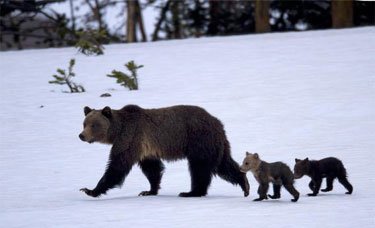
The female grizzly bear, referred to as the Wapiti sow, killed Brian Matayoshi on July 6, 2011 and then killed John Wallace on August 27, 2011, after officials declined to hunt the bear responsible. The Wapiti sow was finally trapped in late September and euthanized October 2nd after four days of forensic analysis and chin stroking.
Jessica Grose, in Slate, describes how the swift and hearty justice dealt out to man-killing grizzlies in simpler and less-grovelly-toward-Nature times has been replaced by a new intensely ethically conscientious regime that will only kill bears which are deemed to have behaved with “unnatural aggression” or which have been found to have eaten people.
In the bad old days, they knew what to do with man-killing bruins.
The first extensively documented death by grizzly within Yellowstone Park’s borders was the fatal mauling of 61-year-old government laborer Frank Welch in 1916. And the park’s first extensively documented judicial execution of a grizzly soon followed. Some historians suspect the bear that killed Welch was abnormally ill-tempered because his toes had been ripped off when he escaped from a trap in 1912. Whatever the bear’s motives, though, Welch’s fellow laborers decided that “Old Two Toes†deserved to die for his crimes. Men from the road camp where Welch had been working placed some edible garbage in front of a barrel filled with dynamite. When the bear began to eat, they blew it to smithereens.
That was how grizzlies were treated if they injured humans in the early days of Yellowstone: They were killed.
Not today. Today, when Ephraim or Ephraimina takes out a tax paying citizen, there is the equivalent of a judicial procedure. There are major exculpatory loopholes. And even totally guilty bears are put down reluctantly, as big, salty tears pour down the faces of the responsible officials.
Every bear is pwecious, you see.
The euthanization of the bear known as “the Wapiti sow†was the culmination of a series of horrifying events that had gripped Yellowstone for months, and alarmed rangers, visitors, and the conservation biologists tasked with keeping grizzly bears safe. In separate incidents in July and August, grizzlies had killed hikers in Yellowstone, prompting a months-long investigation replete with crime scene reconstructions and DNA analysis, and a furious race to capture the prime suspect. The execution of the Wapiti sow opens a window on a special criminal justice system designed to protect endangered bears and the humans who share their land. It also demonstrates the difficulty of judging animals for crimes against us. The government bear biologists who enforce grizzly law and order grapple with the impossibility of the task every day. In the most painful cases, the people who protect these sublime, endangered animals must also put them to death.
Whenever a grizzly bear commits a crime in the continental United States, Chris Servheen gets a call at his office at the University of Montana in Missoula. Servheen has been the Grizzly Bear Recovery Coordinator for the U.S. Fish and Wildlife Service for three decades. …
Before Servheen, Gunther, and their bear management colleagues could decide what to do, they’d need a lot more information. Was a grizzly bear in fact responsible for this second death? If so, which bear did the mauling? And what were the circumstances that led up to attack—was it provoked or had some hiker just been caught unaware? The answers to those questions would determine whether a precious animal would need to die. …
Wildlife biologists like Kerry Gunther help the park’s crime-scene investigators by speculating on a bear’s emotional state. Based on the evidence at hand, he tries to determine whether a given act of bear aggression might have been a natural behavior—the result of being startled while feeding on an elk carcass, for example, or seeing someone approaching her cubs. If a bear appears to have followed a hiker down the trail instead of backing off, or if it attacked campers while they were asleep, that would be more unusual—the result, perhaps of a deranged grizzly mind.
If you blunder into a bear that is thought to have attacked and killed you out of natural aggression (you violated that bear’s space, dude!) or via an impulse of self defense, that’s just too bad for you. The bear goes free, as long as he refrains from dining on your pitiable remains.
The authorities in question reluctantly draw the line at actual predation, simply because they are afraid of the public response to tolerating man-eaters in National Parks.
The zero-tolerance policy for man-eating bears invites an obvious question, though. Once a bear kills someone, whether it’s out of some wild-animal psychopathy or a natural inclination to defend her young, why wouldn’t she eat the corpse? Everyone agrees that it’s natural for grizzlies to eat carrion—they’re scavengers, after all. When I ask Servheen whether grizzlies can get “a taste for human blood”—whether a grizzly that starts eating people-meat will desire it endlessly—he dismisses the idea. “That’s for horror stories in movies,” he says. “Bears don’t get a taste for human blood. There’s no studies that show that.”
No studies show it, in part because every time a bear eats someone, they kill it. Not that it’s something that would ever be studied—biologists would never want to take the risk of keeping a bear that had eaten a person in the greater bear population. “We don’t want to test whether bears really get a taste for people,†Gunther explains. “The public wouldn’t appreciate us using them as subjects.” That’s for horror movies, but it seems like even the bear biologists think there might be some truth to the campfire legends.