Pakistani photographer Atif Saeed got this excellent close-up of a lion at a safari park near Lahore. The photographer then barely managed to get into his car before Simba nailed him. io9
Mallory Ortberg has another episode of Harry Potter as written by Ayn Rand.
“The Ministry of Magic has fallen,†Neville said in despair.
Harry laughed long and loud. “You should not mourn the government,†he told Neville. “The state has never shed a tear for you. Why waste your tears on it?â€
He picked up his wand. “For my part, I withdrew my consent to be governed years ago. Taxation is destroying private resources.†A smile played across Harry’s lips. “I hope they destroyed the national bank, while they were at it. I should like to see the goblins of Gringotts face their real enemy — deregulation.â€
***
HERE LIES DOBBY, the stone read, A FREE ELF.
Underneath, in slightly smaller letters, it continued: What is the basic, the essential, the crucial principle that differentiates freedom from slavery? It is the principle of voluntary action versus physical coercion or compulsion. Freedom, in a political context, has only one meaning: the absence of physical coercion. It does not mean freedom from the landlord, or freedom from the employer, or freedom from the laws of nature which do not provide men with automatic prosperity. It means freedom from the coercive power of the state—and nothing else. If one upholds freedom, one must uphold man’s individual rights; if one upholds man’s individual rights, one must uphold his right to his own life, to his own liberty, to the pursuit of his own happiness—which means: one must uphold a political system that guarantees and protects these rights—which means: the politico-economic system of capitalism. Intellectual freedom cannot exist without political freedom; political freedom cannot exist without economic freedom; a free mind and a free market are corollaries. Since knowledge, thinking, and rational action are properties of the individual, since the choice to exercise his rational faculty or not depends on the individual, man’s survival requires that those who think be free of the interference of those who don’t. Since men are neither omniscient nor infallible, they must be free to agree or disagree, to cooperate or to pursue their own independent course, each according to his own rational judgment. Freedom is the fundamental requirement of man’s mind. A rational mind does not work under compulsion; it does not subordinate its grasp of reality to anyone’s orders, directives, or controls; it does not sacrifice its knowledge, its view of the truth, to anyone’s opinions, threats, wishes, plans, or “welfare.†Such a mind may be hampered by others, it may be silenced, proscribed, imprisoned, or destroyed; it cannot be forced; a wand is not an argument. It is from the work and the inviolate integrity of such minds—from the intransigent innovators—that all of mankind’s knowledge and achievements have come. It is to such minds that mankind owes its survival.
The gravestone was seven and a half feet tall.
***
NINETEEN YEARS LATER
“I’m taking the children down the Platform 9 3/4s to see them off to school,†Ginny said to Harry. “Want to come?â€
“I build trains,†Harry said, adjusting his hat so that the brim sat low over one eye, “I don’t watch children board them.â€
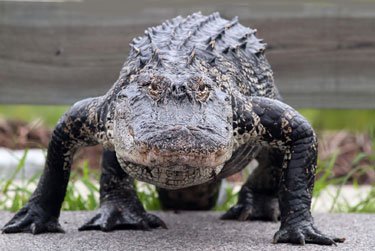
When Pennsylvanians refer to an “Allegheny alligator,” they normally mean Necturus maculosus, a foot-and-a-half long dark salamander, with external, Christmas-tree-like red gills. But this week there have been two sightings reported of a real six-to-seven foot alligator (Alligator mississipiensis) in Western Pennsylvania’s Monongahela River, the one which joins the Allegheny River at Pittsburgh to form the Ohio.
The Southwest Regional Police Department is investigating an unconfirmed sighting of an alligator in the Monongahela River in Belle Vernon, Fayette County.
Authorities said a man on a boat reported that he saw what he believed was an alligator around midnight Tuesday.
He described the animal as approximately 6 to 7 feet long, swimming upstream against the current.
“He saw what he believed to be a log, going upstream about 10 or 15 feet from the shoreline,†Southwest Regional Police Chief John Hartman said. “He took his spotlight out and shined it on the log. He said he saw the head of an alligator, about 7 inches out of the water, two eyes and a tail.â€
Upon investigation, police determined that a possible earlier sighting of the animal was made at approximately 2 p.m. Tuesday.
“I didn’t see teeth or anything. I didn’t think it was an alligator or nothing,†said Josh Adams.
Adams said he was applying for a job when he experienced the interesting sighting.
“After I put in my application, I went for a little walk. I seen a little duck and thought, ‘Awe, that’s cool,’ then it went under real fast and it didn’t come back up,†said Adams.
Southwest Regional Police Department is working with the U.S. Coast Guard, the Pennsylvania Fish and Boat Commission and the Pittsburgh Zoo.
Neighbors said they’re glad authorities are taking this seriously, because they are, too.
But how the heck could a gator survive the bitter cold winter we just had in Pennsylvania?
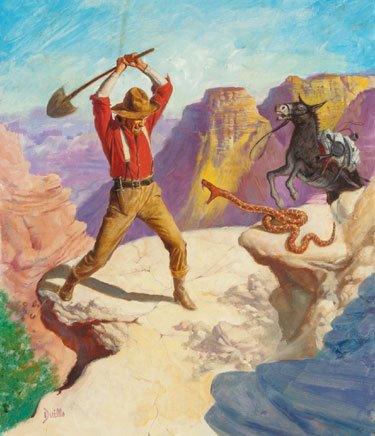
Born in 1928, died 2003, Duillo did covers for more than 500 paperback Mysteries, Detective Stories, Sci Fi, Fantasy, and Westerns as well as countless illustrations for the pulp magazines.
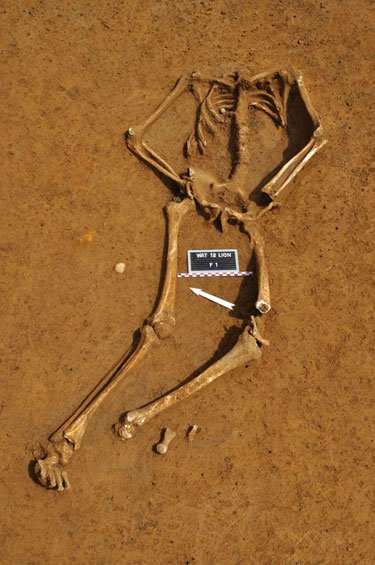
But, in some ways, the artifacts the archaeologist has recovered are able to tell even more of the soldier’s story than his remains can. At his hip, where his pocket would have been, Bosquet uncovered a spoon, a belt buckle, and 22 coins, as well as small pieces of fabric that probably belonged to the soldier’s uniform. Hoping it would have a mark that would enable him to identify the soldier’s regiment, Bosquet took X-rays of the spoon but, disappointingly, no such marks were visible. Bosquet holds out hope that the buckle, which is currently being conserved, may have some identifying marks. It was found near the soldier’s right leg and Bosquet suggests it could be from a belt used as a tourniquet to stop the bleeding from a battlefield wound, possibly the one that damaged his feet and hands. And among the coins, most of which are still awaiting cleaning and identification, there is a French half franc dating to 1811. “Perhaps in Belgium, English soldiers paid in French money in cabarets,†says Bosquet. “Or he may have stolen it from a dead French soldier’s pocket.
The archaeologist was able to identify the soldier as British not only by his position behind the British lines—in the chaos of the battlefield soldiers could easily find themselves on the wrong side—but by the musket ball still lodged in his rib cage. “According to its weight and diameter, the bullet is definitely French,†says Bosquet. Two flints the soldier carried in his pocket also mark him as a member of Wellington’s forces, as they are dark gray and of dimensions corresponding to the Brown Bess musket, the typical weapon of British troops. By contrast, the flints used to fire the French muskets were light yellow.
Sometimes a soldier’s story ends with his death on the battlefield. But for Bosquet, there are still parts of this narrative that he hopes to finish. First and foremost he would like to know the soldier’s name.
Next to the body the archaeologist found a piece of wood with the initials “C.B.†It is possible that the wood was part of the soldier’s gun, but Bosquet isn’t certain, and admits the initials could be those of another man to whom the object originally belonged. With the regimental insignia that Bosquet hoped to get from the spoon, or that may still come from the buckle, it may be possible to search for a “C.B.†among the British rolls. Without these pieces of evidence, giving the soldier a name is unlikely. But the absence of a name doesn’t make the story any less affecting. “After we uncovered him, I could almost see the guy dying before my eyes,†says Bosquet. “It was very touching and evocative of the cruelty of battle. For me, this was very hard.†Bosquet plans to contact the British embassy and army to ask whether they wish to give the remains a proper burial at Waterloo or have them returned to Britain for interment there. The archaeologist also wants to include the discovery in a new memorial at the site, ensuring that the soldier’s story, once told, will never be forgotten.
The faculty of Princeton voted earlier this week to adopt the principles of the 1967 University of Chicago Kalven Report, affirming the principles of academic freedom and freedom of speech within the university community.
Education should not be intended to make people comfortable, it is meant to make them think. Universities should be expected to provide the conditions within which hard thought, and therefore strong disagreement, independent judgment, and the questioning of stubborn assumptions, can flourish in an environment of the greatest freedom.’ . . . Because the University is committed to free and open inquiry in all matters, it guarantees all members of the University community the broadest possible latitude to speak, write, listen, challenge, and learn. Except insofar as limitations on that freedom are necessary to the functioning of the University, the University of Chicago fully respects and supports the freedom of all members of the University community ‘to discuss any problem that presents itself.’ Of course, the ideas of different members of the University community will often and quite naturally conflict. But it is not the proper role of the University to attempt to shield individuals from ideas and opinions they find unwelcome, disagreeable, or even deeply offensive. Although the University greatly values civility, and although all members of the University community share in the responsibility for maintaining a climate of mutual respect, concerns about civility and mutual respect can never be used as a justification for closing off discussion of ideas, however offensive or disagreeable those ideas may be to some members of our community.
The freedom to debate and discuss the merits of competing ideas does not, of course, mean that individuals may say whatever they wish, wherever they wish. The University may restrict expression that violates the law, that falsely defames a specific individual, that constitutes a genuine threat or harassment, that unjustifiably invades substantial privacy or confidentiality interests, or that is otherwise directly incompatible with the functioning of the University. In addition, the University may reasonably regulate the time, place, and manner of expression to ensure that it does not disrupt the ordinary activities of the University. But these are narrow exceptions to the general principle of freedom of expression, and it is vitally important that these exceptions never be used in a manner that is inconsistent with the University’s commitment to a completely free and open discussion of ideas. In a word, the University’s fundamental commitment is to the principle that debate or deliberation may not be suppressed because the ideas put forth are thought by some or even by most members of the University community to be offensive, unwise, immoral, or wrong-headed. It is for the individual members of the University community, not for the University as an institution, to make those judgments for themselves, and to act on those judgments not by seeking to suppress speech, but by openly and vigorously contesting the ideas that they oppose.
Indeed, fostering the ability of members of the University community to engage in such debate and deliberation in an effective and responsible manner is an essential part of the University’s educational mission. As a corollary to the University’s commitment to protect and promote free expression, members of the University community must also act in conformity with the principle of free expression. Although members of the University community are free to criticize and contest the views expressed on campus, and to criticize and contest speakers who are invited to express their views on campus, they may not obstruct or otherwise interfere with the freedom of others to express views they reject or even loathe. To this end, the University has a solemn responsibility not only to promote a lively and fearless freedom of debate and deliberation, but also to protect that freedom when others attempt to restrict it.
Freedom of Expression at Yale was affirmed by the 1975 Woodward Report.