National Review reports a new landmark in political correctness has been hit in Britain.
De Monfort Hall in Leicester, England, has announced that there will be no dwarves in its Snow White Christmas pantomime because the word “dwarf†is too offensive. The production will be called “Snow White and her Seven Friends†and feature child actors as the “friends,†according to an article in the Leicester Mercury.
Despite the fact that that Snow White and the Seven Dwarfs has been around for approximately 9 million years, a spokeswoman for the theater insisted to the Mercury that the word “dwarf†is “generally not a word that people feel comfortable with†and that the play had to be changed.
If nothing is done, then by the middle of next year the world will run out of one of the safest and most effective treatments for snakebites. This could lead to tens of thousands of preventable deaths, warns the international medical organization Doctors Without Borders (MSF), which urges the global health community to take action in tackling one of the planet’s most neglected public health emergencies.
“We are now facing a real crisis,†said Dr Gabriel Alcoba, MSF snakebite medical advisor, in a statement. The anti-venom in question, called Fav-Afrique, is one of the most effective, treating 10 different snake bites that occur in sub-Saharan Africa. Manufacturer Sanofi Pasteur ceased production in 2014, and the last batch is due to expire in June 2016. Even with immediate action no replacement product would be available for at least two years. This could lead to countless deaths and amputations for those who cannot access the appropriate health care. …
Sanofi Pasteur says it has been priced out of the market by cheaper competitors and is instead focusing on rabies treatments. But MSF warns that the safety and effectiveness of these alternatives have not yet been properly established. The pharmaceutical company announced its intention to stop making the product way back in 2010, and has offered to share its anti-venom recipe with others. “It’s very strange that the relevant stakeholders are only realising this problem five years later,†said Sanofi Pasteur spokesman Alain Bernal.
The main threat of this shortage is to those living in sub-Saharan Africa, where 30,000 people a year die from snake bites. Envenomation by snakes is primarily a problem for those in poorer rural populations, who already have a limited access to medicine, due to cost and remoteness. It is these communities that will bear the brunt of this lack of anti-venom.
Unfortunately, according to the WHO, donors are largely uninterested in funding snakebite programs.
The Book section of the Economist describes the curious journey of a Dark Age epic to a firm position in the literary canon and in popular culture as well.
Few works of literature have intimidated readers as much as “Beowulf”, and few have been the cause of such obsession. The Anglo-Saxon epic of a mythic Scandinavian warrior and his monstrous foes is generally seen as the first great work in the English canon. Unfortunately, it is also one of the least accessible. These three thousand lines of dense, alliterative Old English are utterly incomprehensible to speakers of the modern variety, and even in translation the obscure Norse mythology is about as hospitable to the uninitiated reader as an axe to the skull. For most of its history, the poem has behaved like one of the monsters within it, scattering almost everyone in its path, to be confronted only by a handful of compulsive souls.
The poem’s history in the popular imagination is surprisingly short, given that it is set in sixth-century Scandinavia, and may have been composed around that time: it was published just 200 years ago this year. Though the oral folktale passed for generations from bard to bard, and was written down by two unknown scribes at the dawn of the last millennium, it vanished as the Dark Ages receded. The sole surviving manuscript reappeared in the 1500s, and circulated among private collectors before finding its way into the extensive archives of Sir Robert Cotton. These were damaged by a fire at the ominously named Ashburnham House in 1731. Two decades later, in 1753, the flame-singed codex was stowed in the bowels of the British Museum, lost and long forgotten. In all this time a tiny snippet of the poem appeared only once in print.
That “Beowulf†was ever brought to public attention at all was thanks to its chance rediscovery by Grimur Jonsson Thorkelin—an Icelandic antiquarian who stumbled upon it in 1786, and devoted 29 painful years to rendering it in Latin. The tale of Thorkelin (and his ill-fated edition) has something of a Dark Ages quest about it. Having been promised the prestigious role of Keeper of the Royal Privy Archives in Copenhagen, he set sail for Britain in the hope of finding Norse fragments, and chanced upon the “Beowulf†manuscript while scouting in London. As he set about dissecting the muscular Anglo-Saxon verse, he might have chuckled at the parallel with the warrior prince Beowulf, who had also travelled far from his Geatland home in search of glory—albeit of the sort gained by protecting the king of Denmark from man-eating foes.
Clarice Feldman finds the recent mass invasion of Europe by Islamic refugees reminds her of a certain apocalyptic novel she read way back in the early 1970s.
Not one of the rich Gulf States has offered to take in a single Syrian refugee. The U.S., which already spends one billion dollars a year on refugee resettlement and countless more in welfare benefits, is being asked to take in more of these refugees. This would further burden those already at the bottom of the labor market.
Either the West turns them away or it ceases to exist. It’s that simple. The EU and the U.S. had the chance to fight on foreign soil or accept an invasion of their own lands, and chose poorly. Their choice now is to refuse social welfare benefits, scratch multiculturalism, and require assimilation instead of kowtowing to demands for disparate treatment, or die.
This result is not one unforeseen. Over four decades ago, this development was foreseen among others by Jean Raspail, a French author, of The Camp of the Saints, a novel of Europe being overrun by refugees from the Third World. The left’s favorite hate group designator, the Southern Poverty Law Center, attacked the author, the book, and its publishers. “The book is a racist fantasy about an invasion of France and the white Western world by a fleet of starving, dark-skinned refugees, “a haunting and prophetic vision,”SPLC says, “of Western Civilization overrun by a burgeoning Third World population.”
Some fantasy. At the moment about 300,000 immigrants from the Middle East and North Africa have poured into Europe:
More than 300,000 people have crossed into Europe by sea — most of them from Libya to Italy or from Turkey to Greece — and 2,600 have died in the attempt. Thirty to 40 drowned Friday after a boat carrying more than 120 Somalis, Sudanese and Nigerians deflated off the coast of Libya.
The migrants who manage to get to Greece must then begin a difficult trek across Macedonia and Serbia before sneaking into Hungary in hopes of getting, eventually, to preferred destinations like Germany, Sweden and the Netherlands, which are prosperous, offer the chance for jobs and have been more welcoming than other nation.
The pictures show the immigrants are almost entirely men and young boys and once they’ve been granted asylum, there surely will be a call to admit their wives and children and parents and other family members, most of whom will require substantial social welfare services. If history is a guide, most will be inassimilable and reside in self-contained ghettoes, demanding ever more concessions for benefits and special treatment.
It may be inferred again that the present movement for women’s rights will certainly prevail from the history of its only opponent: Northern conservatism. This is a party which never conserves anything. Its history has been that it demurs to each aggression of the progressive party, and aims to save its credit by a respectable amount of growling, but always acquiesces at last in the innovation. What was the resisted novelty of yesterday is today one of the accepted principles of conservatism; it is now conservative only in affecting to resist the next innovation, which will tomorrow be forced upon its timidity and will be succeeded by some third revolution; to be denounced and then adopted in its turn. American conservatism is merely the shadow that follows Radicalism as it moves forward towards perdition. It remains behind it, but never retards it, and always advances near its leader. . . . Its impotency is not hard, indeed, to explain. It is worthless because it is the conservatism of expediency only, and not of sturdy principle. It intends to risk nothing serious for the sake of the truth, and has no idea of being guilty of the folly of martyrdom. It always when about to enter a protest very blandly informs the wild beast whose path it essays to stop, that its “bark is worse than its bite,†and that it only means to save its manners by enacting its decent role of resistance: The only practical purpose which it now serves in American politics is to give enough exercise to Radicalism to keep it “in wind,†and to prevent its becoming pursy and lazy, from having nothing to whip. No doubt, after a few years, when women’s suffrage shall have become an accomplished fact, conservatism will tacitly admit it into its creed, and thenceforward plume itself upon its wise firmness in opposing with similar weapons the extreme of baby suffrage; and when that too shall have been won, it will be heard declaring that the integrity of the American Constitution requires at least the refusal of suffrage to asses. There it will assume, with great dignity, its final position.”
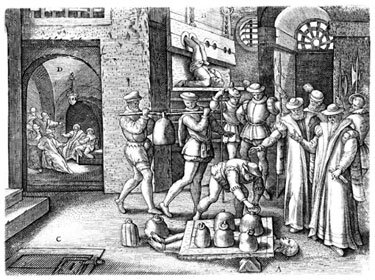
In earlier times, recusants like Margaret Clitherow (1586) might be pressed to death in England.
Bookworm argues, quite correctly, that what has happened to Kim Davis demonstrates that Justice Kennedy’s Obergefel decision results in the establishment of the secularist equivalent of England’s Test Act, which barred Roman Catholics and other religious non-conformists from holding public office. Today’s established church, of course, is the Church of Secular Statist Egalitarianism.
Going back in time a few hundred years, one of the primary things that drove British people to America’s shores — beginning in 1620 — was religious discrimination. A significant feature of this discrimination came into being in the late 17th century with various laws aimed at preventing anyone who was not a member of the Church of England from holding public office (civil or military) or working in a university or college. To get those jobs, one had to take an oath [affirming conformity to the beliefs of the church of England]. …
In other words, no non-conformists, Catholics, Jews… or practitioners of any other non-C of E religions need apply. It was against this backdrop that the Founders, more than twenty years before England slowly started reforming its religious restrictions, enacted the First Amendment to the Constitution, the very first clause of which definitively rejects a religious test for public employment:
Congress shall make no law respecting an establishment of religion, or prohibiting the free exercise thereof…
Today, though, thanks again to Judge Kennedy’s fatuous romanticism and magical constitutional thinking, we are seeing the federal government reject the First Amendment and revert to the Test Act mentality. Davis and others similarly situated are being forced into the equivalent of an oath. …
I warned years ago that, if the gay marriage crowd got its way, we would see the end of the First Amendment and I issued this warning because I foresaw what is happening here: Because gay marriage is antithetical to mainstream traditional faith it can be forced on Americans only if the federal government requires people to abandon their faith — something directly contrary to the promise of the Bill of Rights.
Kim Davis may not be a pretty Hollywood star or an even prettier San Francisco mayor, and her own approach to traditional monogamous heterosexual marriage may be spotty, but she has proven herself to be a true member of the civil disobedience club, one who is willing to go to jail to defend her civil right to practice her religion freely without the United States government forcing her to abandon core doctrinal beliefs as a condition for employment.
Andrew McCarthy, in NR, explains that, not only can the Republican majority in Congress stop Barack Obama’s Iran Treaty, on the basis of the terms of last April’s Constitution-reversing Corker Bill, Congress is obliged to.
While maddening, the Corker bill is not an abject congressional surrender to Obama and Tehran. It is a conditional surrender. It would grant Obama grudging congressional endorsement of the deal in the absence of a now unattainable veto-proof resolution of disapproval, but only if Obama fulfills certain basic terms. Obama has not complied with the most basic one: the mandate that he provide the complete Iran deal for Congress’s consideration. Therefore, notwithstanding Washington’s frenzied assumption that the 60-day period for a congressional vote is winding down, the clock has never actually started to run. Congress’s obligations under Corker have never been triggered; the Corker process is moot. …
The Corker legislation — formally known as the Iran Nuclear Agreement Review Act of 2015 — is crystal clear. In its very first section, the act requires the president to transmit to Congress “the agreement. . . . including all related materials and annexes.†It is too late to do that now: the act dictates that it was to have been done “not later than five days after reaching the agreement†— meaning July 19, since the agreement was finalized on July 14. Underscoring the mandate that all relevant understandings in the Iran deal — including, of course, the essential understandings — must be provided to lawmakers, the act explicitly spells out a definition of the “Agreement†in subsection (h)(1). Under it, this is what the administration was required to give Congress over six weeks ago in order to trigger the afore-described Corker review process:
The term ‘agreement’ means an agreement related to the nuclear program of Iran . . . regardless of the form it takes, . . . including any joint comprehensive plan of action entered into or made between Iran and any other parties, and any additional materials related thereto, including annexes, appendices, codicils, side agreements, implementing materials, documents, and guidance, technical or other understandings, and any related agreements, whether entered into or implemented prior to the agreement or to be entered into or implemented in the future.
The act could not be more emphatic: To get the advantage of the favorable Corker formula that allows him to lift the anti-nuclear sanctions with only one-third congressional support, the president was required to supply Congress with every scintilla of information regarding verification. …
It is not enough to say that Congress has no obligation to proceed with the Corker review process. It would, under the act, be impermissible for Congress to do so.
Of course, the sad reality is the Mitch McConnell and John Boehner are conscious that democrats are wilier and more determined than they are, and have, in everything, the backing of the national media. They have a majority of both houses of Congress and polls show that two thirds of the public opposes the Iran Deal, and they still won’t fight.