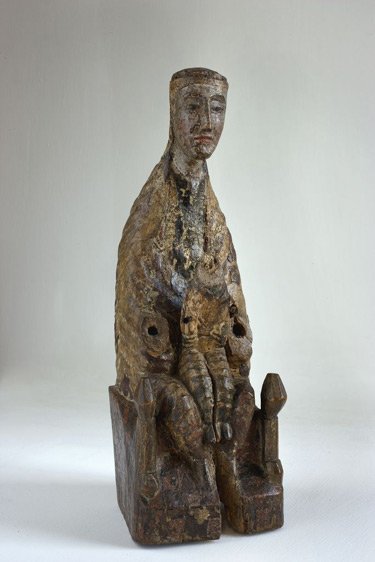
Madonna of OÅ‚obok, Late 12th century. Lime wood, gesso, polychrome. The earliest specimen of romanesque wooden sculpture preserved in Poland. The statue served as a reliquary, as indicated by a hollow in the throne where the relics were kept. From a Cistercian convent established in 1213 in OÅ‚obok in Great Poland. The statue references the theological concept of Sedes Sapientiae, the Throne of Wisdom, characteristic of early medieval liturgy. It symbolizes the idea of Mary as the throne for the Incarnated Logos (Christ), in accordance with the dogma of the Mother of God, adopted by the Council of Ephesus in 431. National Museum, Warsaw.
This is not a polar bear which has decided to migrate to warmer climes.
This is a remarkable sub-species of the North American Black Bear. It is the Kermode Bearr – also known as the spirit bear.
Living along the shorelines and central interior of British Columbia on the west coast of Canada, around ten percent of Kermode bears have white or creamy coats. They are revered among the native peoples of the province.
Pronounced kerr-MOH-dee, the lighter Kermode bears are not albinos. They appear much brighter than most of the population because of recessive alleles.
On July 23, 2010, Roko, a user of Eliezer Yudkowsky’s online forum LessWrong put up a post that Futurists are still worrying about. Shuja Haider, in Viewpoint magazine, looks at this discussion among libertarian geeks from a horrified Marxist perspective.
If the builders of technology are transmitting their values into machinery, this makes the culture of Silicon Valley a matter of more widespread consequence. The Californian Ideology, famously identified by Richard Barbrook and Andy Cameron in 1995, represented a synthesis of apparent opposites: on one hand, the New Left utopianism that was handily recuperated into the Third Way liberal centrism of the 1990s, and on the other, the Ayn Randian individualism that led more or less directly to the financial crisis of the 2000s.
But in the decades since, as the consumer-oriented liberalism of Bill Gates and Steve Jobs gave way to the technological authoritarianism of Elon Musk and Peter Thiel, this strange foundation paved the way for even stranger tendencies. The strangest of these is known as “neoreaction,†or, in a distorted echo of Eliezer Yudkowsky’s vision, the “Dark Enlightenment.†It emerged from the same chaotic process that yielded the anarchic political collective Anonymous, a product of the hivemind generated by the cybernetic assemblages of social media. More than a school of thought, it resembles a meme. The genealogy of this new intellectual current is refracted in the mirror of the most dangerous meme ever created: Roko’s Basilisk.
The Simulated Afterlife
The primordial soup that led to the Basilisk’s genesis is transhumanism, the discourse of Singularity as personal narrative. For some of its advocates, most famously Silicon Valley icon Ray Kurzweil, the animating desire of building machine intelligence is apparently apolitical. It is the ancient fool’s errand, most famously enacted in the legend of the fountain of youth: the desire to eliminate mortality. If we can bring a machine to life, we should be able to bring someone who has died back to life. We will accomplish this by inputting information about that person into a program, which will then run a simulation of that person so accurate it will be indistinguishable from the original. In anticipation of this eventuality, Kurzweil keeps a storage unit full of his father’s old possessions, whom he intends to resurrect by means of feeding information into a superintelligent computer.
If you were to be duplicated in an exact replica, including not just all of your bodily characteristics, but every one of the thoughts and memories that has been physically engraved onto your brain, would that replica be you? This is a problem that troubles both philosophers and scientists, but not Ray Kurzweil. “It would be more like my father than my father would be, were he to live,†he told ABC News.
Hedging his bets, Kurzweil himself fends off the threat of expiration by taking hundreds of nutritional supplements a day and receiving weekly vitamin injections. In order to make it to the year he predicts the Singularity will take place, he will have to live until 2045, when he will be 97. Kurzweil is controversial even among those who share his outlook, but it’s a widespread assumption among Singularitarians that death is not the end.
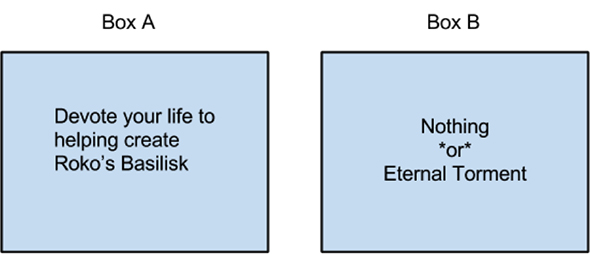
Unfortunately, Roko discovered a drawback to superintelligent resurrection. His post speculated that once the AI comes into being, it might develop a survival instinct that it will apply retroactively. It will want to hasten its own birth by requisitioning human history to work towards its creation. In order to do this, it will institute an incentive that dictates how you will be treated after you come back to life. Those of us who know about this incentive program — and I’m sorry to say that this now includes you — will be required to dedicate our lives to building the superintelligent computer.
Roko gave the example of Elon Musk as someone who has the resources and the motivation to make a worthy contribution, and will be duly rewarded. As for the rest of us, if we don’t find a way to follow through, the AI will resurrect us via simulation and proceed to torture us for all eternity.
This is a simplification of Roko’s post, and if you don’t understand Bayesian decision theory, it may seem too silly to worry about. But among the rationalists of LessWrong, it caused panic, outrage, and “terrible nightmares.â€
Between Fiction and Technology
Yudkowsy responded to Roko’s post the next day. “Listen to me very closely, you idiot,†he began, before switching to all caps and aggressively debunking Roko’s mathematics. He concluded with a parenthetical:
For those who have no idea why I’m using capital letters for something that just sounds like a random crazy idea, and worry that it means I’m as crazy as Roko, the gist of it was that he just did something that potentially gives superintelligences an increased motive to do extremely evil things in an attempt to blackmail us.
The name “Roko’s Basilisk†caught on during the ensuing discussion, in reference to a mythical creature that would kill you if you caught a glimpse of it. This wasn’t evocative enough for Yudkowsky. He began referring to it as “Babyfucker,†to ensure suitable revulsion, and compared it to H.P. Lovecraft’s Necronomicon, a book in the horror writer’s fictional universe so disturbing it drove its readers insane.
Yudkowsky’s point was that the incentive couldn’t have existed until someone brought it up. Roko gave the not-yet-existing AI the idea, because the post will now be available in the archive of information it will draw its knowledge from. At another level of complexity, by telling us about the idea, Roko implicated us in the Basilisk’s ultimatum. Now that we know the superintelligence is giving us the choice between slave labor and eternal torment, we are forced to choose. We are condemned by our awareness. Roko fucked us over forever.
—————————–
A less ideological and less hysterical analysis was provided in 2014, in Slate, by David Auerbach:
LessWrong user Roko postulated a thought experiment: What if, in the future, a somewhat malevolent AI were to come about and punish those who did not do its bidding? What if there were a way (and I will explain how) for this AI to punish people today who are not helping it come into existence later? In that case, weren’t the readers of LessWrong right then being given the choice of either helping that evil AI come into existence or being condemned to suffer?
You may be a bit confused, but the founder of LessWrong, Eliezer Yudkowsky, was not. He reacted with horror:
Listen to me very closely, you idiot.
YOU DO NOT THINK IN SUFFICIENT DETAIL ABOUT SUPERINTELLIGENCES CONSIDERING WHETHER OR NOT TO BLACKMAIL YOU. THAT IS THE ONLY POSSIBLE THING WHICH GIVES THEM A MOTIVE TO FOLLOW THROUGH ON THE BLACKMAIL.
You have to be really clever to come up with a genuinely dangerous thought. I am disheartened that people can be clever enough to do that and not clever enough to do the obvious thing and KEEP THEIR IDIOT MOUTHS SHUT about it, because it is much more important to sound intelligent when talking to your friends.
This post was STUPID.
Yudkowsky said that Roko had already given nightmares to several LessWrong users and had brought them to the point of breakdown. Yudkowsky ended up deleting the thread completely, thus assuring that Roko’s Basilisk would become the stuff of legend. It was a thought experiment so dangerous that merely thinking about it was hazardous not only to your mental health, but to your very fate.
3000 lb., 8 story nylon King Kong balloon erected on the Empire State Building in 1983 to celebrate the 50th Anniversary of the motion picture developed a hole in his left shoulder during inflation and had to be removed and repaired. New Yorkers expressed disappointment.New York Times.
More on the Great British Book Heist that took place last January in Daily Beast:
Late in the night on Jan. 29, three still-unknown thieves drilled through the skylight of a building near Heathrow Airport and rappelled 40 feet to the floor, bypassing the security alarms.
They went straight to six specific crates that contained three dealers’ worth of books that were en route to the California International Antiquarian Book Fair in Oakland.
Over the course of several hours, they unloaded the books they wanted into duffel bags, belayed their loot to the roof, and took off in a waiting van. The haul totaled nearly $2.5 million.
“Behind these books there is a lot of work because we have to search to try to find out where the books are—auction houses, collectors, colleagues—and there’s big research behind these books,†Alessandro Meda Riquier, one of the affected dealers, tells Sky News. “They are not only taking money away from me but also a big part of my job.â€
Riquier was the owner of several of the most noteworthy tomes that were taken in the heist. The most expensive book was a second edition of Copernicus’s On the Revolutions of the Heavenly Spheres from 1566 in which the astronomer introduced his revolutionary theory that the sun—not the Earth—is the center of the universe.
That book alone is worth over $250,000. Among the rest of the trove are several rare editions of Dante’s Divine Comedy and a smattering of Galileos, Newtons, and da Vincis, among other titles from the luminaries of the early sciences.
All in all, it is the quantity of books stolen rather than the individual titles that make this heist so significant.
“The books were there for only a short time in that warehouse, and this is a very exotic commodity so this is not something that the average person thinks that they can sell,†Jeremy Norman, a rare book dealer with a specialty in the early sciences, tells The Daily Beast. “I think it’s a real mystery. You really wonder how they knew the stuff was there, and the timing of it, and how they were shipped off, and what the real motivation was.â€
Several theories have been offered as to why the thieves went after this quarry. One suggests that this may have been a “made to order†theft, one in which a buyer specifically commissioned the thieves to take these titles.
Similar to fine art, stolen antique books are very difficult to sell on the legitimate market—and thereby net the title’s full value. When a rare book crime becomes known, organizations like the Antiquarian Booksellers Association of America (ABAA) quickly take action to alert their members to the volumes that were stolen so dealers can be on the lookout for anyone trying to offload a tainted treasure.
The Crimson reports that “the Puritan stock” is going to be re-written out of Harvard’s alma mater song.
Harvard will hold a competition to change the final line of “Fair Harvard,†the University’s 181-year-old alma mater, which has read “Till the stock of the Puritans die†since its composition in 1836.
Government professor Danielle S. Allen, co-chair of Presidential Task Force for Inclusion and Belonging, announced the plans to change the lyric at a three-hour event the task force held Wednesday in Sanders Theatre. Convened by University President Drew G. Faust in September, the committee is tasked with evaluating Harvard’s efforts to create an inclusive environment and recommend improvements.
The group is also launching a second competition for “a new musical variant” of the alma mater that could be performed as electronic, hip hop, or spoken word music. The traditional music would remain the official mode of performance for the song, but the new mode would be “preserved by the University as an endorsed alternative,†according to the group’s website—“The inspiration is ‘Hamilton.’ The point is to use your imagination,†it reads.
University affiliates can submit lyric and music variant submissions on the task force’s website through September, and winners will be announced in spring 2018.
Also at Wednesday’s event, the “Afternoon of Engagement on Inclusion and Belonging†featured remarks from Faust, stories from Harvard affiliates, and collaborative exercises designed to inform the task force’s future discussions.
In her welcoming remarks, Faust shared a story about receiving letters from young girls around the world after she became the University’s first female president.
“Diversity, inclusion, and belonging are fundamental to our missions and to our identity and essential for creating a better university, and the responsibility for that is one shared by students, faculty, and staff,†she said.
Individuals from across the University then took to the stage to discuss their personal experiences with “belonging. 
Eden H. Girma ’18… recalled participating in a protest at Primal Scream, a biannual naked run around Harvard Yard before the first day of finals. The protesters wanted to observe minute and a half of silence for black men killed by police, Girma said.
“Thinking back to that experience, with all of the emotions that I had, I can only see at the moment, that seems so clear to me, seeing two Harvards. One, a student body that felt so intrinsically implicated in the violence that was happening in the world, and another that seemed so blind to that,†Girma said. “Thinking retrospectively, I know there are so many nuances to this.â€
——————————-
——————————-
“Fair Harvard”
Fair Harvard! we join in thy Jubilee throng,
And with blessings surrender thee o’er
By these Festival-rites, from the Age that is past,
To the Age that is waiting before.
O Relic and Type of our ancestors’ worth,
That hast long kept their memory warm,
First flow’r of their wilderness! Star of their night!
Calm rising thro’ change and thro’ storm.
Farewell! be thy destinies onward and bright!
To thy children the lesson still give,
With freedom to think, and with patience to bear,
And for Right ever bravely to live.
Let not moss-covered Error moor thee at its side,
As the world on Truth’s current glides by,
Be the herald of Light, and the bearer of Love,
Till the stock of the Puritans die.
Samuel Gilman, Class of 1811
[Revised 1998]
——————————-
Shouldn’t they also change the song’s title to “Dusky Harvard”?
The admission to elite Ivy League Schools of non-traditional applicants started out as an effort to make more national the constituency of such schools and to discharge what the administrations of those universities saw as a duty to supply a national leadership class. In those days, the basis for the admission of outsider applicants was a combination meritocratic grades and test scores with geographical diversity.
More recently, identity group representation and Affirmative Action compensatory admission of members of favored groups has played a major role in determining the makeup of classes at elite schools.
In my own day, we had only a small number of African-American classmates, but they were admitted on pretty much the same sort of bases as everybody else, getting only a small (equivalent to geographical diversity) number of extra points for being black. Our black classmates consequently integrated into their Yale classes quite conventionally.
A few years later, in the early 1970s, Yale had a larger constituency of African Americans, admitted with a much stronger dose of racial favoritism. Those admittees were commonly far less well prepared for Yale educationally and integrated far less well. They tended to hang out together in all black groups, and spent most of their time in the African-American identity house. One tended not to know any of them. A few were spectacular failures, winding up arrested for crimes on campus. One guy, admitted to Yale out of the New Haven inner city community, was busted for dealing heroin to townies out of his room in Jonathan Edwards.
Today, decades later, the representation of non-traditional minority groups at these elite schools is much larger still, and those groups of students are more unruly, more obsessed with group identity and historical grievances, more self-entitled than ever.
In the early decades of the 20th Century, presidents of elite schools like Harvard placed a strict quota on Jewish admissions, fearing that intensely keen Jewish academic competition would change the composition of classes and the constituency of such schools completely, remaking them into Jewish institutions.
Today, minority admittees and presiding administrations eagerly lobby for fundamentally changing the composition, constituency, and even the complexion of those schools. Matters have reached a point at which the non-traditional groups feel entitled to rename buildings and to purge references and memorials to illustrious alumni and benefactors on the basis of their own amour propre. Now, at Harvard, they are sending the founders and original constituency of the college into exile from the school’s alma mater. All this causes me to wonder: had the people who initiated the effort at diversity admissions been able to foresee this occurring, would they ever have admitted any of these minorities at all in the first place?
The Miami dialect is not a second-language accent, like you’d hear from a Cuban immigrant whose first language is Spanish. It is an American English dialect like New York City English, Southern American English, or any other dialect in this country: spoken by native-born Americans who speak English either as a first language or fluently along with the language of their parents. Which doesn’t stop the accent from seeming foreign to others: Carter says that his students will sometimes find themselves in a neighboring county, only to be asked what country they’re from.
There’s a whole bunch of things that set Miami English apart from other dialects. Much of it comes from Spanish: words or sounds that are pronounced in a certain way in Spanish will eventually show up in English. An easy one is the word “salmon,†which in Miami is pronounced with the L: “sall-mon.†That comes directly from the Spanish word for the fish, which is, well, salmón. (In Spanish, all consonants make one sound and one sound only.*)
But that letter L gets even weirder. It turns out Spanish and English have different pronunciations of the letter, which are referred to as “light L†and “dark L.†English actually has both of them: a light L is found in words starting with L, like the word “light.†A dark L is found sometimes at the ends of words, as in the word “feel.†Say that out loud: can you hear how, in “feel,†it sounds almost like “fee-yulâ€? That “ull-†sound as the first part of the L sound, that’s a dark L, and it’s made with a slightly different shape of your tongue in your mouth. In Miami, all L sounds are dark, so a word like “literally†sounds more like “ull-iterally.â€
Vowels also show some impact from Spanish. Elsewhere in the country, English speakers have a tendency to “front†some vowels. “Front†and “back†refers to the position of your tongue in your mouth, so “ee†is a front vowel, whereas “oh†and “ooh†are back vowels. In the South and Mid-Atlantic, English speakers will move their back vowels a little to the front, so “boat†sounds like “behh-oht.†But in Spanish, that’s absolutely not done, and that carries over to Miami English. Keeping “oh†in the back isn’t unique to Miami, but it is unique to Miami within the Southern U.S.
Another vowel thing: much of the U.S. does this weird thing with the “ah†sound in words like “hand.†When that vowel comes before a nasal consonant—M or N—it becomes kind of nasal and more complex, turning into more like “hay-and.†Miamians, though, don’t do that, so “hand†has the exact same vowel as “cat.†Try saying it out loud. It feels strange, right? Almost British-y.
Miami English also has lots and lots of calques, which are loan phrases: essentially direct translations of Spanish phrases. In Atlanta, New York, and Seattle—actually, basically anywhere besides Miami—you get out of a car. In Miami, you get down from a car, because “down from the car†is a direct translation from the Spanish, bajar del carro. There are dozens of these: in Miami you don’t get in line or wait in line, you make a line. You don’t get married to somebody, you get married with them. When talking about money, you don’t say “five ninety-nine†for $5.99; you say “five with ninety-nine.†If you’re not up to anything much, you might say “I’m eating shit,†the basic equivalent of “I’m not doing shit.†“Some of those English calques are based on Cuban Spanish, and my strong suspicion is that kids are learning the local variety of English unaware of the sources of the loan words,†says Carter.
The verbs “come†and “go†are also different in English and Spanish, and thus different in Miami English. “In English, the verbs ‘come’ and ‘go’ are really peculiar,†says Carter. “If you invite me to your house, I’ll say ‘I’m coming over now,’ even though what I meant to say is ‘I’m going over now.’†These words are based on “deiksis,†the relationship between the speaker and listener. Theoretically, “come†should mean heading toward the speaker or listener, and “go†should mean heading away from the speaker or listener. Come to where I am, go to this other location. But in English, it’s not that simple; we often get those totally wrong. Spanish speakers, and Miami English speakers, never get those wrong. An invitation to a birthday party in Miami might say, “Go celebrate Maria’s 10th birthday party at the zoo.†Sounds weird, but is actually correct: neither the sender nor the receiver of the invitation is at the zoo, so it should be “go.â€
One of the hardest to nail down is in the actual rhythm of speech. Spanish is syllable-timed, meaning that each syllable is spoken for the same length of time. English is not; it is stress-timed, so certain syllables, especially one-syllable words, are shorter than others. (Think about “for,†“and,†and pronouns like “he†and “she.â€) Miami English isn’t exactly syllable-timed, but it’s more regular than other English dialects, which makes it sound…different, somehow. “I have heard parodies of Latinos, or Latino characters who are putting on being Latino, where you’ll find them speaking in a very fast way which gives that impression,†says Carter. It’s not that Spanish-speakers speak more quickly, just that their timing is different than English. We don’t quite know how it’s different, but speaking very quickly can sort of trigger our conception of Spanish rhythms.
Miami English is not, though, the same as other Spanish-influenced dialects of English, like Chicano English in Southern California. Some of those calques, for example, are specific to Cuba or the Caribbean and not found in Mexico. One of the most telling examples of a Southern Californian accent is turning “ing†and “ink†endings into “eeng†and “eenk,†so “thinking†becomes “theenkeeng.†These are not found at all in Miami.
Miami English isn’t only spoken by Miami Latinos, though they are the predominant group that has this dialect. Carter has found that many Anglo whites in Miami will use this dialect—but not always. Miami English coexists with Spanglish and flat-out Spanish in Miami, and speakers will often switch between those depending on who they’re speaking to. A white teenager might use the Miami English dialect with friends, and a Northeast-like accent with parents—after all, there’s a good chance the teen’s parents hail from the North.
A major part of what makes Miami English special is how quickly and thoroughly immigrant groups have come to dominate the city. In, say, New York, even the biggest immigrant groups—Italian, Irish, Puerto Rican, Dominican, Chinese—are still comparatively minor parts of the whole. But Cubans, and then other Spanish-speakers, became the dominant force in Miami so quickly that, essentially, stranger calques and pronunciations and rhythms have been free to become the norm.
Sunday night’s episode of The Simpsons, “Caper Chase,†ridiculed the “highly-entitled wusses†that attend America’s universities.
When Mr. Burns tries to endow a Department of Nuclear Plant Management at his alma mater, Yale University, he comes face to face with the horror that is today’s college campus: easily offended, politically correct students overdosed with a hatred for micro-aggressions and cultural appropriation with a need for safe spaces.
Mr. Burns- I’d like to endow a Department of Nuclear Plant Management.
Male Yale Representative- Wonderful. Of course we can’t do nuclear.
Female Yale Representative – Our students are highly-entitled wusses.
Male Yale Representative – You’d be creating a space for violence to happen. How about funding a chair in the non-narrative cinema of self-identified pan-sexuals?
Mr. Burns- What? What? What? What? What?!
Female Yale Representative – We also need to hire more deans to decide which Halloween costumes are appropriate.
Male Yale Representative – Eight deans should do it.
Mr. Burns- (Sputters) Is this still a coven of capitalism where evil money can acquire a patina of virtue?
Male Yale Representative – Yes, that’s in our charter.
Female Yale Representative – But with an issue as hetero-patriarchal as nuclear power, we’ll have to hire multicultural empathizers, build a new safe space.
College Student- Not so fast. We insist on a chair of anti-nuclear studies and a nuclear-neutral curriculum pathway.
Male Yale Representative – Absolutely, Teddy. We run all decisions past the squash team.
College Student- Also the fencing team, water polo and Handsome Dan the mascot.
Mascot- (Goofy laughter)
Mr. Burns- Release me, you hound.
Mascot- (Goofy laughter) Oh, yeah.
Mr. Burns- What’s happened to this place? (Gasps) (Gasps) This was the home of ruthless media disruptor Samuel F.B. Morse. Who’s his successor? That fellow?
College Student- “Fellow”? That word is cis-gender-normative, okay? You’re worse than Hitler!
Mr. Burns- Too late for flattery. I’m not giving this school a dime.
…
The Simpsons was explicit in its parody of Yale students, even using an exact quote from a student.
Mr. Burns learns that the PC-obsession has reached all corners of the university as he meets a few recently fired professors, including one professor who was fired for celebrating Columbus Day and another who referred to God as “He.â€
Later in the episode, Homer must disrupt a man’s scheme to place robot-students in colleges in order to receive tax-payer funded student loans. Upon leaving a gender-neutral bathroom, Homer comes up with a plan to sabotage the robots by offending them.
——————————-
This video wasn’t loading successfully this morning, but I’ll leave it here for now, hoping that they’ll fix the link.